
I don't watch Dancing With the Stars. Talent competition shows have never exactly been my cup of tea. But one does not have to be a loyal viewer of the show to know that there has been some controversy among its fans over Bristol Palin being on the show and, what is more, returning every single week. The gist of their arguments is that Bristol Palin is not a star. She is simply the daughter of a former vice presidential candidate and a teenage mother who had a child out of wedlock.
I don't know about Bristol Palin's dancing, but they have a point that she is not a star. The Merriam-Webster Dictionary defines sense 5 of star as: a.) the principal member of a theatrical or operatic company who usually plays the chief roles; b.) a highly publicised theatrical or motion picture performer; c.) an outstandingly talented performer (a track star), and d.) a person who is preeminent in a field. Now Bristol Palent is not the member of a theatrical or operatic company, let alone one who plays the chief roles. She is not a theatrical or motion picture performer, let alone a highly publicised one. She is not an outstandingly talented performer in anything (particularly her dancing if her critics are to be believed. And she is not preeminent in any field. It would seem then that Bristol Palin is definitely not a star.
Of course, if you ask me, this is not the first time someone who is not a star has competed on Dancing with the Stars. Earlier this year Kate Gosselin, whose only claim to fame was having her own reality show (Jon and Kate Plus Eight), competed on this show. No less than Hugh Hefner criticised this fact. When asked if he would ever considered Kate Gosselin posing for Playboy, not only did he say, "No! No! No!" but he also stated he did not understand why she was even on Dancing With the Stars. Hef said flatly, "I don't think she's a celebrity." I have to agree with Mr. Hefner. Kate Gosselin fits none of the definitions of star, unless someone can construe that she is preeminent in the field of reality shows, which is a most dubious honour indeed.
Of course, Kate Gosselin was not the first time a non-star appeared on the show. Dancing With the Stars let the genie out of the bottle all the way back in its first season when Trista Sutter, famous only from The Bachelorette, danced on the show. Since then there has been Kim Kardashian, Melissa Rycroft (she was on The Bachelor, in case you don't recognise the name--I had to look it up myself), Kate Gosselin, and Bristol Palin. In none of these cases were these individuals stars by any stretch of the imagination, yet somehow they appeared on Dancing With the Stars.
It seems to me that if Dancing With the Stars continue to feature individuals who are not stars, individuals who are almost famous, or for whom for fame is a fleeting thing at most, then perhaps it should change its name. Perhaps it should be Dancing With the Almost Famous or Dancing With the Fleetingly Famous. It certainly does not seem like it deserves the name Dancing With the Stars!
Monday, November 22, 2010

Sunday, November 21, 2010
Miscast: How Some Classic Films Could Have Been Very Different.
Can anyone actually picture someone playing Rhett Butler other than Clark Gable? Or somebody else besides Humphrey Bogart playing Rick Blaine? In the case of many classic films their casting seems so perfect that it must have been inevitable. In our minds some actors were so perfect in their parts that it seems improbable to us looking back to think that anyone else might have been considered for those roles. As history shows, however, in Hollywood there is no such thing as a done deal. And in many instances of classic films, their casts could have been very different from what we know them today.
 Indeed, perhaps no other film has had as many rumours surrounding its casting as the legendary Casablanca. The most persistent rumour to this day has been that Ronald Reagan was considered for the part of Rick Blaine even before Humphrey Bogart (the man who would ultimately play the role). Although often stated as fact, the rumour that Ronald Reagan was ever seriously considered for the role of Rick is just that, a rumour. This persistent urban legend has its roots in a fake publicity item released by Warner Brothers to The Hollywood Reporter and published on Janurary 5, 1942. The publicity release stated that Ann Sheridan and Ronald Regan would co-star for the third time in Casablanca, alongside Dennis Morgan. Despite the press release, Warner Brothers had no intention whatsoever in casting Ronald Reagan as Rick Blaine. What is more, they knew that they could not cast in him in the part even had they wanted to. At the time, Mr. Reagan was a second lieutenant in the U.S. Cavalry Reserve. The studio had written repeated deferments to keep him out of service, but with America at war they knew that he would not be deferred one more time.
While Ronald Reagan was not seriously considered for the role of Rick Blaine, Ann Sheridan was a different matter. In fact, on February 14, 1942 Hal Wallis asked casting director Steve Trilling to consider Humphrey Bogart and Ann Sheridan for the lead roles in Casablanca. Ann Sheridan might seem an odd choice today, but one must consider at this point in the development of Casablanca the lead female role in the film was still an American named Lois Meredith. It was only a few days later that Ann Sheridan would be entirely out of the running for the movie, as it was decided to change American Lois Meredith to the foreigner Ilsa Lund. Even then, Ingrid Bergman was not the first choice to play Ilsa. Instead Hal Wallis initially considered legendary beauty Hedy Lamarr. The casting of Miss Lamarr in the role was thwarted by Louis B. Mayer, the head of MGM, who refused to loan the actress to any other studio. Mr. Wallis then turned to the much friendlier David O. Selznick, who agreed to loan another legendary, foreign beauty to the producer--Ingrid Bergman.
While Ann Sheridan was seriously considered for the lead female role in Casablanca for a very short time, it would appear that, like Ronald Reagan, Dennis Morgan was not seriously considered for the role of Victor Laszlo. In fact, Hal Wallis's first choice to play Laszlo was Philip Dorn. As it turned out, Philip Dorn was unavailable as he was busy making Random Harvest (1942. The part then went to Paul Henreid.
 While Hal Wallis insisted on Humphrey Bogart as Rick Blaine very early in the pre-production of Casablanca, it was still possible that he might not have gotten the part. Jack Warner told Hal Wallis that George Raft was lobbying him for the role of Rick Blaine. That George Raft wanted the role of Rick very, very much is quite interesting, as for much of Bogie's career he was producers' second choice after Mr. Raft! The role of "Mad Dog" Roy Earle in High Sierra (1941) was first offered to George Raft. When Mr. Raft turned the role down, the part went to Mr. Bogart. The role of Sam Spade in The Maltese Falcon (1941) was initially offered to George Raft. He turned it down because he thought director John Huston had too little experience. Once more Humphrey Bogart was cast in the role. With Casablanca, for the first time the roles of Humhprey Bogart and George Raft would be reversed. Mr. Raft wanted a role for which Humphrey Bogart was the first choice. Of course, Bogie would also get the part.
Today it is impossible to picture Casablanca with George Raft, Hedy Lamarr, and Philip Dorn in the lead roles. If things had gone differently, however, that could have been the movies lead cast. I rather suspect that Casablanca would not then be so highly regarded as it is today. While George Raft was a great actor, I think his talent was lesser than that of Humphrey Bogart in the end, who was perfect as the hard boiled cynic who is actually an incurable romantic, and in the end the greatest hero American cinema would ever produce.
While many rumours surrounding the casting of Casablanca are unwarranted, many of the rumours surrounding the casting of Gone with the Wind are very much warranted. Particularly when it came to the lead role of Scarlett O'Hara, almost anyone could have gotten the part. That is not to say that there were not a few actresses initially considered for the role of the spoiled, temperamental Southern belle. In the beginning three actresses were considered for the pivotal role of Scarlett: Miriam Hopkins, Margaret Sullavan, and Bette Davis. Miriam Hopkins was the only native of Georgia ever seriously considered for the role of Scarlett, having been born in Savannah. Despite this obvious advantage, she would not get the part in the end. For myself, I think Miriam, although pretty, was not dangerously beautiful enough to be Scarlett, not to mention too fair haired.Having read Gone with the Wind, I always pictured Scarlett as she is in the movie--a dark haired, Black Irish beauty. As to Bette Davis, she could certainly play a Southern Belle despite being born in Massachusetts (the only way she could have been more of a Yankee is to have been born in Connecticut). She was quite convincing in Jezebel (1938). That having been said, although charming, I do not think Miss Davis was physically attractive enough to play the preternaturally beautiful Scarlett. As to Margaret, I do not see how she could have ever been considered for the role of Scarlett O'Hara, even as a joke. She was not even pretty, let alone beautiful, and lacked any charm whatsoever. Indeed, the only film in which she showed any charm was The Shop Around the Corner (1940), and I give credit in that film more to director Ernst Lubitsch and screenwriters Samson Raphaelson and Ben Hecht than I do her!
 When none of these actresses proved suitable to play Scarlett, David O. Selznick put out a nation wide casting call for the role. Many famous and unknown actresses vied for the role. Among these actresses was Katharine Hepburn, who actually thought she was doing Mr. Selznick a favour when she marched into his office and said, "I am Scarlett O'Hara! The role is practically written for me!" To this David O. Selznick flatly replied, "I can't imagine Rhett Butler chasing you for ten years." While Miss Hepburn had considerable talent and she could be very charming, I cannot see how she could believe the role of Scarlett O'Hara was practically written for her. Although mildly attractive, she was not so beautiful that dozens of men would court her, let alone chase her for ten years. More importantly, I think Miss Hepburn was simply incapable of playing Scarlett. There was no more archetypal Yankee in Hollywood than Katharine Hepburn. Her New England lockjaw accent appeared in every film she ever made, to the point that I believe she was incapable of producing any other accent, let alone something so dramatically different as a Southern drawl!
Tallulah Bankhead was a front runner for the role of Scarlett for a time. She certainly had the advantage of being the genuine article, a real Southern belle, having been born to gentry in Alabama. In the end, however, David O. Selznick decided she was too old for the part (as of 1938 she was 36 years old). Joan Bennett was also in serious contention, but, while she impressed David O. Selznick, in the end she would be out of the running. Among other actresses considered for the were Jean Arthur, Susan Hayward (who proved too inexperienced), and Anita Louise. Ultimately two fantastically beautiful brunettes would vie for the role of Scarlett O'Hara, and they were the only actresses given colour screen tests. As we all know, one was English rose Vivien Leigh. The other was Paulette Goddard.
 While I have serious doubts that Katharine Hepburn could ever play a Southern belle, I do not harbour those same doubts about Paulette Goddard. Although born in Queens, Miss Goddard could play a Southern belle, as she did in Reap the Wild Wind (1942). And she had a good deal in common with Scarlett O'Hara. She had a mischievous streak that showed in many of her roles (especially her comedies), and she could be temperamental in the same way Scarlett was. Furthermore, Miss Goddard was incredibly, unbelievably, dangerously beautiful just as Scarlett was. Indeed, to me she was ideal insofar as she was dark haired, just the way I pictured Scarlett. So why did Paulette Goddard lose the role to Viiven? After her colour screen test David O. Selznick and then director George Cuckor decided she would need coaching if she was to play Scarlett O'Hara, whereas Vivien Leigh would not.
Unlike Scarlett O'Hara, Clark Gable was David O. Selznick's choice for Rhett Butler from the beginning. That having been said, a few other actors were also considered for the role. Gary Cooper was approached for the role, but he refused it because he thought Gone with the Wind would be the biggest flop in the history of cinema. Personally, it is hard for me to see the laid back Gary Cooper as Rhett Butler. Mr. Cooper was the epitome of quiet strength, and Rhett was never quiet. Errol Flynn was actually in serious contention for the role, to the point that papers were drawn up for Warner to lend Mr. Flynn to David O. Selznick. It seems today impossible that Errol Flynn could have played the role of Rhett Butler, but then in real life as on film Errol Flynn was something of a gentleman and a rouge much the way Rhett was. I don't know about Mr. Selznick, but my objection is that Mr. Flynn was perhaps too much of a rouge to play Rhett. Rhett could be a rouge, but he was always first and foremost the epitome of the Southern gentleman.
 While historically Leslie Howard played Ashley Wilkes, he was not the only actor in contention for the role. Both Ronald Colman and Franchot Tone were in consideration for the part. I rather think Ronald Colman was much too powerful a performer to play the weak willed, somewhat non-committal Ashley. After all, he had played such legendary characters as Bulldog Drummond, Rafffles, and Major Rudolf Rassendyll (the hero of The Prisoner of Zenda). I am not sure he could have played an indecisive character like Ashley! Franchot Tone was a much better choice. He could play strong roles, but he most often played the idle playboy. I could seem him playing the emotionally torn Ashley Wilkes, who was too weak willed to let himself or Scarlett be happy. In fact, I think he may have been a better choice to play Ashley than Leslie Howard. As a fan of Mr. Howard, I think he, like Mr. Colman, was too powerful presence to play Ashley. After all, he was the Scarlet Pimpernel and the original film version of Professor Henry Higgins. Leslie Howard himself believed he was miscast as Ashley, maintaining he was much too old for the part. Indeed, David O. Selznick had to bribe Leslie Hoard with an associate producer credit on Intermezzo: A Love Story (1939) before he would take the role!
Janet Gaynor was initially considered as Melanie Wilkes, something I find unbelievable today. Like Tallulah Bankhead, I submit she was too old for the part of Melanie. As it was, Olivia de Havilland very nearly did not get the part. It was friend and the original director of the film George Cuckor who asked Miss de Havilland to read for the part. While she proved wonderful in the role, there was one fly in the ointment: her contract with Warner Brothers. As one of their top stars, Jack Warner was determined not to loan Miss de Havilland to David O. Selznick. Utlimately, Miss de Havilland had to appeal to a higher power: Jack Warner's wife Irene. Mrs. Warner intervened and Olivia de Havilland got the part.
In my worst nightmares Gone with the Wind would star Katharine Hepburn, Gary Cooper, Janet Gaynor, and Leslie Howard. I can even hear in my mind Miss Hepburn's New England lockjaw as she utters "Tomorrow is another day," while hearing Gary Cooper take a full minute simply to say "Frankly, my dear, I don't give a damn." Fortunately, history unfolded differently.
Not only could Gone with the Wind have had a different cast, but so could that other mega-classic from 1939, The Wizard of Oz. As hard as it is to believe today, Judy Garland might not have played Dorothy Gale. While Mervyn Leroy always insisted he wanted Miss Garland to play Dorothy, evidence suggests that MGM was pressuring him to cast popular star Shirley Temple in the role, even though they would have had to have gotten her on loan from Fox. Fortunately, several factors would keep Shirley Temple out of Oz. First, while Mervyn Leroy championed Judy Garland, so too did powerful associate producer Arthur Freed. Second, Roger Edens, musical supervisor at MGM, listened to Shirley Temple's singing and determined her style was unsuited to the movie. Third, 20th Century Fox was very reticent about loaning out their top star. I believe that this was very fortunate, as I think MGM's top brass was dead wrong to think Miss Temple was right for the role of Dorothy. While I think Shirley Temple became a very charming adult, as a child I always found her annoying. Even as a child myself, I could never sit through a Shirley Temple movie.
 Another starlet was also considered for the role of Dorothy, none other than Judy Garland's rival form Universal Deanna Durbin. In fact, Deanna Durbin had been signed to MGM in 1935, but the studio unwisely let her contract option expire, giving Universal the chance to sign the starlet. While in 1938 Judy Garland was not yet a major star, Universal had already given Miss Durbin a good deal of film experience and she even had a loyal following. It is hard to say why Deanna Durbin would not be cast as Dorothy. Perhaps MGM believed Universal would not loan one of their top stars (and who could blame them if they wouldn't), or perhaps MGM felt Judy Garland's more jazz oriented singing style was more suited to the film than Deanna Durbin's operatic style. Whatever the reason, Judy would play Dorothy and ultimately outshine Deanna Durbin in terms of star power.
It is well known that Buddy Ebsen was set to play the Tin Man until he had a reaction to the aluminium powder used in his make up. What is not so well known is that Buddy Ebsen was not originally slated to play the Tin Man. In the beginning Ray Bolger was cast as the Tin Man and Buddy Ebsen as the Scarecrow. Mr. Bolger was rather unhappy in his part as the Tin Man. His childhood idol, song and dance man Fred Stone, had played the Scarecrow on stage in 1902. Mr.Bolger then wanted to play the Scarecrow. Buddy Ebsen had no objections, so Mr. Bolger convinced Mervyn Leroy to switch them in their roles. Unfortunately, after ten days of shooting Mr. Ebsen had a reaction to the aluminium powder in the Tin Man make up, resulting in a lengthy stay in hospital. Jack Haley was then cast as the Tin Man. Personally, given all three men were legendary song and dance men, I think all three were capable of playing either role. Indeed, I think Ray Bolger would have been a fine Tin Man, although given his love of the Scarecrow, I can see how he would be better in that role!
W. C. Fields, under contract to MGM, was the studio's original choice for the Great and Powerful Oz. It is not exactly clear why Mr. Fields did not take the role. One rumour has it that Mr. Fields, then one of the most popular comic actors of the time, thought the role was too small. Another rumour is that he simply asked for too much money. Both rumours could be true. Regardless, the part would go to Frank Morgan instead. Given that W. C. Fields and Frank Morgan were both adept at playing bumblers and con men (and the Wizard of Oz was both), I think Mr. Fields would have been a good Wizard, much as Mr. Morgan was.
 Much of the reason MGM decided to make The Wizard of Oz was the phenomenal success of Walt Disney's Snow White and the Seven Dwarves (1937), at that time the highest grossing motion picture of all time. For that reason, as hard as it is to believe now, MGM originally wanted the Wicked Witch of the West to be glamourous and beautiful much as the Wicked Queen in Snow White and the Seven Dwarves. MGM initially considered Edna May Oliver, but ultimately the part went to the decidedly glamourous Gale Sondergaard. MGM would have a change of heart, however, so that the Wicked Witch of the West would become the archetypal, old hag. This did not make Gale Sondergaard at all happy, so she was replaced as the Wicked Witch of the West by Margaret Hamilton. Ironically, Margaret Hamilton was nothing like her most famous role. A one time a school teacher, she genuinely loved children and devoted her life to them, even after becoming famous as an actress. Today it is hard to picture the Wicked Witch of the West as glamourous, and quite honestly I think MGM was right to change their minds. While I think Gale Sondergaard was a great actress, I think most of us who have read The Wonderful Wizard of Oz see the Wicked Witch as the archetypal witch, warts and all. While it was nothing like the warm hearted Margaret Hamilton in real life, she was fantastic in the role.
Glinda the Good Witch of the North, could also have had a different actress in the role. Some sources report that the legendary Fanny Brice was considered for the role. In the end the role would go to another comedienne, Billie Burke. I think Fanny Brice would have made a good Glinda the Good Witch, even if we today can only picture Billie Burke in the role.
Ultimately, I think MGM made very good choices with regards to The Wizard of Oz. Buddy Ebsen would have made a good Scarecrow. W. C. Fields would have made a good Wizard. Deanna Durbin would have made a good Dorothy. That having been said, to me Shirley Temple as Dorothy is the stuff from which nightmares are made, and I cannot see Gale Sondergaard as the Wicked Witch!
There are those who hold to the auteur theory, maintaining that it is ultimately the director who determines the quality of a picture. There are others who maintain that filmmaking is a collaborative effort. I think there is something to both of these theories, but I also think the casting of classic films over the years often demonstrates another factor in making movies. Quite simply, a lot of what makes a good film is sheer luck or circumstances. What if George Raft had successfully convinced Jack Warner he should be Rick Blaine? What if Paulette Goddard had been chosen as Scarlett O'Hara instead of Vivien Leigh? What if MGM had gotten their way and Shirley Temple was cast as Dorothy? Would Casablanca, Gone with the Wind, and The Wizard of Oz be considered classics today? I think Gone with the Wind could have worked with Paulette Goddard as its lead, but I rather suspect Casablanca and particularly The Wizard of Oz might not be remembered so fondly. It seems to me much of what makes a good film is good casting, and often casting is a pure roll of the dice.
 Indeed, perhaps no other film has had as many rumours surrounding its casting as the legendary Casablanca. The most persistent rumour to this day has been that Ronald Reagan was considered for the part of Rick Blaine even before Humphrey Bogart (the man who would ultimately play the role). Although often stated as fact, the rumour that Ronald Reagan was ever seriously considered for the role of Rick is just that, a rumour. This persistent urban legend has its roots in a fake publicity item released by Warner Brothers to The Hollywood Reporter and published on Janurary 5, 1942. The publicity release stated that Ann Sheridan and Ronald Regan would co-star for the third time in Casablanca, alongside Dennis Morgan. Despite the press release, Warner Brothers had no intention whatsoever in casting Ronald Reagan as Rick Blaine. What is more, they knew that they could not cast in him in the part even had they wanted to. At the time, Mr. Reagan was a second lieutenant in the U.S. Cavalry Reserve. The studio had written repeated deferments to keep him out of service, but with America at war they knew that he would not be deferred one more time.
While Ronald Reagan was not seriously considered for the role of Rick Blaine, Ann Sheridan was a different matter. In fact, on February 14, 1942 Hal Wallis asked casting director Steve Trilling to consider Humphrey Bogart and Ann Sheridan for the lead roles in Casablanca. Ann Sheridan might seem an odd choice today, but one must consider at this point in the development of Casablanca the lead female role in the film was still an American named Lois Meredith. It was only a few days later that Ann Sheridan would be entirely out of the running for the movie, as it was decided to change American Lois Meredith to the foreigner Ilsa Lund. Even then, Ingrid Bergman was not the first choice to play Ilsa. Instead Hal Wallis initially considered legendary beauty Hedy Lamarr. The casting of Miss Lamarr in the role was thwarted by Louis B. Mayer, the head of MGM, who refused to loan the actress to any other studio. Mr. Wallis then turned to the much friendlier David O. Selznick, who agreed to loan another legendary, foreign beauty to the producer--Ingrid Bergman.
While Ann Sheridan was seriously considered for the lead female role in Casablanca for a very short time, it would appear that, like Ronald Reagan, Dennis Morgan was not seriously considered for the role of Victor Laszlo. In fact, Hal Wallis's first choice to play Laszlo was Philip Dorn. As it turned out, Philip Dorn was unavailable as he was busy making Random Harvest (1942. The part then went to Paul Henreid.
 While Hal Wallis insisted on Humphrey Bogart as Rick Blaine very early in the pre-production of Casablanca, it was still possible that he might not have gotten the part. Jack Warner told Hal Wallis that George Raft was lobbying him for the role of Rick Blaine. That George Raft wanted the role of Rick very, very much is quite interesting, as for much of Bogie's career he was producers' second choice after Mr. Raft! The role of "Mad Dog" Roy Earle in High Sierra (1941) was first offered to George Raft. When Mr. Raft turned the role down, the part went to Mr. Bogart. The role of Sam Spade in The Maltese Falcon (1941) was initially offered to George Raft. He turned it down because he thought director John Huston had too little experience. Once more Humphrey Bogart was cast in the role. With Casablanca, for the first time the roles of Humhprey Bogart and George Raft would be reversed. Mr. Raft wanted a role for which Humphrey Bogart was the first choice. Of course, Bogie would also get the part.
Today it is impossible to picture Casablanca with George Raft, Hedy Lamarr, and Philip Dorn in the lead roles. If things had gone differently, however, that could have been the movies lead cast. I rather suspect that Casablanca would not then be so highly regarded as it is today. While George Raft was a great actor, I think his talent was lesser than that of Humphrey Bogart in the end, who was perfect as the hard boiled cynic who is actually an incurable romantic, and in the end the greatest hero American cinema would ever produce.
While many rumours surrounding the casting of Casablanca are unwarranted, many of the rumours surrounding the casting of Gone with the Wind are very much warranted. Particularly when it came to the lead role of Scarlett O'Hara, almost anyone could have gotten the part. That is not to say that there were not a few actresses initially considered for the role of the spoiled, temperamental Southern belle. In the beginning three actresses were considered for the pivotal role of Scarlett: Miriam Hopkins, Margaret Sullavan, and Bette Davis. Miriam Hopkins was the only native of Georgia ever seriously considered for the role of Scarlett, having been born in Savannah. Despite this obvious advantage, she would not get the part in the end. For myself, I think Miriam, although pretty, was not dangerously beautiful enough to be Scarlett, not to mention too fair haired.Having read Gone with the Wind, I always pictured Scarlett as she is in the movie--a dark haired, Black Irish beauty. As to Bette Davis, she could certainly play a Southern Belle despite being born in Massachusetts (the only way she could have been more of a Yankee is to have been born in Connecticut). She was quite convincing in Jezebel (1938). That having been said, although charming, I do not think Miss Davis was physically attractive enough to play the preternaturally beautiful Scarlett. As to Margaret, I do not see how she could have ever been considered for the role of Scarlett O'Hara, even as a joke. She was not even pretty, let alone beautiful, and lacked any charm whatsoever. Indeed, the only film in which she showed any charm was The Shop Around the Corner (1940), and I give credit in that film more to director Ernst Lubitsch and screenwriters Samson Raphaelson and Ben Hecht than I do her!
When none of these actresses proved suitable to play Scarlett, David O. Selznick put out a nation wide casting call for the role. Many famous and unknown actresses vied for the role. Among these actresses was Katharine Hepburn, who actually thought she was doing Mr. Selznick a favour when she marched into his office and said, "I am Scarlett O'Hara! The role is practically written for me!" To this David O. Selznick flatly replied, "I can't imagine Rhett Butler chasing you for ten years." While Miss Hepburn had considerable talent and she could be very charming, I cannot see how she could believe the role of Scarlett O'Hara was practically written for her. Although mildly attractive, she was not so beautiful that dozens of men would court her, let alone chase her for ten years. More importantly, I think Miss Hepburn was simply incapable of playing Scarlett. There was no more archetypal Yankee in Hollywood than Katharine Hepburn. Her New England lockjaw accent appeared in every film she ever made, to the point that I believe she was incapable of producing any other accent, let alone something so dramatically different as a Southern drawl!Tallulah Bankhead was a front runner for the role of Scarlett for a time. She certainly had the advantage of being the genuine article, a real Southern belle, having been born to gentry in Alabama. In the end, however, David O. Selznick decided she was too old for the part (as of 1938 she was 36 years old). Joan Bennett was also in serious contention, but, while she impressed David O. Selznick, in the end she would be out of the running. Among other actresses considered for the were Jean Arthur, Susan Hayward (who proved too inexperienced), and Anita Louise. Ultimately two fantastically beautiful brunettes would vie for the role of Scarlett O'Hara, and they were the only actresses given colour screen tests. As we all know, one was English rose Vivien Leigh. The other was Paulette Goddard.
 While I have serious doubts that Katharine Hepburn could ever play a Southern belle, I do not harbour those same doubts about Paulette Goddard. Although born in Queens, Miss Goddard could play a Southern belle, as she did in Reap the Wild Wind (1942). And she had a good deal in common with Scarlett O'Hara. She had a mischievous streak that showed in many of her roles (especially her comedies), and she could be temperamental in the same way Scarlett was. Furthermore, Miss Goddard was incredibly, unbelievably, dangerously beautiful just as Scarlett was. Indeed, to me she was ideal insofar as she was dark haired, just the way I pictured Scarlett. So why did Paulette Goddard lose the role to Viiven? After her colour screen test David O. Selznick and then director George Cuckor decided she would need coaching if she was to play Scarlett O'Hara, whereas Vivien Leigh would not.
Unlike Scarlett O'Hara, Clark Gable was David O. Selznick's choice for Rhett Butler from the beginning. That having been said, a few other actors were also considered for the role. Gary Cooper was approached for the role, but he refused it because he thought Gone with the Wind would be the biggest flop in the history of cinema. Personally, it is hard for me to see the laid back Gary Cooper as Rhett Butler. Mr. Cooper was the epitome of quiet strength, and Rhett was never quiet. Errol Flynn was actually in serious contention for the role, to the point that papers were drawn up for Warner to lend Mr. Flynn to David O. Selznick. It seems today impossible that Errol Flynn could have played the role of Rhett Butler, but then in real life as on film Errol Flynn was something of a gentleman and a rouge much the way Rhett was. I don't know about Mr. Selznick, but my objection is that Mr. Flynn was perhaps too much of a rouge to play Rhett. Rhett could be a rouge, but he was always first and foremost the epitome of the Southern gentleman.
 While historically Leslie Howard played Ashley Wilkes, he was not the only actor in contention for the role. Both Ronald Colman and Franchot Tone were in consideration for the part. I rather think Ronald Colman was much too powerful a performer to play the weak willed, somewhat non-committal Ashley. After all, he had played such legendary characters as Bulldog Drummond, Rafffles, and Major Rudolf Rassendyll (the hero of The Prisoner of Zenda). I am not sure he could have played an indecisive character like Ashley! Franchot Tone was a much better choice. He could play strong roles, but he most often played the idle playboy. I could seem him playing the emotionally torn Ashley Wilkes, who was too weak willed to let himself or Scarlett be happy. In fact, I think he may have been a better choice to play Ashley than Leslie Howard. As a fan of Mr. Howard, I think he, like Mr. Colman, was too powerful presence to play Ashley. After all, he was the Scarlet Pimpernel and the original film version of Professor Henry Higgins. Leslie Howard himself believed he was miscast as Ashley, maintaining he was much too old for the part. Indeed, David O. Selznick had to bribe Leslie Hoard with an associate producer credit on Intermezzo: A Love Story (1939) before he would take the role!
Janet Gaynor was initially considered as Melanie Wilkes, something I find unbelievable today. Like Tallulah Bankhead, I submit she was too old for the part of Melanie. As it was, Olivia de Havilland very nearly did not get the part. It was friend and the original director of the film George Cuckor who asked Miss de Havilland to read for the part. While she proved wonderful in the role, there was one fly in the ointment: her contract with Warner Brothers. As one of their top stars, Jack Warner was determined not to loan Miss de Havilland to David O. Selznick. Utlimately, Miss de Havilland had to appeal to a higher power: Jack Warner's wife Irene. Mrs. Warner intervened and Olivia de Havilland got the part.
In my worst nightmares Gone with the Wind would star Katharine Hepburn, Gary Cooper, Janet Gaynor, and Leslie Howard. I can even hear in my mind Miss Hepburn's New England lockjaw as she utters "Tomorrow is another day," while hearing Gary Cooper take a full minute simply to say "Frankly, my dear, I don't give a damn." Fortunately, history unfolded differently.
Not only could Gone with the Wind have had a different cast, but so could that other mega-classic from 1939, The Wizard of Oz. As hard as it is to believe today, Judy Garland might not have played Dorothy Gale. While Mervyn Leroy always insisted he wanted Miss Garland to play Dorothy, evidence suggests that MGM was pressuring him to cast popular star Shirley Temple in the role, even though they would have had to have gotten her on loan from Fox. Fortunately, several factors would keep Shirley Temple out of Oz. First, while Mervyn Leroy championed Judy Garland, so too did powerful associate producer Arthur Freed. Second, Roger Edens, musical supervisor at MGM, listened to Shirley Temple's singing and determined her style was unsuited to the movie. Third, 20th Century Fox was very reticent about loaning out their top star. I believe that this was very fortunate, as I think MGM's top brass was dead wrong to think Miss Temple was right for the role of Dorothy. While I think Shirley Temple became a very charming adult, as a child I always found her annoying. Even as a child myself, I could never sit through a Shirley Temple movie.
 Another starlet was also considered for the role of Dorothy, none other than Judy Garland's rival form Universal Deanna Durbin. In fact, Deanna Durbin had been signed to MGM in 1935, but the studio unwisely let her contract option expire, giving Universal the chance to sign the starlet. While in 1938 Judy Garland was not yet a major star, Universal had already given Miss Durbin a good deal of film experience and she even had a loyal following. It is hard to say why Deanna Durbin would not be cast as Dorothy. Perhaps MGM believed Universal would not loan one of their top stars (and who could blame them if they wouldn't), or perhaps MGM felt Judy Garland's more jazz oriented singing style was more suited to the film than Deanna Durbin's operatic style. Whatever the reason, Judy would play Dorothy and ultimately outshine Deanna Durbin in terms of star power.
It is well known that Buddy Ebsen was set to play the Tin Man until he had a reaction to the aluminium powder used in his make up. What is not so well known is that Buddy Ebsen was not originally slated to play the Tin Man. In the beginning Ray Bolger was cast as the Tin Man and Buddy Ebsen as the Scarecrow. Mr. Bolger was rather unhappy in his part as the Tin Man. His childhood idol, song and dance man Fred Stone, had played the Scarecrow on stage in 1902. Mr.Bolger then wanted to play the Scarecrow. Buddy Ebsen had no objections, so Mr. Bolger convinced Mervyn Leroy to switch them in their roles. Unfortunately, after ten days of shooting Mr. Ebsen had a reaction to the aluminium powder in the Tin Man make up, resulting in a lengthy stay in hospital. Jack Haley was then cast as the Tin Man. Personally, given all three men were legendary song and dance men, I think all three were capable of playing either role. Indeed, I think Ray Bolger would have been a fine Tin Man, although given his love of the Scarecrow, I can see how he would be better in that role!
W. C. Fields, under contract to MGM, was the studio's original choice for the Great and Powerful Oz. It is not exactly clear why Mr. Fields did not take the role. One rumour has it that Mr. Fields, then one of the most popular comic actors of the time, thought the role was too small. Another rumour is that he simply asked for too much money. Both rumours could be true. Regardless, the part would go to Frank Morgan instead. Given that W. C. Fields and Frank Morgan were both adept at playing bumblers and con men (and the Wizard of Oz was both), I think Mr. Fields would have been a good Wizard, much as Mr. Morgan was.
 Much of the reason MGM decided to make The Wizard of Oz was the phenomenal success of Walt Disney's Snow White and the Seven Dwarves (1937), at that time the highest grossing motion picture of all time. For that reason, as hard as it is to believe now, MGM originally wanted the Wicked Witch of the West to be glamourous and beautiful much as the Wicked Queen in Snow White and the Seven Dwarves. MGM initially considered Edna May Oliver, but ultimately the part went to the decidedly glamourous Gale Sondergaard. MGM would have a change of heart, however, so that the Wicked Witch of the West would become the archetypal, old hag. This did not make Gale Sondergaard at all happy, so she was replaced as the Wicked Witch of the West by Margaret Hamilton. Ironically, Margaret Hamilton was nothing like her most famous role. A one time a school teacher, she genuinely loved children and devoted her life to them, even after becoming famous as an actress. Today it is hard to picture the Wicked Witch of the West as glamourous, and quite honestly I think MGM was right to change their minds. While I think Gale Sondergaard was a great actress, I think most of us who have read The Wonderful Wizard of Oz see the Wicked Witch as the archetypal witch, warts and all. While it was nothing like the warm hearted Margaret Hamilton in real life, she was fantastic in the role.
Glinda the Good Witch of the North, could also have had a different actress in the role. Some sources report that the legendary Fanny Brice was considered for the role. In the end the role would go to another comedienne, Billie Burke. I think Fanny Brice would have made a good Glinda the Good Witch, even if we today can only picture Billie Burke in the role.
Ultimately, I think MGM made very good choices with regards to The Wizard of Oz. Buddy Ebsen would have made a good Scarecrow. W. C. Fields would have made a good Wizard. Deanna Durbin would have made a good Dorothy. That having been said, to me Shirley Temple as Dorothy is the stuff from which nightmares are made, and I cannot see Gale Sondergaard as the Wicked Witch!
There are those who hold to the auteur theory, maintaining that it is ultimately the director who determines the quality of a picture. There are others who maintain that filmmaking is a collaborative effort. I think there is something to both of these theories, but I also think the casting of classic films over the years often demonstrates another factor in making movies. Quite simply, a lot of what makes a good film is sheer luck or circumstances. What if George Raft had successfully convinced Jack Warner he should be Rick Blaine? What if Paulette Goddard had been chosen as Scarlett O'Hara instead of Vivien Leigh? What if MGM had gotten their way and Shirley Temple was cast as Dorothy? Would Casablanca, Gone with the Wind, and The Wizard of Oz be considered classics today? I think Gone with the Wind could have worked with Paulette Goddard as its lead, but I rather suspect Casablanca and particularly The Wizard of Oz might not be remembered so fondly. It seems to me much of what makes a good film is good casting, and often casting is a pure roll of the dice.
Saturday, November 20, 2010
If I Had Started the Silver Age at DC Comics
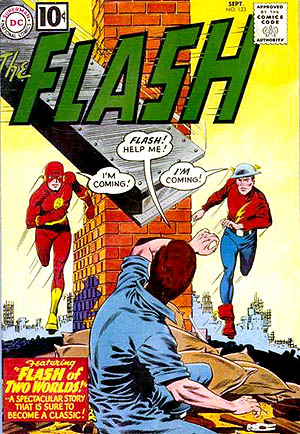
Of course, things could have unfolded differently. Rather than creating a brand new character called The Flash, Julius Schwartz, Robert Kanigher, and John Broome could have simply revived the Golden Age Flash. Or he could have chosen another character published by Detective Comics, National Comics, and All-American Comics (the three interrelated companies that would become National Periodical Publications and hence DC Comics). That the Silver Age would take place at all there seems to be little doubt. And given the fact that in 1956 most comic book companies were either already out of business or in danger of going out of business, it makes sense that it would have begun at National Periodical Publications. Beyond that, however, it could have unfolded differently. As a comic book fan and a fan of the characters from All-American Comics in particular (The Flash, Green Lantern, Hawkman, The Atom, and so on), I have given much thought to how the Silver Age would taken place if I had been in Julius Schwartz's place. Or if Mr Schwartz thought like me.
Given the fact that he was possibly All-American Comics' most popular character besides Wonder Woman (who was still being published by National Periodical Publications in 1956), much like Julius Schwartz I would have probably have chosen The Flash as the superhero to revive. That having been said, I would not have created a whole new character. Instead, I simply would have revived The Flash of the Golden Age. The original Flash was created by writer Gardner Fox and artist Harry Lampert. He was Jay Garrick, a college student who attained the ability of moving at super fast speeds when he inhaled heavy water vapours. He would be a founding member of the first superhero team in comic book history, the Justice Society of America. He was so popular he appeared at one time in four different titles: Flash Comics, his own title (All Flash), Comic Cavalcade, and All Star Comics (as a member of the Justice Society of America). He last appeared in the final issues of All Flash (January 1948), Flash Comics (February 1949), and All Star Comics (March 1951).
Of course, while I would revive Jay Garrick, I would probably give him a new costume. While I personally like his costume, it definitely looks like something a hero from the Forties would wear, not a hero working in the Fifties. That having been said, Carmine Infantino would not be the man to design that costume. Mr. Infantino has his following, but I personally have always found his art lacking. I probably would have went with Gil Kane (who later co-created the Silver Age Green Lantern) or Murphy Anderson (who worked on a number of Silver Age DC comic books). As to writers, much like Julius Schwartz, I would have gone with John Broome.
Of course, within the comic books themselves there would have to be a backstory behind the revival of Jay Garrick. As I see it, Jay Garrick would have retired as The Flash shortly after his last appearance in All Star Comics #57, March 1951. In the meantime he would have married his sweetheart, Joan Williams. This brings us up to 1956, when Jay has been retired for five years. Keystone City is threatened once more when three of The Flash's opponents (The Shade, The Fiddler, and The Thinker) are released from prison and begin a crime wave in Keystone City. With Keystone City so threatened, Jay Garrick would design a new costume and resume his career as The Flash.
Provided this revival of The Flash was as successful as the introduction of Barry Allen as The Flash was in real life (and I have little reason to doubt it wouldn't be), I would then revive more Golden Age characters. Historically, Green Lantern (although, like The Flash, a different character from the Golden Age one) would be the next character Julius Schwartz would revive. As much as I love Green Lantern (the Golden Age version is my second favourite superhero of all time besides Batman), I think I would have taken a different route. In 1956 Busy Arnold sold his company, the Quality Comics Group, to National Periodical Publications, lock, stock, and barrel. National Periodical Publications would only continue publishing a few of Quality Comics' titles, Blackhawk among them. They would not continue Plastic Man, Quality Comics' most popular character, whose title barely lasted into the Silver Age (the last issue was #64, November 1956). I would then revive Plastic Man. Or perhaps given his last issue would only have been very recently, I suppose I would simply be picking up where Quality Comics left off. Plastic Man would begin again, with issue #65 sometime in 1957. I would probably revive Doll Man as well, whose last issue of his own title was in 1953. Doll Man would pick back up with issue 48 sometime between 1957 and 1960. I would then revive other Golden Age Quality Comics characters, including The Ray, Uncle Sam, The Black Condor, Kid Eternity, and so on. Here it must be noted that with the exceptions of Plastic Man (finally revived by National Periodical Publications in 1966) and Kid Eternity (who would not be revived until 1976, and then as part of DC's revival of Captain Marvel, a Fawcett character), the major heroes from Quality Comics would go unused by DC until 1973!
Of course, while I would have not missed the opportunity National Periodical Publications had to mine the Quality Comics superheroes they had bought in 1956 the way the company did so historically, I would have revived Green Lantern just as Julius Schwartz did in real life. Like The Flash, this was not the original character, but an entirely new one. The Green Lantern of the Silver Age was created by writer John Broome and Gil Kane and first appeared in Showcase #22, October 1959. He was test pilot Hal Jordan, who was given a ring, which gives the wearer power over the physical world limited by his own will power, by the dying alien Abin Sur. It turns out Abin Sur belonged to galactic police force called the Green Lantern Corps, making Hal Jordan only one of many. The revival of Green Lantern proved as successful as that of The Flash, leading to the revival of other Golden Age characters.
Like I would have with The Flash, I would not have created a whole new character, but simply revived the original, created by Gardner Fox and Martin Nodell. The original Green Lantern was Alan Scott, who as a railroad engineer came upon a magic green lantern, which instructed him to make a ring from its metal. With this ring he had power over the physical world limited only by his own will power. Green Lantern proved popular, appearing in four titles at one time: All-American Comics, Green Lantern, Comic Cavalcade, and, as a member of the Justice Society of America, All-Star Comics. Like The Flash, he last appeared in All Star Comics #57, March 1951. I would probably use the same creative team Julius Schwartz did historically: John Broome and Gil Kane. I would also give Green Lantern a new costume (as much as I love Alan Scott, his costume is outlandish looking). As to a back story, well, Alan Scott would have retired in 1951 to concentrate on his career in broadcasting (I figure by then he'd be making the transition into television). It would be in either 1958 or 1959 that Vandal Savage, the immortal villain, would seize total control of Gotham City. Alan Scott would then be forced out of retirement. This would be ideal if I also edited the Batman titles, which sadly Julius Schwartz did not yet (I assume I would not either).
I figure like Julius Schwartz I would also revive The Atom, Hawkman, and The Black Canary, although in each case I would simply revive the Golden Age character as opposed to creating a whole, new character as Mr. Schwartz did. Of course, this could mean I could bring back the Justice Society of America and All Star Comics (beginning with issue #58, ignoring the ten years it survived as a Western title). Of course, in simply reviving the Golden Age characters this would mean the history of DC Comics would be dramatically different from the way it actually unfolded. As everyone familiar with comic book history knows, after the revivals of The Flash and Green Lantern, there was some demand on the part of the older fans of the original characters. This presented Julius Schwartz and in particular writer Gardner Fox with a problem. It was established that Jay Garrick was simply a comic book character in the world of Barry Allen! The solution to the problem was to establish that the Golden Age National Comics, Detective Comics, and All-American Comics characters existed in a different world. As established in "Flash of Two Worlds" in The Flash #123, September 1961, in which Barry Allan accidentally travels into another reality, Earth Two, where Jay Garrick was The Flash from 1940 onwards! Barry Allan and the Silver Age characters all lived on Earth One. By the Seventies, DC Comics would not only have Earth One and Earth Two, but Earth-S (home of the Fawcett characters licensed to them at the time and, for some odd reason, Kid Eternity), Earth-X (home of the Quality Comics characters except Kid Eternity), and others. Of course, if Julius Schwartz had simply revived the original characters, there never would have been any parallel universes (unless the old Quality characters lived in one....)!
Of course, Julius Schwartz would not only be responsible for reviving many Golden Age superheroes in new forms, but he would also be responsible for saving Batman. In the late Fifties Batman had degenerated into an imitation of Superman, but without the super powers. He had an extended family (Batwoman, Bat-Girl, Ace the Bathound....). He engaged in such silly adventures as fighting aliens and travelling through time. This took a toll on the popularity of Batman, at one time the most popular character in the whole comic book industry besides Superman. Indeed, by 1964 both Batman and Detective Comics were in danger of cancellation. Having had great success in reviving superheroes, Julius Schwartz was made editor of the Batman titles and given the task of saving the character.
Julius Schwartz did away with Batman's extended family. He also did away with the rather silly, pseudo-science fiction stories, instead making Batman the world's greatest detective. He also had Carmine Infantino redesign Batman's costume, including placing an oval around the Bat insignia on his chest. One unpopular decision Mr. Schwartz made was killing off Alfred the butler and introducing Aunt Harriet (this was done to assuage the accusations Dr. Frederic Wertham had made in his 1954 book Seduction of the Innocent that Batman and Robin were gay). Alfred would appear on the 1966 TV show and hence he would be revived in the comic books as well. The sales of the Batman titles would improve, although it would not truly be safe until the TV show debuted in 1966.
Like Julius Schwartz, I would have also performed emergency surgery on Batman. During the Fifties, the character had become something of a joke, so it was little wonder his sales slipped so badly. I would, however, go about things differently from Julius Schwartz. I would have kept Batman's old costume, and I certainly would not have hired Carmine Infantino as a new artist. I would have gone with Gil Kane, Murphy Anderson, or Joe Kubert. While I liked the early New Look stories with Batman as a detective, I would have gone all the way back to the original portrayal of Batman in 1939 as a brutal vigilante. Oh, I know I could not have gotten away with the violence of the stories in the late Thirties (the Comics Code of the Sixties would not permit it), but I would come as close as I possibly could. I certainly would not have killed off Alfred. Bruce Wayne is a millionaire, which means he should have a butler! Like Julius Schwartz, I would have gotten rid of Batwoman, Bat-Girl, the Bathound, et. al, although I probably would have killed them off. One thing I would have done is gotten rid of Robin the Boy Wonder. Oh, I would not have killed him off, but after 24 years of appearing in comic books I figure it would be time for Dick Grayson to graduate high school and go off to college (preferably as far away from Gotham City as possible, like Oxford...). If Robin ever made a guest appearance, he'd have a new costume (something close to what Robin wears these days). Batman's old rouge's gallery having fallen into disuse save for The Joker, I would bring back Two-Face, Catwoman, The Penguin, The Mad Hatter, and so on. The Joker having become a mere practical joker since the Fifties, I'd return him to his original, homicidal self. Of course, I have to wonder how all of this would affect the upcoming TV show....
Historically, when Julius Schwartz revived The Flash in 1956, he began the Silver Age. The new version of The Flash proved so popular that there would be other new versions of Golden Age heroes: Green Lantern, The Atom, and Hawkman. This would lead other companies to get back into the superhero business. The first would be Archie Comics, publishing The Adventures of The Fly in 1959 and The Jaguar in 1961. When Julius Schwartz created a new superhero team, the Justice League of America, featuring DC Comics superheroes much like the Justice Society of America of the Golden Age, it inspired Marvel Comics to re-enter the field of superheroes. Quite simply, Julius Schwartz started the Silver Age. That having been said, it could have unfolded very differently.
Friday, November 19, 2010
TV Producer William Self Passes On
William Self, who was an executive in charge in production at 20th Century Fox when the studio produced such classic shows as Daniel Boone, Batman. and M*A*S*H, passed on November 15, 2010, at the age of 89. The cause was a heart attack.
William Self was born on June 21, 1921 in Dayton, Ohio. He was the son of an advertising executive who was also a part time playwright. In 1943 he graduated from the University of Chicago with a degree in political science. Mr. Self was exempt from military service due to medical reasons. As a result, he worked as an copy writer at an advertising agency in Chicago for one year. It was while in Chicago that he made his acting debut in one of his father's plays. It was in 1944 that he moved to Los Angeles to pursue a career in acting.
William Self made his film debut in The Story of G. I. Joe in 1945 in the small role of Private Cookie Henderson. Over the next few years he appeared in such films as Decoy (1946), Monsieur Verdoux (1947), Kilroy was Here (1947), Red River (1948), I Was a Male War Bride (1949), Sands of Iwo Jima (1949), and Operation Pacific. He had a somewhat substantial role as Corporal Barnes in The Thing From Another World (1951). He would also appear in the films Pat and Mike (1952), Plymouth Adventure (1952), and Destination Gobi (1953).
In 1952 his friend Bernard Tabakin asked William Self to lend a hand on the syndicated series China Smith. Not only did this break Mr. Self into television, but it was also the end of his acting career. He went onto produce his first television series, Schlitz Playhouse. He also directed several episodes. In 1956 he produced the movie Ride the High Iron. He then produced the short lived The Frank Sinatra Show. Not long after his stint on The Frank Sinatra Show, Mr. Self was hired as director of development at CBS. His first pilot would be for show that would become legendary--The Twilight Zone.
It was in 1959 that William Self was hired by 20th Century Fox. He served as executive producer on the series Hotel de Paree, Hong Kong, Follow the Sun, and Adventures in Paradise. As an executive in charge of production at 20th Century Fox he would work on such legendary shows as Peyton Place, Daniel Boone, 12 O'Clock High, Daniel Boone, Blue Light, Batman, and Room 222. While at 20th Century Fox he rose to become president of 20th Century Fox Television and vice president of 20th Century Fox Corporation. While there he took 20th Century Fox's television arm from near death to one of the most powerful television production companies in Hollywood, producing shows from Nanny and the Professor to M*A*S*H.
After fifteen years at 20th Century Fox, William Self left in 1974 to form Frankovich-Self Productions with Mike Frankovich. The company produced The Shootist (1976) and From Noon Till Three (1976). It was in 1977 that he returned to CBS as vice president/head of the West Coast. A year later he was made vice president in charge of television movies and miniseries. In 1982 he became president of CBS Theatrical Films and oversaw ten movies made in the next three years, among them The Corn is Green (1979), Bill (1981), and Better Off Dead (1985). He then founded William Self Productions. With Norman Rosemont he produced several Hallmark Hall of Fame presentations, including Sarah Plain and Tall, Skylark, and Sarah Plain and Tall: Winter's End.
William Self was a competent actor, often playing uncredited, small roles with conviction. As a television executive who oversaw production of TV series, however, Mr. Self would be one the greatest in the field. He took 20th Century Fox's television branch from nearly ceasing to exist to one of the powerful television production companies in the world. It was on his watch that 20th Century Fox produced such classics as Daniel Boone, Batman, The Green Hornet, and M*A*S*H. Mr. Self's success in television was perhaps due to two simple reasons. First, there can be no doubt he knew what audiences liked. Mr. Self oversaw shows that would become hits and many that would see continued success even after their first runs on network television had ended. Second, he was not afraid to stand up for a show that he knew would be a hit, even when it was something dramatically different. After disastrous screenings before test audiences, ABC was getting cold feet regarding Batman. William Self stood by the William Dozier and the starkly original series, which went onto become the smash hit of 1966 and one of the biggest hits in the history of television. Sadly, Mr. Self was rarity as a television executive in the Sixties He would be even rarer now.
William Self was born on June 21, 1921 in Dayton, Ohio. He was the son of an advertising executive who was also a part time playwright. In 1943 he graduated from the University of Chicago with a degree in political science. Mr. Self was exempt from military service due to medical reasons. As a result, he worked as an copy writer at an advertising agency in Chicago for one year. It was while in Chicago that he made his acting debut in one of his father's plays. It was in 1944 that he moved to Los Angeles to pursue a career in acting.
William Self made his film debut in The Story of G. I. Joe in 1945 in the small role of Private Cookie Henderson. Over the next few years he appeared in such films as Decoy (1946), Monsieur Verdoux (1947), Kilroy was Here (1947), Red River (1948), I Was a Male War Bride (1949), Sands of Iwo Jima (1949), and Operation Pacific. He had a somewhat substantial role as Corporal Barnes in The Thing From Another World (1951). He would also appear in the films Pat and Mike (1952), Plymouth Adventure (1952), and Destination Gobi (1953).
In 1952 his friend Bernard Tabakin asked William Self to lend a hand on the syndicated series China Smith. Not only did this break Mr. Self into television, but it was also the end of his acting career. He went onto produce his first television series, Schlitz Playhouse. He also directed several episodes. In 1956 he produced the movie Ride the High Iron. He then produced the short lived The Frank Sinatra Show. Not long after his stint on The Frank Sinatra Show, Mr. Self was hired as director of development at CBS. His first pilot would be for show that would become legendary--The Twilight Zone.
It was in 1959 that William Self was hired by 20th Century Fox. He served as executive producer on the series Hotel de Paree, Hong Kong, Follow the Sun, and Adventures in Paradise. As an executive in charge of production at 20th Century Fox he would work on such legendary shows as Peyton Place, Daniel Boone, 12 O'Clock High, Daniel Boone, Blue Light, Batman, and Room 222. While at 20th Century Fox he rose to become president of 20th Century Fox Television and vice president of 20th Century Fox Corporation. While there he took 20th Century Fox's television arm from near death to one of the most powerful television production companies in Hollywood, producing shows from Nanny and the Professor to M*A*S*H.
After fifteen years at 20th Century Fox, William Self left in 1974 to form Frankovich-Self Productions with Mike Frankovich. The company produced The Shootist (1976) and From Noon Till Three (1976). It was in 1977 that he returned to CBS as vice president/head of the West Coast. A year later he was made vice president in charge of television movies and miniseries. In 1982 he became president of CBS Theatrical Films and oversaw ten movies made in the next three years, among them The Corn is Green (1979), Bill (1981), and Better Off Dead (1985). He then founded William Self Productions. With Norman Rosemont he produced several Hallmark Hall of Fame presentations, including Sarah Plain and Tall, Skylark, and Sarah Plain and Tall: Winter's End.
William Self was a competent actor, often playing uncredited, small roles with conviction. As a television executive who oversaw production of TV series, however, Mr. Self would be one the greatest in the field. He took 20th Century Fox's television branch from nearly ceasing to exist to one of the powerful television production companies in the world. It was on his watch that 20th Century Fox produced such classics as Daniel Boone, Batman, The Green Hornet, and M*A*S*H. Mr. Self's success in television was perhaps due to two simple reasons. First, there can be no doubt he knew what audiences liked. Mr. Self oversaw shows that would become hits and many that would see continued success even after their first runs on network television had ended. Second, he was not afraid to stand up for a show that he knew would be a hit, even when it was something dramatically different. After disastrous screenings before test audiences, ABC was getting cold feet regarding Batman. William Self stood by the William Dozier and the starkly original series, which went onto become the smash hit of 1966 and one of the biggest hits in the history of television. Sadly, Mr. Self was rarity as a television executive in the Sixties He would be even rarer now.
Thursday, November 18, 2010
Silent Child Star Baby Marie Osborne R.I.P.
Marie Osborne, a child star in the silent era, passed on November 11, 2010 at the age of 99. She was known in her days of child stardom as "Baby Marie Osborne."
Marie Osborne was born Helen Alice Myres in Denver Colorado on November 5, 1911. Under circumstances that are not entirely clear now, she became the child of Leon and Edith Osborn, who renamed her "Marie" and added an "e' to her surname in an apparent attempt to hide the adoption. In 1914 the Osborns moved to Long Beach to pursue their chosen careers. Leon Osborn was a theatre manage, while Edith Osborn was an actress. Too poor to afford babysitters, they took young Marie with them when they worked on films at Baboa studios. It was not long before Marie Osborne, still a toddler was cast in films. In 1914 she appeared in Kidnapped in New York. The following year she was cast in Maid of the Wild. Baboa signed her to a contract.
It would be in 1916 that director Henry King would build the film Little Mary Sunshine entirely around her. Miss Osborne was soon a major star, even though she was still a toddler. Over the next few years she would star in several films, including Shadows and Sunshine (1916),Twin Kiddies (1917), Told at Twilight (1917), Sunshine and Gold (1917), Captain Kiddo (1917), Dolly Does Her Bit (1918), Dolly's Vacation (1918), and The Little Diplomat (1919). Despite her popularity, all was not well behind the scenes. Her parents fought over custody of Miss Osborne, over money, and other matters. In the meantime Marie Osborne's popularity began to subside. She made one last film, Little Miss Gingersnap (1919), and retired at the age of 8 years old.
As an adult Marie Osborne would work in a dime store. It was about this time that she received a call from the superintendent of the Colorado Children's Home, he revealed that the Osborns had adopted her and that her actual father was a millionaire who had left a tidy inheritance. It was afterwards that, with the help of Henry King, she returned to motion pictures, although only in bit parts. She appeared in such films as Roberta (1935), The Last Days of Pompeii (1935), Swing Time (1935), Stage Door (1937), Follow the Boys (1944), Here Come the Co-Eds (1945), and Bunco Squad (1950). She was also a stand in for Ginger Rogers in several films. In the Fifties she began working in the costume and wardrobe department as 20th Century Fox. She worked on such films as Around the World in 80 Days (1956), How to Murder Your Wife (1965), The Way We Were (1973), and The Godfather II (1974).
Marie Osborne was a major star in her time. As a child actress she made a fortune, which was unfortunately squandered by her adoptive parents. Of the 29 films she made as a child, only a handful survive today. Regardless, as a star she brought Hollywood to international prominence.
Marie Osborne was born Helen Alice Myres in Denver Colorado on November 5, 1911. Under circumstances that are not entirely clear now, she became the child of Leon and Edith Osborn, who renamed her "Marie" and added an "e' to her surname in an apparent attempt to hide the adoption. In 1914 the Osborns moved to Long Beach to pursue their chosen careers. Leon Osborn was a theatre manage, while Edith Osborn was an actress. Too poor to afford babysitters, they took young Marie with them when they worked on films at Baboa studios. It was not long before Marie Osborne, still a toddler was cast in films. In 1914 she appeared in Kidnapped in New York. The following year she was cast in Maid of the Wild. Baboa signed her to a contract.
It would be in 1916 that director Henry King would build the film Little Mary Sunshine entirely around her. Miss Osborne was soon a major star, even though she was still a toddler. Over the next few years she would star in several films, including Shadows and Sunshine (1916),Twin Kiddies (1917), Told at Twilight (1917), Sunshine and Gold (1917), Captain Kiddo (1917), Dolly Does Her Bit (1918), Dolly's Vacation (1918), and The Little Diplomat (1919). Despite her popularity, all was not well behind the scenes. Her parents fought over custody of Miss Osborne, over money, and other matters. In the meantime Marie Osborne's popularity began to subside. She made one last film, Little Miss Gingersnap (1919), and retired at the age of 8 years old.
As an adult Marie Osborne would work in a dime store. It was about this time that she received a call from the superintendent of the Colorado Children's Home, he revealed that the Osborns had adopted her and that her actual father was a millionaire who had left a tidy inheritance. It was afterwards that, with the help of Henry King, she returned to motion pictures, although only in bit parts. She appeared in such films as Roberta (1935), The Last Days of Pompeii (1935), Swing Time (1935), Stage Door (1937), Follow the Boys (1944), Here Come the Co-Eds (1945), and Bunco Squad (1950). She was also a stand in for Ginger Rogers in several films. In the Fifties she began working in the costume and wardrobe department as 20th Century Fox. She worked on such films as Around the World in 80 Days (1956), How to Murder Your Wife (1965), The Way We Were (1973), and The Godfather II (1974).
Marie Osborne was a major star in her time. As a child actress she made a fortune, which was unfortunately squandered by her adoptive parents. Of the 29 films she made as a child, only a handful survive today. Regardless, as a star she brought Hollywood to international prominence.
Wednesday, November 17, 2010
Sound Engineer Carroll Pratt Passes On
Carroll Pratt, an Emmy winning sound engineer who helped develop the laugh track, passed on November 14, 2010 at the age of 89.
Carroll Pratt was born on April 19, 1921 in Hollywood. His father was a sound engineer in radio and film. He graduated from Santa Monica High School in 1939 and joined his father at MGM in 1939. He attended Santa Monica College. In 1942 he joined the Army Air Forces. He served aboard a B-24 bomber, which was shot down. He was a prisoner of war in a German prison camp before escaping two years later.
Following World War II he returned to MGM. It was while he was a sound mixer there in the early Fifties that Charles Roland Douglass approached him with an offer to work on the Laff Box, a series of audiotape loops containing recorded laughter--essentially the first laugh track. The two were eventually joined by Mr. Pratt's brother John. Eventually the Pratts would strike out on their own and found their own laugh track business.
From 1957 to 1958 Carroll Pratt worked on sound for the TV series Sgt. Preston of the Yukon. He would later work on The Tonight Show Starring Johnny Carson. Over the years he would work on many television specials, including Sheena Easton...Act One, Bill Cosby Himself, Winter Carnival in Quebec, Penn and Teller Go Public, Motown Returns to the Apollo, The Smother's Brothers Comedy Hour 20th Reunion, Dolly. Great Performances, The Magic of David Copperfield, The Kennedy Centre Honours, several Grammy Awards ceremonies, and The Glenn Miller Band Reunion. He also worked on the TV series Head of the Class and Married With Children.
While many might view the laugh track as a dubious achievement, it has become ubiquitous on television. Besides, Carroll Pratt achieved much beyond helping develop the laugh track. He was a skilled sound engineer who won six Emmy Awards and was nominated for another five. Few sound engineers can boast such a record.
Carroll Pratt was born on April 19, 1921 in Hollywood. His father was a sound engineer in radio and film. He graduated from Santa Monica High School in 1939 and joined his father at MGM in 1939. He attended Santa Monica College. In 1942 he joined the Army Air Forces. He served aboard a B-24 bomber, which was shot down. He was a prisoner of war in a German prison camp before escaping two years later.
Following World War II he returned to MGM. It was while he was a sound mixer there in the early Fifties that Charles Roland Douglass approached him with an offer to work on the Laff Box, a series of audiotape loops containing recorded laughter--essentially the first laugh track. The two were eventually joined by Mr. Pratt's brother John. Eventually the Pratts would strike out on their own and found their own laugh track business.
From 1957 to 1958 Carroll Pratt worked on sound for the TV series Sgt. Preston of the Yukon. He would later work on The Tonight Show Starring Johnny Carson. Over the years he would work on many television specials, including Sheena Easton...Act One, Bill Cosby Himself, Winter Carnival in Quebec, Penn and Teller Go Public, Motown Returns to the Apollo, The Smother's Brothers Comedy Hour 20th Reunion, Dolly. Great Performances, The Magic of David Copperfield, The Kennedy Centre Honours, several Grammy Awards ceremonies, and The Glenn Miller Band Reunion. He also worked on the TV series Head of the Class and Married With Children.
While many might view the laugh track as a dubious achievement, it has become ubiquitous on television. Besides, Carroll Pratt achieved much beyond helping develop the laugh track. He was a skilled sound engineer who won six Emmy Awards and was nominated for another five. Few sound engineers can boast such a record.
Sunday, November 14, 2010
Little Red Riding Hood
"Who's that I see walkin' in these woods?"
(Ron Blackwell, "Li'l Red Riding Hood," popularised by Sam the Sham and the Pharoahs)
Among the best known and most popular fairy tales is "Little Red Riding Hood." There are actually several variations on the story, but all of them involve a girl who is going through the woods to deliver food to her grandmother and the wolf who lays a trap for her at her grandmother's house. Just as there have been several variations on the basic tale behind "Little Red Riding Hood," so too have there been a number of different interpretations.
The earliest printed version of "Little Red Riding Hood" was "Le Petit Chaperon Rouge (literally "Little Red Riding Hood")" by Charles Perrault, included in his Histoires et contes du temps passé, avec des moralités. Contes de ma mère l'Oye in 1697. Interestingly, in Mr. Perrault's version Red Riding Hood is said to be an "attractive, well-bred young lady." This would seem to run counter to the image presented in more recent versions of "Little Red Riding Hood" which present her as a child, the words "young lady" implying she is either a teenager or a young woman. At any rate, it would indicate she has come of age. Here I must point out that the French word petit, like the Engish word little, may be more indicative of Red Riding Hood's size than it is of her age. It must also be pointed out that in Charles Perrault's version, no woodsman arrives to save Red Riding Hood and her grandmother. The story simply ends with the wolf devouring Red Riding Hood.
Of course, it seems likely that the tale of "Little Red Riding Hood" pre-dates Charles Perrault's printed version. There is a story from Chinese folklore, "Grandaunt Tiger," that superficially resembles "Little Red Riding Hood," but it is very doubtful that it is the original source of the story. Indeed, in "Grandaunt Tiger" the tiger devours the father and mother of the family before arriving at the family's house and trying to gain entrance in scenes more reminiscent of "The Three Little Pigs" than "Little Red Riding Hood." It seems much more likely that "Little Red Riding Hood" has its origins in Europe itself.
Indeed, in the early legends and myths of various European peoples, wolves often figure as voracious and vicious predators. The most famous example of this widespread belief may be found in Norse Mythology, in which Fenrir was a monstrous wolf so huge that he threatened even the gods. Indeed, not only did the early Germanic peoples apparently believe wolves were a threat to society, but they also believed in werewolves--shapeshifters capable of assuming the form of a wolf. The Norse Vatnsdœla saga, Haraldskvæði and the Völsunga saga all mention the úlfhéðnar, warriors who donned wolf skins and behaved as wolves (and perhaps became wolves literally). The Angles and Saxons may have an equivalent to the Norse úlfhéðnar. Our modern word werewolf goes all the way back to Old English werewulf (literally "man wolf"). Belief in werewolves survived among the various Germanic peoples beyond the conversion to Christianity. Indeed, in the 16th century individuals were still being tried for allegedly being werewolves. The most famous werewolf trial may have been German farmer Peter Stumpp, who was accused of being a serial killer, cannibal, and a werewolf. He was executed in 1589. Another famous werewolf trial occurred in France over a decade before the Peter Stumpp trial. French hermit Giles Garnier was convicted and executed in 1573 for allegedly being a werewolf.
The belief in wolves as threats to humanity is also found in legends from the Celtic peoples. In Irish mythology the hero Cas Corach slew the three wolf like daughters of Airitech. In Welsh legend Lylwelyn the Great of Gwynedd mistakenly killed his faithful dog Gelert after finding him covered in blood that he thought belonged to his infant son. Lylwelyn later learned Gelert was actually defending his son against a vicious wolf who tried to attack the boy.
Beyond the figure of the wolf, other elements of "Little Red Riding Hood" can also be found in earlier beliefs among the Germanic peoples. A recurring theme in the myths and legends of the Germanic peoples was the opposition between the safety of human society versus the dangers of the wilds. Indeed, this opposition is obvious in the Old English epic Beowulf. in which the mead hall of Hroðgar, Heorot, is the bastion of human society and Grendel the monster from the wilds. Grendel is called mearcstapa, "stalker of the marshes" and the poem often refers to Grendel dwelling in the fens. The opposition between the security of human society and the dangers of the wilds (the woods, the fens, the heath, and so on) is also reflected in the Germanic languages. In Old Norse another word for outlaw (the word itself deriving from Old Norse útlagi) was vargr, a word also meaning "wolf." Outlaws are said to be skoggangr, "dwelling in the woods." In Old English another word for outlaw was wulfheáfod, literally "wolf's head." The wilds were not simply the dwelling space of outlaws and wild animals such as wolves, but the dwelling space of ettins (creatures like Grendel), malignant spirits, and other threates to mankind.
In Iona and Peter Opie's book The Classic Fairy Tales, they point out that the exchange between Little Red Riding Hood and the wolf (in which Red Riding Hood says "My, what big eyes you have...") superficially resembles a dialogue between Loki and the giant Thrym in the Old Norse poem "Þrymskviða." In the poem Thrym has stolen the thunder god Thorr's hammer and demands the hand of the goddess Freyja in marriage before he will return it. Not wishing to marry Freyja to a giant, the gods dress Thorr as Freyja and send the thunder god and Loki to meet with Thrym. When Thrym observes that Freyja's eyes are a blazing red, Loki states that "she" has not slept in many nights. When Thrym observes that Freyja has an enormous appetite, Loki replies that "she" has not eaten for a long while either. While it would be ludicrous to theorise a relationship between "Little Red Riding Hood" and "Þrymskviða," ""Þrymskviða" does show that the exchange between Little Red Riding Hood and the wolf has a precedent in European folklore.
While it would appear that "Little Red Riding Hood" has its roots in European folk beliefs, it is impossible to know precisely when it emerged. It seems likely that the fairy tale had existed for some time before Mr. Perrault published his version. Indeed, many variants may have existed, some under the title "The Story of the Grandmother," in France, Italy, and other parts of Europe. In "The Story of the Grandmother" the villain is not always a wolf. In a French version of the tale, the villain was a bzou, a werewolf. In an Italian variant of the tale, the villain was an ogre rather than a wolf. In some variants the wolf actually feeds the flesh of the grandmother to Red Riding Hood, making her an unwittng cannibal. In others the wolf tells Red Riding Hood to remove her clothing and pitch it into the fire before getting into bed with him. Some versions of the tale end much as Charles Perrault's version did, with the wolf eating Red Riding Hood. In other versions the grandmother and Red Riding Hood trick the wolf, in others it is Red Riding Hood alone who tricked him and survives. The best known version may be that published by the Brothers Grimm in 1812, in which a huntsman arrives to kill the wolf, so that Red Riding Hood and the grandmother emerge from the animal unscathed. For much of the 19th Century, the sanitised versions of "Little Red Riding Hood," in which Red Riding Hood and her grandmother are saved, predominated.
Being a fairly old and popular fairy tale, there have been several different interpretations of "Little Red Riding Hood" over the years. One of the earliest interpretations of the fairy tale was put forth by anthropologist Edward Burnett Tylor. He theorised that Red Riding Hood's scarlet cloak represented the sun and the wolf represented the night, so that the fairy tale was essentially an expression of the daily cycle of the daylight giving way to night. If this sounds a bit far fetched today, as hard as it is to believe, explaining myths and fairy tales as solar myths was very popular in the 19th Century.
Biologist Dr. Valerius Geist much more recently argued that "Little Red Riding Hood" was based on the danger of actual wolf attacks. Dr. Geist maintains that wolves are in fact dangerous predators who present a risk to human beings. This is quite possible given reports of wolf attacks in Europe. Jean-Marc Moriceau in Histoire du méchant loup : 3 000 attaques sur l'homme en France noted that in France alone there were 3069 people killed by wolves, of which 1857 were not rabid, from 1580 to 1830. That having been said, wolf attacks in modern Europe are a rarity. Indeed, from modern observations of the animal it would seem wolves are shy animals who will actually abandon a kill when approached by humans. While it is possible that "Little Red Riding Hood" was based on the fear of actual wolf attacks, the data on wolves would seem to be conflicting as to how likely that is to be the case.
Indeed, it seems to me as likely that "Little Red Riding Hood" may have more to do with the fear of werewolves than the actual animal. As noted above, the werewolf trials of Giles Garnier and Peter Stumpp took place in 1573 and 1589 respectively. In Estonia from 1610 to 1650 there were a number of witch trials in which accusations of lycanthropy often predominated rather than accusations of magic. It would seem that in the 16th and 17th Centuries the belief in werewolves in Europe was still very strong, strong enough that individuals were tried and executed for being werewolves. Given that in one variant of "Little Red Riding Hood" it was a bzou, a werewolf, rather a mere wolf who stalked Red Riding Hood, this likely seems the case.
Of course, in the 20th Century the most popular interpretations of "Little Red Riding Hood" have delved into the subject of sex. It is hard to argue against such theories especially given Charles Perrault describes Red Riding Hood as a "attractive, well-bred young lady,." words which bring to mind a teenager or a young adult rather than a little girl. It was as early as 1912 that psychoanalyst Otto Rank provided a sexual interpretation of "Little Red Riding Hood," seeing the fairy tale as an expression of the infantile thought of cutting open the stomach to induce birth. In 1951 Erich Fromm, in The Forgotten Langauge, would go even further. He explained the red hood as representative of menstruation, and the fairy tale essentially being about a young woman who is confronted by sex for the very first time. Rather than wanting to eat Red Riding Hood, the wolf wants to seduce her. The fairy tale then serves as a cautionary tale for young women. The number of theorists putting forth the idea that the red hood is the hymen and the tale essentially about the seduction of a virgin are far too numerous to list here. In her 1975 book Against Our Will, Susan Brownmiller also saw "Little Red Riding Hood" as essentially about sex, but cast the fairy tale in much more sinister terms. Quite simply, Miss Brownmiller sees "Little Red Riding Hood" as a tale about rape.
Regardless of how it is interpreted, "Little Red Riding Hood" may be the most referenced fairy tale in pop culture. Indeed, there have been several modern variations of the fairy tale in the form of short stories and novels. James Thurber altered the fairy tale dramatically in "The Little Girl and The Wolf," in which the little girl dispatches the wolf with an semi-automatic pistol hidden in her basket. In 1940 Howard L Chace wrote "Ladie Rat Rotten Hat," where the story in told in English, but not using the right words. In 1979 Angela Carter published the story "The Company of Wolves" in her anthology The Bloody Chamber. In "The Company of Wolves" the wolf is in reality a werewolf, who in the end is seduced by Red Riding Hood. As far as novels, in Wolf, published in 1990, Gillian Cross updated the story to modern times in a loose adaptation. In Laurence Anholt and Arthur Robins's children's novel Little Red Riding Wolf, the roles of the wolf and Red Riding Hood are reversed, with the Big Bad Girl stalking Little Red Riding Wolf.
As might be expected of a fairy tale, "Little Red Riding Hood" has been adapted as an animated cartoon several times. Among the earliest animated versions of the fairy tale is also among Walt Disney's earliest cartoons. In 1922 Mr. Disney produced a "Little Red Riding Hood" cartoon for Laugh-O-Gram Cartoons.In 1931, Walt Disney's archrivals the Fleischer Brothers produced their own animated shorts based on the fairy tale. "Dizzy Red Riding Hood" featured Betty Boop as the woman in the red hood. Surprisingly for an early Betty Boop cartoon, it largely eschewed a more sexual interpretation of the fairy tale. The wolf wanted to eat Betty, not seduce her.
While the Fleischers may have avoided touching on the subject of sex in their adaptation of "Little Red Riding Hood," Tex Avery certainly would not. In 1943 Tex Avery produced "Red Hot Riding Hood," in which Red is a sexy nightclub entertainer and the Big Bad Wolf a patron of the night club who openly lusts after her. The short would prove so popular that he would make three sequels: "Wild and Wolfy," "Swing Shift Cinderella," and "Little Rural Riding Hood." In 1944 Friz Freleng directed "Little Red Riding Rabbit," in which Bugs Bunny is what Red Riding Hood is delivering to her grandmother. Mr. Freleng would also eschew sex in this animated short, with the wolf concentrating instead on eating the tasty rabbit Red Riding Hood brought her grandma.
"Little Red Riding Hood" has been referenced in a few films, most notably Neil Jordan's 1984 movie adaptation of the same name of Angela Carter's "The Company of Wolves," in which the wolf is in actuality a werewolf. Beginning with La Caperucita Roja in 1960, Roberto Rodriguez would direct three films based around the fairy tale. The others were Caperucita y sus tres amigos (1961) and Caperucita y Pulgarcito contra los monstruos (1962). The 1996 film Freeway was a modernised version of the tale, recasting the wolf as a dangerous serial killer and Red Riding Hood as a sexually abused teenager. In 1996 David Kaplan directed a short based on the fairy tale, entitled "Little Red Riding Hood," starring Christina Ricci in the title role. In the 2001 short Falsehood, director Kenneth Liu recast the story as a legal drama, with the Big Bad Wolf on trial. In 2003 Giacomo Cimini directed Red Riding Hood, a horror film loosely based on the fairy tale in which the "wolf" is the imaginary friend of an obviously psychotic Jenny McKenzie (the "Red Riding Hood" of the title). The 2010 SyFy television movie Red recast "Red Riding Hood" as a werewolf hunter.
"Little Red Riding Hood" has also been referenced in at least one play. Stephen Sondheim and James Lapine's musical Into the Woods sent up many fairy tales, among them "Little Red Riding Hood." In Into the Woods, the wolf clearly lusts after Red Riding Hood and has no intention of simply eating her...
"Little Red Riding Hood" has also figured in various advertisements over the years. In 1953 in print ads Max Factor advertised a lipstick colour called "Riding Hood Red," which they boasted "would bring the wolves out." A commercial from the Fifties for Snowdrift Shortening parodied the fairy tale. In a 1963 print ad Hertz portrayed Red Riding Hood as a nubile young woman driving to her Grandmother's house in her "little red Hertz." A 1997 commercial for Sprint Caller ID service featured the Big Bad Wolf calling a beautiful, young woman (Red Riding Hood), who ignores the call when she sees it is from "B. B. Wolf." In 1998 movie director Luc Besson directed a commercial for Chanel No. 5 featuring actress Estella Warren as "Red Riding Hood," who retrieves a bottle of Chanel No. 5 before going out for the night. As she leaves, her pet wolf howls. Another 1998 advert, this one for Honey Nut Cheerios, featured Kesley Grammer as the voice of the wolf and actress Carrie Fletcher as Red Riding Hood. In a 2001 advert for Pepsi One, actress Kim Cattrall played Red Riding Hood.
"Little Red Riding Hood" has also been referenced in several songs, where there should be no surprise that the sexual element dominates. In fact, sex permeated the first song about Red Riding Hood, "How Could Red Riding Hood (Have Been So Very Good)" by A. P. Randolph, to such a degree that it became the first song ever banned on radio when it was published in 1926. In 1958 "Little Red Riding Hood" was the Big Bopper's B-side to his single "The Big Bopper's Wedding." While the sexual element dominates the Big Bopper's "Little Red Riding Hood," the song actually owes as much to "The Three Little Pigs" as it does the fairy tale "Little Red Riding Hood." The most famous song about Red Riding Hood could well be "Li'l Red Riding Hood," written by Ron Blackwell and released by Sam the Sham and the Pharaohs in 1966. The song is sung from the point of view of the wolf and draws upon lines from the fairy tale to make it clear that the wolf has something other than in mind that eating Red Riding Hood....
Over the years "Little Red Riding Hood" has been explained as a solar myth, as the result of actual wolf attacks, as a tale of sexual awakening, and in a number of other ways. Regardless, it remains one of the most famous and popular fairy tales of all time. Regardless of which interpretation of the fairy tale proves to be the most predominant in the future, it seems obvious that "Little Red Riding Hood" will remain one of the most beloved fairy tales of all time.
(Ron Blackwell, "Li'l Red Riding Hood," popularised by Sam the Sham and the Pharoahs)
Among the best known and most popular fairy tales is "Little Red Riding Hood." There are actually several variations on the story, but all of them involve a girl who is going through the woods to deliver food to her grandmother and the wolf who lays a trap for her at her grandmother's house. Just as there have been several variations on the basic tale behind "Little Red Riding Hood," so too have there been a number of different interpretations.
The earliest printed version of "Little Red Riding Hood" was "Le Petit Chaperon Rouge (literally "Little Red Riding Hood")" by Charles Perrault, included in his Histoires et contes du temps passé, avec des moralités. Contes de ma mère l'Oye in 1697. Interestingly, in Mr. Perrault's version Red Riding Hood is said to be an "attractive, well-bred young lady." This would seem to run counter to the image presented in more recent versions of "Little Red Riding Hood" which present her as a child, the words "young lady" implying she is either a teenager or a young woman. At any rate, it would indicate she has come of age. Here I must point out that the French word petit, like the Engish word little, may be more indicative of Red Riding Hood's size than it is of her age. It must also be pointed out that in Charles Perrault's version, no woodsman arrives to save Red Riding Hood and her grandmother. The story simply ends with the wolf devouring Red Riding Hood.
Of course, it seems likely that the tale of "Little Red Riding Hood" pre-dates Charles Perrault's printed version. There is a story from Chinese folklore, "Grandaunt Tiger," that superficially resembles "Little Red Riding Hood," but it is very doubtful that it is the original source of the story. Indeed, in "Grandaunt Tiger" the tiger devours the father and mother of the family before arriving at the family's house and trying to gain entrance in scenes more reminiscent of "The Three Little Pigs" than "Little Red Riding Hood." It seems much more likely that "Little Red Riding Hood" has its origins in Europe itself.
Indeed, in the early legends and myths of various European peoples, wolves often figure as voracious and vicious predators. The most famous example of this widespread belief may be found in Norse Mythology, in which Fenrir was a monstrous wolf so huge that he threatened even the gods. Indeed, not only did the early Germanic peoples apparently believe wolves were a threat to society, but they also believed in werewolves--shapeshifters capable of assuming the form of a wolf. The Norse Vatnsdœla saga, Haraldskvæði and the Völsunga saga all mention the úlfhéðnar, warriors who donned wolf skins and behaved as wolves (and perhaps became wolves literally). The Angles and Saxons may have an equivalent to the Norse úlfhéðnar. Our modern word werewolf goes all the way back to Old English werewulf (literally "man wolf"). Belief in werewolves survived among the various Germanic peoples beyond the conversion to Christianity. Indeed, in the 16th century individuals were still being tried for allegedly being werewolves. The most famous werewolf trial may have been German farmer Peter Stumpp, who was accused of being a serial killer, cannibal, and a werewolf. He was executed in 1589. Another famous werewolf trial occurred in France over a decade before the Peter Stumpp trial. French hermit Giles Garnier was convicted and executed in 1573 for allegedly being a werewolf.
The belief in wolves as threats to humanity is also found in legends from the Celtic peoples. In Irish mythology the hero Cas Corach slew the three wolf like daughters of Airitech. In Welsh legend Lylwelyn the Great of Gwynedd mistakenly killed his faithful dog Gelert after finding him covered in blood that he thought belonged to his infant son. Lylwelyn later learned Gelert was actually defending his son against a vicious wolf who tried to attack the boy.
Beyond the figure of the wolf, other elements of "Little Red Riding Hood" can also be found in earlier beliefs among the Germanic peoples. A recurring theme in the myths and legends of the Germanic peoples was the opposition between the safety of human society versus the dangers of the wilds. Indeed, this opposition is obvious in the Old English epic Beowulf. in which the mead hall of Hroðgar, Heorot, is the bastion of human society and Grendel the monster from the wilds. Grendel is called mearcstapa, "stalker of the marshes" and the poem often refers to Grendel dwelling in the fens. The opposition between the security of human society and the dangers of the wilds (the woods, the fens, the heath, and so on) is also reflected in the Germanic languages. In Old Norse another word for outlaw (the word itself deriving from Old Norse útlagi) was vargr, a word also meaning "wolf." Outlaws are said to be skoggangr, "dwelling in the woods." In Old English another word for outlaw was wulfheáfod, literally "wolf's head." The wilds were not simply the dwelling space of outlaws and wild animals such as wolves, but the dwelling space of ettins (creatures like Grendel), malignant spirits, and other threates to mankind.
In Iona and Peter Opie's book The Classic Fairy Tales, they point out that the exchange between Little Red Riding Hood and the wolf (in which Red Riding Hood says "My, what big eyes you have...") superficially resembles a dialogue between Loki and the giant Thrym in the Old Norse poem "Þrymskviða." In the poem Thrym has stolen the thunder god Thorr's hammer and demands the hand of the goddess Freyja in marriage before he will return it. Not wishing to marry Freyja to a giant, the gods dress Thorr as Freyja and send the thunder god and Loki to meet with Thrym. When Thrym observes that Freyja's eyes are a blazing red, Loki states that "she" has not slept in many nights. When Thrym observes that Freyja has an enormous appetite, Loki replies that "she" has not eaten for a long while either. While it would be ludicrous to theorise a relationship between "Little Red Riding Hood" and "Þrymskviða," ""Þrymskviða" does show that the exchange between Little Red Riding Hood and the wolf has a precedent in European folklore.
While it would appear that "Little Red Riding Hood" has its roots in European folk beliefs, it is impossible to know precisely when it emerged. It seems likely that the fairy tale had existed for some time before Mr. Perrault published his version. Indeed, many variants may have existed, some under the title "The Story of the Grandmother," in France, Italy, and other parts of Europe. In "The Story of the Grandmother" the villain is not always a wolf. In a French version of the tale, the villain was a bzou, a werewolf. In an Italian variant of the tale, the villain was an ogre rather than a wolf. In some variants the wolf actually feeds the flesh of the grandmother to Red Riding Hood, making her an unwittng cannibal. In others the wolf tells Red Riding Hood to remove her clothing and pitch it into the fire before getting into bed with him. Some versions of the tale end much as Charles Perrault's version did, with the wolf eating Red Riding Hood. In other versions the grandmother and Red Riding Hood trick the wolf, in others it is Red Riding Hood alone who tricked him and survives. The best known version may be that published by the Brothers Grimm in 1812, in which a huntsman arrives to kill the wolf, so that Red Riding Hood and the grandmother emerge from the animal unscathed. For much of the 19th Century, the sanitised versions of "Little Red Riding Hood," in which Red Riding Hood and her grandmother are saved, predominated.
Being a fairly old and popular fairy tale, there have been several different interpretations of "Little Red Riding Hood" over the years. One of the earliest interpretations of the fairy tale was put forth by anthropologist Edward Burnett Tylor. He theorised that Red Riding Hood's scarlet cloak represented the sun and the wolf represented the night, so that the fairy tale was essentially an expression of the daily cycle of the daylight giving way to night. If this sounds a bit far fetched today, as hard as it is to believe, explaining myths and fairy tales as solar myths was very popular in the 19th Century.
Biologist Dr. Valerius Geist much more recently argued that "Little Red Riding Hood" was based on the danger of actual wolf attacks. Dr. Geist maintains that wolves are in fact dangerous predators who present a risk to human beings. This is quite possible given reports of wolf attacks in Europe. Jean-Marc Moriceau in Histoire du méchant loup : 3 000 attaques sur l'homme en France noted that in France alone there were 3069 people killed by wolves, of which 1857 were not rabid, from 1580 to 1830. That having been said, wolf attacks in modern Europe are a rarity. Indeed, from modern observations of the animal it would seem wolves are shy animals who will actually abandon a kill when approached by humans. While it is possible that "Little Red Riding Hood" was based on the fear of actual wolf attacks, the data on wolves would seem to be conflicting as to how likely that is to be the case.
Indeed, it seems to me as likely that "Little Red Riding Hood" may have more to do with the fear of werewolves than the actual animal. As noted above, the werewolf trials of Giles Garnier and Peter Stumpp took place in 1573 and 1589 respectively. In Estonia from 1610 to 1650 there were a number of witch trials in which accusations of lycanthropy often predominated rather than accusations of magic. It would seem that in the 16th and 17th Centuries the belief in werewolves in Europe was still very strong, strong enough that individuals were tried and executed for being werewolves. Given that in one variant of "Little Red Riding Hood" it was a bzou, a werewolf, rather a mere wolf who stalked Red Riding Hood, this likely seems the case.
Of course, in the 20th Century the most popular interpretations of "Little Red Riding Hood" have delved into the subject of sex. It is hard to argue against such theories especially given Charles Perrault describes Red Riding Hood as a "attractive, well-bred young lady,." words which bring to mind a teenager or a young adult rather than a little girl. It was as early as 1912 that psychoanalyst Otto Rank provided a sexual interpretation of "Little Red Riding Hood," seeing the fairy tale as an expression of the infantile thought of cutting open the stomach to induce birth. In 1951 Erich Fromm, in The Forgotten Langauge, would go even further. He explained the red hood as representative of menstruation, and the fairy tale essentially being about a young woman who is confronted by sex for the very first time. Rather than wanting to eat Red Riding Hood, the wolf wants to seduce her. The fairy tale then serves as a cautionary tale for young women. The number of theorists putting forth the idea that the red hood is the hymen and the tale essentially about the seduction of a virgin are far too numerous to list here. In her 1975 book Against Our Will, Susan Brownmiller also saw "Little Red Riding Hood" as essentially about sex, but cast the fairy tale in much more sinister terms. Quite simply, Miss Brownmiller sees "Little Red Riding Hood" as a tale about rape.
Regardless of how it is interpreted, "Little Red Riding Hood" may be the most referenced fairy tale in pop culture. Indeed, there have been several modern variations of the fairy tale in the form of short stories and novels. James Thurber altered the fairy tale dramatically in "The Little Girl and The Wolf," in which the little girl dispatches the wolf with an semi-automatic pistol hidden in her basket. In 1940 Howard L Chace wrote "Ladie Rat Rotten Hat," where the story in told in English, but not using the right words. In 1979 Angela Carter published the story "The Company of Wolves" in her anthology The Bloody Chamber. In "The Company of Wolves" the wolf is in reality a werewolf, who in the end is seduced by Red Riding Hood. As far as novels, in Wolf, published in 1990, Gillian Cross updated the story to modern times in a loose adaptation. In Laurence Anholt and Arthur Robins's children's novel Little Red Riding Wolf, the roles of the wolf and Red Riding Hood are reversed, with the Big Bad Girl stalking Little Red Riding Wolf.
As might be expected of a fairy tale, "Little Red Riding Hood" has been adapted as an animated cartoon several times. Among the earliest animated versions of the fairy tale is also among Walt Disney's earliest cartoons. In 1922 Mr. Disney produced a "Little Red Riding Hood" cartoon for Laugh-O-Gram Cartoons.In 1931, Walt Disney's archrivals the Fleischer Brothers produced their own animated shorts based on the fairy tale. "Dizzy Red Riding Hood" featured Betty Boop as the woman in the red hood. Surprisingly for an early Betty Boop cartoon, it largely eschewed a more sexual interpretation of the fairy tale. The wolf wanted to eat Betty, not seduce her.
While the Fleischers may have avoided touching on the subject of sex in their adaptation of "Little Red Riding Hood," Tex Avery certainly would not. In 1943 Tex Avery produced "Red Hot Riding Hood," in which Red is a sexy nightclub entertainer and the Big Bad Wolf a patron of the night club who openly lusts after her. The short would prove so popular that he would make three sequels: "Wild and Wolfy," "Swing Shift Cinderella," and "Little Rural Riding Hood." In 1944 Friz Freleng directed "Little Red Riding Rabbit," in which Bugs Bunny is what Red Riding Hood is delivering to her grandmother. Mr. Freleng would also eschew sex in this animated short, with the wolf concentrating instead on eating the tasty rabbit Red Riding Hood brought her grandma.
"Little Red Riding Hood" has been referenced in a few films, most notably Neil Jordan's 1984 movie adaptation of the same name of Angela Carter's "The Company of Wolves," in which the wolf is in actuality a werewolf. Beginning with La Caperucita Roja in 1960, Roberto Rodriguez would direct three films based around the fairy tale. The others were Caperucita y sus tres amigos (1961) and Caperucita y Pulgarcito contra los monstruos (1962). The 1996 film Freeway was a modernised version of the tale, recasting the wolf as a dangerous serial killer and Red Riding Hood as a sexually abused teenager. In 1996 David Kaplan directed a short based on the fairy tale, entitled "Little Red Riding Hood," starring Christina Ricci in the title role. In the 2001 short Falsehood, director Kenneth Liu recast the story as a legal drama, with the Big Bad Wolf on trial. In 2003 Giacomo Cimini directed Red Riding Hood, a horror film loosely based on the fairy tale in which the "wolf" is the imaginary friend of an obviously psychotic Jenny McKenzie (the "Red Riding Hood" of the title). The 2010 SyFy television movie Red recast "Red Riding Hood" as a werewolf hunter.
"Little Red Riding Hood" has also been referenced in at least one play. Stephen Sondheim and James Lapine's musical Into the Woods sent up many fairy tales, among them "Little Red Riding Hood." In Into the Woods, the wolf clearly lusts after Red Riding Hood and has no intention of simply eating her...
"Little Red Riding Hood" has also figured in various advertisements over the years. In 1953 in print ads Max Factor advertised a lipstick colour called "Riding Hood Red," which they boasted "would bring the wolves out." A commercial from the Fifties for Snowdrift Shortening parodied the fairy tale. In a 1963 print ad Hertz portrayed Red Riding Hood as a nubile young woman driving to her Grandmother's house in her "little red Hertz." A 1997 commercial for Sprint Caller ID service featured the Big Bad Wolf calling a beautiful, young woman (Red Riding Hood), who ignores the call when she sees it is from "B. B. Wolf." In 1998 movie director Luc Besson directed a commercial for Chanel No. 5 featuring actress Estella Warren as "Red Riding Hood," who retrieves a bottle of Chanel No. 5 before going out for the night. As she leaves, her pet wolf howls. Another 1998 advert, this one for Honey Nut Cheerios, featured Kesley Grammer as the voice of the wolf and actress Carrie Fletcher as Red Riding Hood. In a 2001 advert for Pepsi One, actress Kim Cattrall played Red Riding Hood.
"Little Red Riding Hood" has also been referenced in several songs, where there should be no surprise that the sexual element dominates. In fact, sex permeated the first song about Red Riding Hood, "How Could Red Riding Hood (Have Been So Very Good)" by A. P. Randolph, to such a degree that it became the first song ever banned on radio when it was published in 1926. In 1958 "Little Red Riding Hood" was the Big Bopper's B-side to his single "The Big Bopper's Wedding." While the sexual element dominates the Big Bopper's "Little Red Riding Hood," the song actually owes as much to "The Three Little Pigs" as it does the fairy tale "Little Red Riding Hood." The most famous song about Red Riding Hood could well be "Li'l Red Riding Hood," written by Ron Blackwell and released by Sam the Sham and the Pharaohs in 1966. The song is sung from the point of view of the wolf and draws upon lines from the fairy tale to make it clear that the wolf has something other than in mind that eating Red Riding Hood....
Over the years "Little Red Riding Hood" has been explained as a solar myth, as the result of actual wolf attacks, as a tale of sexual awakening, and in a number of other ways. Regardless, it remains one of the most famous and popular fairy tales of all time. Regardless of which interpretation of the fairy tale proves to be the most predominant in the future, it seems obvious that "Little Red Riding Hood" will remain one of the most beloved fairy tales of all time.
Subscribe to:
Posts (Atom)
