Saturday, December 18, 2021

Bing Crosby and Christmas

With the possible exception of Gene Autry, there has probably never been an entertainer so closely associated with Christmas as Bing Crosby. Not only was his biggest hit a Christmas song ("White Christmas"), but that song remains the biggest selling single of all time. Over the years Bing Crosby appeared in numerous radio and television Christmas specials and recorded a number of Christmas songs and albums. In the mid-20th Century, it may well have been difficult to picture Christmas without Bing Crosby.

While "White Christmas" looms large in Bing Crosby's legend, his association with Christmas began long before its release in 1942. Bing Crosby's long association with Christmas began in 1935 with the Christmas edition of The Kraft Music Hall, which Mr. Crosby co-hosted with Paul Whiteman at that point. The Kraft Music Hall would include an annual Christmas edition every year that Bing Crosby hosted. In 1946 Bing Crosby moved to the show Philco Radio Time, where he also hosted an annual Christmas edition. Bing Crosby would have different shows from the late Forties into the Fifties, including This is Bing Crosby (1948-1960), The Bing Crosby-Chesterfield Show (1949-1952), The Bing Crosby Show for General Electric (1952-1954), and The Bing Crosby Show (1954-1956). On each of these shows Christmas episodes were annual traditions. After Bing Crosby's last radio show ended in 1956, he continued to do Christmas specials on radio each titled A Christmas Sing with Bing. Starting in 1946, these annual radio specials would last until 1962.

Strangely enough, while Bing Crosby's radio shows had featured Christmas episodes starting in 1935 and afterwards he hosted six years' worth of Christmas specials on radio, he was a relative latecomer when it came to Christmas specials on television. He was a guest on the 1957 Christmas edition of The Frank Sinatra Show, "Happy Holidays with Bing and Frank." He would not host his first Christmas television special, The Bing Crosby Christmas Show, until 1961.

After The Bing Crosby Christmas Show in 1961, Bing Crosby would appear each year in either a Christmas special or a Christmas episode of a television show for the next sixteen years.  In 1964 rather than a Christmas special, he appeared in a Christmas episode of his sitcom The Bing Crosby Show, "The Christmas Show." That having been said, descriptions of the episode make it sound as if it differed very little from his Christmas specials. In 1965, 1966, 1967, and 1968 he hosted the Christmas episodes of the variety show The Hollywood Palace. Interestingly enough, in 1968 this put Bing Crosby in competition with himself. While The Hollywood Palace was airing on ABC, his movie White Christmas (1954) was airing on NBC Saturday Night at the Movies! Bing Crosby continued to host his own Christmas specials until the final one in 1977. That Christmas special, Bing Crosby's Merrie Olde Christmas, may remain his most famous Christmas special of al. Filmed in London in September 1977, among his guests was David Bowie, with whom he performed the duet "Peace on Earth"/"Little Drummer Boy." "Peace on Earth"/"Little Drummer Boy" would be released as a single in 1982 by RCA. It peaked at no. 3 on the UK single chart and received a good deal of airplay on American radio stations. It was only a few weeks after Bing Crosby's Merrie Olde Christmas had been filmed that Bing Crosby died of a massive heart attack at age 74. The special aired posthumously, bring an end to the tradition of Bing Crosby Christmas specials that had existed since the 1930s.

Of course, while Bing Crosby hosted Christmas specials on radio and television for years, he also recorded a large number of Christmas songs. The first Christmas song he ever recorded was a version of "Silent Night" in 1935. That initial version remained unreleased because Mr. Crosby felt it was not right for an entertainer to make money from a religious song. "Silent Night" was then re-recorded and it was arranged for all the money made from it to go to charity. This version of "Silent Night" went to no. 7 on the Billboard singles chart.

Bing Crosby would not record much in the way of Christmas songs until 1942, when a holiday-themed movie would bring him his biggest hit. Holiday Inn (1942) featured the songs "Happy Holiday" and "White Christmas." Bing Crosby had actually performed "White Christmas" eight months before the movie was released. He first performed it on The Kraft Music Hall on December 25 1941. Curiously, at the time it was thought "Be Careful It's My Heart," performed during the Valentine's Day sequence in Holiday Inn, would be the big hit from the movie. Initially "Be Careful Its My Heart" did perform the best of the two songs, making it all the way to no. 2 on the Billboard Pop chart. As the months grew closer to December, however, "White Christmas" began to pick up steam. In 1942 it ultimately spent eleven weeks on the Billboard Pop chart. It would return to the Billboard charts twenty different times before Billboard created a separate holiday chart. It became the biggest selling single of all time and remains so to this day.

Holiday Inn and "White Christmas" marked Bing Crosby's most prolific period recording Christmas songs, from 1942 to 1955. In 1943 he would have another hit that would become a Christmas standard, "I'll Be Home for Christmas." was written by lyricist Kim Gannon and composer Walter Kent, who had in mind the men and women serving overseas during World War II. The song struck a chord and remained on the Billboard Pop charts for eleven weeks, peaking at no. 3. Bing Crosby would have several more major hit Christmas songs, including his own version of "Rudolph the Red-Nosed Reindeer," "A Marshmallow World," his version of "Silver Bells," among others.

Bing Crosby also recorded Christmas songs with the Andrew Sisters. The first record they recorded together was "Ciribiribin (They're So in Love)" in 1939. In 1943 Bing Crosby and the Andrew Sisters recorded their first Christmas song together, "Jingle Bells." They later recorded  "Santa Claus is Comin' to Town" in 1947, "The Twelve Days of Christmas" and "Here Comes Santa Claus" in 1949, and "Poppa Santa Claus"  and "Mele Kalikimaka" in 1950.

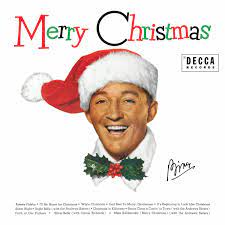
After 1955 Bing Crosby recorded Christmas songs less frequently, although he would continue to release Christmas albums. His first was Merry Christmas in 1945. It was followed by Christmas Greetings in 1949, A Christmas Sing with Bing around the World in 1956, I Wish You a Merry Christmas in 1962, and others. Of course, compilation albums of his Christmas songs have continued to be released even after his death.

It is mark of how strongly linked Bing Crosby is with Christmas that his songs his songs continue to make the Billboard Holiday chart. In 2011 Billboard created the holiday chart, and since then multiple Bing Crosby songs have hit the chart each year. It should come as no surprise that "White Christmas" has made the Billboard Holiday chart every year since its creation. And while it is more associated with Perry Como, so has Bing Crosby's version of "It's Beginning to Look a Lot Like Christmas." Bing Crosby's Christmas television specials remain available on DVD and some have found their way onto YouTube. Both Holiday Inn and White Christmas continue to air on multiple television outlets each year. Forty four years after his death, Bing Crosby is still linked to Christmas in many people's minds.

Friday, December 17, 2021

"Here Comes Santa Claus (Down Santa Calus Lane)" by Gene Autry

"Here Comes Santa Claus (Down Santa Claus Lane)" was the first Christmas song ever recorded by singing cowboy Gene Autry. It was also one of his biggest hits. The song went to #9 on the Billboard pop chart and #5 on the Billboard country chart. It marked the first many Christmas songs would record, including "Rudolph the Red-Nosed Reindeer," which remains one of the biggest singles of all time, and "Frosty the Snowman."

The roots of "Here Come Santa Claus (Down Santa Claus Lane)" are in Hollywood history. In 1928 prominent businessman Colonel Harry Baine conceived of a Christmas parade to promote the businesses along Hollywood Boulevard. The Hollywood Chamber of Commerce agreed to Colonel Baine's idea and as result the first Santa Claus Lane Parade was held in 1928. The area of Hollywood Boulevard from La Brea Avenue to Vine Street was renamed "Santa Claus Lane." That first Santa Claus Lane Parade was rather modest. It featured only a few floats and Santa Claus escorted by Universal starlet Jeanette Loff.

While the Santa Claus Lane Parade started out small, it grew swiftly in the coming years. The businesses in Hollywood received the cooperation of the studios, so that movie stars appeared in the parade and even served as Grand Marshals. For instance, popular comedian Joe E. Brown was the Grand Marshal of the Santa Claus Lane Parade in 1932. By the mid-Thirties, the parade not only featured floats, movie stars, and Santa Claus, but equestrian units and marching bands as well.

The Santa Claus Lane Parade was suspended from the years 1942 to 1944 because of World War II, but it returned in 1945 bigger than ever. It was renamed the "Hollywood Christmas Parade" in 1978.

Gene Autry had served as the Grand Marshal of the Santa Claus Lane Parade in 1939. He later rode in the parade in 1946, during which he heard children shouting, "Here comes Santa Claus!" The experience inspired him to write the lyrics to "Here Come Santa Claus (Down Santa Claus Lane)," with  Oakley Haldeman writing the music. The song proved to be a hit when released in 1947. He re-recorded it in 1953 and then again in 1957. Since its original release it has been covered by everyone from Bing Crosby to Elvis Presley.

The song was included in Gene Autry's 1949 movie The Cowboy and the Indians, its only appearance in a Gene Autry film. The Cowboy and the Indians is notable for the first appearance of Gene Autry's signature song, "Back in the Saddle Again." It is also notable for featuring Clayton Moore and Jay Silverheels not long before they appeared together on the TV show The Lone Ranger.

Without further ado, here is "Here Comes Santa Claus (Down Santa Claus Lane)."

Thursday, December 16, 2021

Those Times Santa Claus Was Naughty in Advertisements

The popular image of Santa Claus is jolly, kind, and morally upright old man who spreads Christmas joy and brings gifts to everyone. This was not always the case in the 20th Century, when some advertisements insisted on portraying Santa as, well, naughty. This might seem surprising today, but the mid-20th Century was a politically incorrect time when smoking was acceptable and sex was used to sell everything. During this time Santa drank and smoke, and even had an eye for the ladies in ads.

Yes, that's Kris Kringle himself smoking in this 1951 Pall Mall ad! Of course, keep in mind this was 13 years before the Surgeon General's first report on smoking.

Not only did ads portray Santa smoking cigarettes, but cigars as well. Indeed, in this 1940 White Owl ad not only is Saint Nick smoking a cigar, but a lady who is definitely not Mrs. Claus is sitting on his lap!


In vintage ads not only does Santa smoke, but he also drinks! What is more, from the size of those bottles in this 1936 Martini Vermouth he drinks a lot. I guess travelling around the world distributing gifts in a 24 hour period is stressful...


If smoking and drinking seems out of character for Santa Claus, then what about Santa being a peeping Tom in this 1944 Kayser Hosiery ad? The artist was Whitney Darrow, one of the many legendary cartoonists to work for The New Yorker.


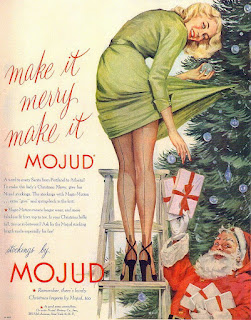
In this 1951 ad for Mojud Stockings, Santa gives a present to a lady whose dress has gotten caught in her Christmas tree. From that look on Santa's face, I have to wonder that he isn't hoping she is on the Naughty List.

Wednesday, December 15, 2021

One More Michael Nesmith Song

I am still reeling from the death of Michael Nesmith last Friday. Those who know me would hardly be surprised, as I have always been a huge Monkees fan and Mike was always my favourite. It is for that reason I decided tonight to share another one of my favourite songs by Michael Nesmith. It is "Papa Gene's Blues." It is one of Michael Nemisth's many songs in which the title seemingly has nothing to do with the song. Indeed, if "Papa Gene's Blues" seems like an odd title for the song, consider that its original title was "Brand X." The title did present some problems for Colgems, who misspelled it on some early pressings of the first album, The Monkees, as "Papa Jean's Blues."

Tuesday, December 14, 2021

Godspeed Anne Rice


Anne Rice, who revolutionized horror fiction with such books as The Vampire Lestat and Queen of the Damned, died on December 11 2021 at the age of 80. The cause was complications from a stroke.

Anne Rice was born  Howard Allen Frances O'Brien on October 4 1941 in New Orleans. Explanations for her male birth name have varied, but all agree that she was named for her father. She adopted the name"Anne" on her first day of school. A nun asked her what her name was, ad she said "Anne," because she thought it was a pretty name. Her name was legally changed to "Anne" in 1947. Her mother died when she was 15, and her father later remarried. Her father moved the family to north Texas when she was 16. It was at Richardson High School in north Texas that she met her future husband Stan Rice. After graduating from Richardson High School she attended for her freshman year and North Texas State College also in Denton for her sophomore year. She dropped out of college because she ran out of money. After moving to California she completed her education at the University of San Francisco and San Francisco State University.

It was in 1976 that Anne Rice's first book, Interview with The Vampire was published. It was the first book in the The Vampire Chronicles series and introduced her most famous character, Lestat. It would be followed by the much more successful The Vampire Lestat in 1985. It would be followed by twelve more novels in The Vampire Chronicles. Her second book was the historical novel The Feast of All Saints in 1979. In 1983 the novel The Claiming of Sleeping Beauty, which she wrote under the pseudonym A. N. Roquelaure, was published. It was the first in her series of erotic novels based on the "Sleeping Beauty" fairy tale. In 1965 Exit to Eden and in 1986 Belinda were published. Both were under the pseudonym Anne Rampling and both were erotic fiction.

In 1989 Ramses the Damned was published. It dealt with the resurrected mummy trope. It was followed by two more Ramses novels. The following year The Witching Hour, the first in the trilogy Lives of the Mayfair Witches, was published. In the Naughts  she wrote two religious novels, Christ the Lord: Out of Egypt and Christ  the Lord: The Road to Cana. In 2012 The Wolf Gift was published, the first of two books dealing with lycanthropy.

Anne Rice revolutionized vampire fiction. She was among the first authors to humanize vampires, starting with Interview with The Vampire. In humanizing vampires, Anne Riche also altered the mythos surrounding them. Not to content to use the myths established by Bram Stoker and countless vampire movies, Mrs. Rice created her own myths. She also infused her novels with an eroticism that was not yet commonplace in works on vampires. Anne Rice would bring her own take to other classic figures of horror as well, from resurrected mummies to witches to werewolves. Anne Rice changed the horror genre forever.

Monday, December 13, 2021

Cara Williams Passes On

Cara Williams, who played Gladys in the sitcom Pete and Gladys and was nominated for the Academy Award for Best Supporting Actress for her role in The Defiant Ones (1958), died on December 9 2021 at the age of 96.

Cara Williams was born Bernice Kamiat in Brooklyn, New York on June 29 1925. Her parents divorced when she was very young, and her mother moved the family to Los Angeles. Bernice Kamiat took an interest in acting while very young and chose "Cara Williams" as her stage name. She attended the Hollywood Professional school and began acting on radio. She was only 16 years old when she was signed by 20th Century Fox.

Cara Williams made her film debut in a small role in Wide Open Town in 1941. She appeared in small, often uncredited roles in such films as Girls' Town (1942), In the Meantime, Darling (1944), and Laura (1944). She had her first major role in Boomerang (1947). For the remainder of the Forties she appeared in such films as Sitting Pretty (1948), The Saxon Charm (1948), and Knock on Any Door (1949). She made her television debut in an episode of Theatre of Romance in 1949. The following year she appeared in the shows The Clock, The Philco Television Playhouse, The Chevrolet Tele-Theatre, The Web, Starlight Theatre, The Billy Rose Show, and Suspense.

In the Fifties Cara Williams made several guest appearances on the TV show Alfred Hitchcock Presents. In 1960 she began playing Gladys on the sitcom Pete and Gladys, opposite Harry Morgan as Pete. She guest starred on the show Robert Montgomery Presents, Armstrong Circle Theatre, Broadway Television Theatre, Steve Randall, Matinee Theatre, On Trial, Lux Video Theatre, Jane Wyman Presents Fireside Theatre, Date with the Angels, Naked City, Westinghouse Desilu Playhouse, and Zane Grey Theatre. She appeared in the movies The Girl Next Door (1953), Monte Carlo Baby (1953), The Great Diamond Robbery (1954), Meet Me in Las Vegas (1956), The Helen Morgan Story (1957), The Defiant Ones (1958), and Never Steal Anything Small (1949).

In the Sixties she continued to star on Pete and Gladys. She also starred in the single season sitcom The Cara Williams Show. She guest starred on Jackie Gleason: American Scene Magazine, The Red Skelton Show, and Valentine's Day. She appeared in the movie The Man from Diner's Club (1963). In the Seventies she guest starred on Rhoda, Medical Center, and Visions. She appeared in the movies Doctor's Wives (1971), The White Buffalo (1977), and The One Man Jury (1978). She made her last appearance on film in the TV movie In Security in 1982.

Chances are good that Cara Williams might be best remembered as Gladys, Pete's scatter-brained wife on Pete and Gladys, but she played a wide variety of role throughout her career. She played waitress Irene Nelson, a witness to murder, in Boomerang. In The Defiant Ones she played a mother who takes in two escaped convicts (Sidney Poitier and Tony Curtis), a role for which she was nominated for an Oscar. In The Man form the Diner's Club she played a gangster's moll who becomes involved with the meek Diner's Club clerk (Danny Kaye) of the title. Cara Williams was equally adept at comedy and drama, and always gave a good performance, no matter small her role.

Saturday, December 11, 2021

My Favourite Michael Nesmith Songs

There are those artists we love from our earliest days, so early that we might not even recall where we first encountered them. The Monkees number among those artists for me. I might have seen the TV show in its first run on NBC, although I don't remember it. My much older sister owned The Monkees' albums and they were frequently played on the radio, so I am certain I must have heard their songs while very young. One thing of which I am certain is that I watched the reruns of The Monkees faithfully when CBS started showing the series in 1969. At six years old something about both the show and the band just clicked for me. I have to think much of it was that it was sheer escapism of the sort young boys enjoy. The Monkees faced everything from gangsters to modern day pirates to the Devil himself. While The Monkees was an escapist TV show, to a small degree it had an underlying message. Quite simply, each week it showed that four down-and-out young men could come out on top against whatever was thrown against them. Fora young boy or, really, anyone of any age, that can be an important message to hear.

While I love all four Monkees, from the beginning Michael Nesmith was my favourite. Mike was the intellectual of the group, possessed with very dry wit and a keen mind. It was Mike who most often got The Monkees out of any jams they were in, who came up with any solutions to problems they might face. As a relatively intelligent lad whose humour was ea bit left of centre even then, I identified with Mike, even if I might not possess his leadership skills (I still don't).

Of course, The Monkees was more than a sitcom. Each week it featured at least one song performed by the band, and some of those songs were written by the band members themselves. Indeed, Michael Nesmith was a songwriter before the TV show even debuted. He had written and recorded his own singles before the debut of The Monkees. His song "Mary, Mary" (later covered by The Monkees) was recorded by The Paul Butterfield Band in 1966, and his song "Different Drum" was recorded by The Greenbriar Boys that year. Michael Nesmith's songs for The Monkees number among my favourites of the band, and I love a number of his solo songs as well. In tribute to the great Michael Nesmith, I thought I would post some of my favourite songs he wrote. These aren't all of my favourites, by any means. Since I can't decide which ones I like best, I decided to present them in chronological order.


"Sweet Young Thing" was co-written by Michael Nesmith, Gerry Goffin, and Carole King, but it is identifiably a Michael Nesmith song. Indeed, it sounds a lot like his other early work. It is my second favourite Monkees song, after "She" (which was composed by Boyce and Hart).


Angry at Don Kirshner for releasing the album without The Monkees' input or even knowledge, Michael Nesmith once called the band's second album, More of The Monkees, "the worst album in the history of the world." That having been said, for all its shortcomings, More of The Monkees does include some of the band's best songs, including "She," Michael Nesmith's own "Mary, Mary," "(I'm Not Your) Steppin'' Stone," and "I'm a Believer." Among those songs is "The Kind of Girl I Could Love." It has always numbered among my favourite songs by Michael Nesmith.


Headquarters was historic as the first Monkees album recorded without substantial use of session musicians. "You Just May Be The One" had been recorded earlier for the television show, but for the album The Monkees recorded a new version. What is more, it is the one song on Headquarters on which all four Monkees play the same instruments that they are shown playing on the show (Mike on guitar, Peter on bass, Micky on drums, and Davy on tambourine). While I love both versions, I do prefer the album version of "You Just May Be the One" to the TV version. It has always been one of my favourite Monkees songs, although for a time I couldn't listen to it without breaking down in tears as I identify it with someone who is no longer with us.


"Daily Nightly" was inspired by the Sunset Strip curfew riots, and the media's misinformation regarding them. The Monkees had earlier discussed the Sunset Strip curfew riots at the end of the episode "Find The Monkees," even going so far as to point out that the word "riots" was inaccurate. Along with "Star Collector" (also from the album Pisces, Aquarius, Capricorn, & Jones Ltd.), "Daily Nightly" was the first song on which a Moog synthesizer was used.


As mentioned earlier, Michael Nesmith's song "Different Drum" was first recorded by The Greenbriar Boys. It was included on their album Better Late Than Never! in 1966. Michael Nesmith had offered "Different Drum" to The Monkees, but it was one of a number of Michael Nesmith's songs that was rejected by music supervisor Don Kirshner. The Stone Poneys then recorded their own version of their song and relased it as a single. It went to no. 13 on the Billboard Hot 100. For me this is yet more evidence that Don Krishner was not the music expert he thought he was...


"Tapioca Tundra" appeared on the album The Birds, The Bees & The Monkees and it was also the B-side of the second single from the album, "Valleri." It did particularly well as a B-side, actually going to no. 34 on the Billboard Hot 100.


"Circle Sky" is perhaps best known for its inclusion in The Monkees' movie Head. The movie features a live performance of the song filmed at the Valley Auditorium in Salt Lake City on May 17 1968. Sadly, the movie Head bombed at the box office. Its soundtrack album became the first Monkees album not to reach the top ten on the Billboard album chart, going only to no. 45. A new version would later be recorded for The Monkees' 1996 album Justus.


"Rio" was a single from Michael Nesmith's 1977 album From a Radio Engine to the Photon Wing. At the time music videos were hardly unknown. Musical short films have existed nearly as long as talking motion pictures have. In the Forties Soundies were made for the Panoram visual jukebox and in the late Fifties and Sixties there were musical shorts made for the Scopitone, Cinebox, and Color-Sonics visual jukeboxes. Of course, in the Sixties promotional films were made for artists from The Beatles to The Monkees' songwriters Boyce & Hart. That having been said, the music video for "Rio" was historic. In 1977 many American artists did not bother with music videos. What is more, conceptual videos were just coming into their own at the time. "Rio" would then have an impact. Indeed, while the video was shot in 1977, it looks like something that could have come from the Eighties.


"Cruisin'" was the last single Michael Nesmith would release as a solo artist. It was from his 1979 album  Infinite Rider on the Big Dogma. A music video was shot for Michael Nesmith's 1981 collection of comedy skits and music videos Elephant Parts. Elephant Parts also included the music video for "Rio," as well as music videos for "Magic," "Light," and "Tonight." Elephant Parts won the first Grammy for Music Video. As to Sunset Sam in the "Cruisin'" video that is Steve Strong, not a young Hulk Hogan as often reported.