
Saturday, May 13, 2023
"Here, There and Everywhere" by The Beatles
I have not been feeling well of late, which is why I have not posted much on this blog this week. Tonight I thought I would then leave you with one of my favourite songs by The Beatles and one of my favourite songs written by Paul McCartney. This is an animated video created by the London based firm Trunk Animation. They have also created videos for other Beatles songs, including "Back in the U.S.S.R." and "Glass Onion."

Friday, May 12, 2023
Two Unusual Homes on Late Fifties Sitcoms
The late Fifties was the era of domestic sitcoms like The Donna Reed Show and Leave It to Beaver. The families on these shows generally lived in suburban homes that were almost always two storeys. There were at least two exceptions during this era. One centred on a group of hillbillies who migrated from the Appalachian Mountains of West Virginia to a farm in the San Fernando Valley. The other centred on the teenage son of a small town grocer.
 The Real McCoys debuted on October 3 19457 on ABC and centred on the family of the title, who inherited a farm in the San Fernando Valley from an uncle. This alone made it different from the many sitcoms set in the suburbs of the time. Further setting them apart was the fact that their house was only a single storey. In the pilot a house on the Iverson Ranch was used. It had appeared in movies from Outlaws of Boulder Pass (1942) to Don't Knock the Rock (1956). For the regular series a house resembling the one on the Iverson Ranch was built on the old RKO Forty Acres lot, that had recently been bought by Desilu. Such classic films as King Kong (1933) and Gone with the Wind (1939) had been filmed there. The first season of The Adventures of Superman and later The Andy Griffith Show and Batman would be filmed there.
As might be expected, the living room on The Real McCoys looked a bit old fashioned, with furniture that probably went back to the Victorian era. The same was true of the bedrooms, down to their wrought iron beds To a lesser degree, the same could be said of its kitchen/dining room. The McCoy's home offered a sharp contrast to the many Mid-Century Modern suburban homes featured on other sitcoms.
 While the McCoys lived in the country, the Gillis family on Dobie Gillis lived in the fictional town of Central City. Dobie Gillis centred on the girl-crazy teenager of the title (Dwayne Hickman), who was the son of the owner of a neighbourhood grocery store (Frank Faylen). As was typical of such neighbourhood groceries, the Gillis family lived above the store. This already sets it apart from many domestic sitcoms of the era. Of course, being located above a grocery, the Gillis home was also located in a downtown district rather than a residential area. In establishing shots of the downtown, other businesses are visible, including King Drug Store (a Rexall Pharmacy) and the State Hotel. From various episodes it would appear that Charlie Wong's ice cream parlour, Riff Ryan's Music Store, the Bijou Theatre, and Ziegler's clothing store are all within walking distance of the grocery. Even further setting it apart is that very little of the action on the show actually takes place in the Gillis home. It usually takes place in the grocery or at Central City High (later S. Peter Pryor Junior College), with some scenes at the local ice cream parlour on occasion.
When scenes do take place in the Gillis home, it is often in the dining room/kitchen or Dobie's bedroom. The Gillis home is set apart from the various domestic sitcoms in that its dining room and kitchen are combined, but other than that the dining room/kitchen is similar to what one might see on other sitcoms of the time, complete with a toaster and a refrigerator (albeit a small one). Dobie's bedroom is also what one would expect from a teenager living in the late Fifties. Pictures and sports pennants decorate the wall, and a lamp sets on a night stand by the bed. There is apparently a tree outside the bedroom window, which explains how Dobie's pal Maynard (Bob Denver) is able to enter the room by way of the window (Dobie's room is on the second storey, above the grocery store). The Glllis family does have a living room, although its appearance could vary from episode to episode. Sometimes it has a table for dining when they have guests, sometimes it doesn't. When the table does appear, its position in the living room may vary. What is consistent about the Gillis living room is that it has a couch, several cabinets filled with knick knacks, and armchairs. Like many old-time, downtown stores, the Gillis Grocery also had a basement, as seen in first season episode "The Chicken from Outer Space." In the end, the Gillis home is a sharp contrast to the homes seen on such shows as The Adventures of Ozzie and Harriet and The Donna Reed Show.
Of course, both The Real McCoys and Dobie Gillis differed from other shows of the late Fifties in other ways. The Real McCoys was the first of the rural sitcoms, which set it apart from the sitcoms set in the suburbs. Although it debuted in 1959, Dobie Gillis had much more in common with such sitcoms of the Sixties as Bewitched and The Monkees than it did Father Knows Best and Leave It to Beaver. I will say that of the two homes I prefer the Gillis home to the McCoys' home. I grew up on a farm and we had a better house than the McCoys, complete with Mid-Century Modern furnishings. Besides, I think it would have been fun living above a grocery store. Think about it. One would never have to go far to get groceries!

As might be expected, the living room on The Real McCoys looked a bit old fashioned, with furniture that probably went back to the Victorian era. The same was true of the bedrooms, down to their wrought iron beds To a lesser degree, the same could be said of its kitchen/dining room. The McCoy's home offered a sharp contrast to the many Mid-Century Modern suburban homes featured on other sitcoms.

When scenes do take place in the Gillis home, it is often in the dining room/kitchen or Dobie's bedroom. The Gillis home is set apart from the various domestic sitcoms in that its dining room and kitchen are combined, but other than that the dining room/kitchen is similar to what one might see on other sitcoms of the time, complete with a toaster and a refrigerator (albeit a small one). Dobie's bedroom is also what one would expect from a teenager living in the late Fifties. Pictures and sports pennants decorate the wall, and a lamp sets on a night stand by the bed. There is apparently a tree outside the bedroom window, which explains how Dobie's pal Maynard (Bob Denver) is able to enter the room by way of the window (Dobie's room is on the second storey, above the grocery store). The Glllis family does have a living room, although its appearance could vary from episode to episode. Sometimes it has a table for dining when they have guests, sometimes it doesn't. When the table does appear, its position in the living room may vary. What is consistent about the Gillis living room is that it has a couch, several cabinets filled with knick knacks, and armchairs. Like many old-time, downtown stores, the Gillis Grocery also had a basement, as seen in first season episode "The Chicken from Outer Space." In the end, the Gillis home is a sharp contrast to the homes seen on such shows as The Adventures of Ozzie and Harriet and The Donna Reed Show.
Of course, both The Real McCoys and Dobie Gillis differed from other shows of the late Fifties in other ways. The Real McCoys was the first of the rural sitcoms, which set it apart from the sitcoms set in the suburbs. Although it debuted in 1959, Dobie Gillis had much more in common with such sitcoms of the Sixties as Bewitched and The Monkees than it did Father Knows Best and Leave It to Beaver. I will say that of the two homes I prefer the Gillis home to the McCoys' home. I grew up on a farm and we had a better house than the McCoys, complete with Mid-Century Modern furnishings. Besides, I think it would have been fun living above a grocery store. Think about it. One would never have to go far to get groceries!
Wednesday, May 10, 2023
The Late Great Newton Minow

Newton Minow was born on January 7 1926 in Milwaukee, Wisconsin. During World War II he served in the United States Army. Following the war he received a Bachelor of Science degree from Northwestern University and then a Juris Doctor from Northwestern University School of Law. He went to work for the law firm of Mayer, Brown & Platt and then became a law clerk to Chief Justice Fred M. Vinson of the U.S. Supreme Court. He became an assistant counsel to Adlai Stevenson, Governor of Illinois, and was afterwards a partner in law firm of Stevenson, Rifkind & Wirtz. It was in 1961 that President John F. Kennedy appointed Newton Minow as the Chairman of the FCC.
Newton Minow would have an enormous impact as the Chairman of the FCC. He supported passage of the All-Channel Receiver Act of 1962, which required all television manufacturers to include a UHF tuner on their sets. This made UHF television stations more viable. He was also influential with regards to satellite communications. He pushed through the licence for a test of Telstar that occurred in July 1962.He also campaigned for Congress to pass legislation related to communications satellites. While these achievements are arguably greater that the "Vast Wasteland" speech, Mr. Minow remains best known for that speech. Although the speech is remembered for the phrase "vast wasteland," it was not a condemnation of all television programming. Instead he was reminding broadcasters that they must serve the public interest and as a result they must do better. Indeed, he cited a number of television shows he considered to be of quality, including Kraft Theatre and The Twilight Zone.
After serving as the Chairman of the FCC, Newton Minow would do further work in communications. He sat on the Board of Governors of National Educational Television and its successor the Public Broadcasting Service. From 1978 to 1980 he was Chairman of PBS. He also served as President and Chief Executive Officer of Carnegie Corporation, a foundation founded by Andrew Carnegie "to promote the advancement and diffusion of knowledge and understanding" and one of PBS's chief sponsors.
Newton Minow later worked as senior counsel at Sidney Austin LLP. Later he served as Honorary Consul General of the Republic of Singapore.
Newton Minow also wrote books, including Inside the Presidential Debates: Their Improbable Past and Promising Future, and Abandoned in the Wasteland: Children, Television, and the First Amendment.
Newton Minow would have an enormous impact, both as FCC Chairman and as a private individual. He was important in the passage of the All Receivers Act, which required all television sets to have UHF receivers. The requirement that all TV sets have UHF tuners would allow ABC to expand until it was finally competitive with NBC and CBS. It would also allow for the proliferation of independent television stations and public television stations. His support of thee Communications Satellite Act of 1962 and INTELSAT helped pave the way for communications satellites. As to his speech "Television and the Public Interest," it would lead to the networks airing more news coverage and educational content throughout the Sixties and Seventies. Newton Minow also supported public television. In the end Newton Minow may have had more impact than any other FCC Chairman. Indeed, he may have had more impact on television and communications than most of those who actually in the industry.
Saturday, May 6, 2023
Guy Lee, One of the Actors Who Played Charlie Wong on Dobie Gillis
 |
| Guy Lee, Dwayne Hickman, and Shelia James from Dobie Gillis |
Aside from The Many Loves of Dobie Gillis, Guy Lee made two guest appearances on Bonanza (playing a different role each time), and also guest starred on episodes of Richard Diamond, Private Detective; Death Valley Days; Honey West; Ironside; and others. He also appeared in such movies as Girls! Girls! Girls! (1962) and One More Train to Rob (1971).
Guy Lee's biggest impact may have been as an agent who represented such Asian American actors as B. D. Wong and John Lone, as well as an activist. He took over The Bessie Loo Talent Agency, which represented Asian American actors, from Bessie Loo, who had been an actress, when she retired. Guy Lee & Associates was still in operation as of 2019. Guy Lee was a co-founder and board member of the Association of Asian Pacific American Artists, which was founded in 1976 to right stereotyping and promote a more realistic portrayal of Asian Americans and Pacific Islanders in movies and television. He was among the many Asian Americans who protested the casting of British actor Jonathan Pryce as the engineer in the Broadway production of Miss Saigon rather than an Asian actor.
Guy Lee died on November 22 1993 at the age of 66 from cancer. While it is likely he will always be best remembered as Charlie Wong on The Many Loves of Dobie Gillis, he did so much more.
Friday, May 5, 2023
The Late Great Gordon Lightfoot

Gordon Lightfoot was born on November 7 1938 in Orillia, Ontario. His mother encouraged his musical talent and he started performing while still young. He sang in the choir of St. Paul's United Church in Orillia and he performed from time to time on local radio in Orillia. When he was twelve years old he appeared at Massey Hall in Toronto for the first time. In high school he was competed in track-and-field, and even set school records for for shot-put and pole vault. He studied music at the University of Toronto. He was twenty years old when he moved to Los Angeles and studied jazz composition at the Westlake College of Music in Hollywood.
After two years Gordon Lightfoot returned to Toronto. He performed on the CBC television program Country Hoedown as part of the Singin' Swingin' Eight. He also performed as the various coffee houses around Toronto, both as a soloist and as a part of folk ensembles. His first single, "(Remember Me) I'm the One," was released in 1962. It went to no. 3 on the Canadian singles chart. It was followed by "It's Too Late, He Wins" and "Adios, Adios" that same year. In 1963 he moved to the United Kingdom where he hosted the BBC's Country and Western Show. He returned to Canada in 1964. His first album, Lightfoot!, was released in 1966. In 1967 he was commissioned by the CBC to write the "Canadian Railroad Trilogy" for the television special One Hundred Years Young, celebrating Canada's centennial. He also performed the song in the special. In 1970 he appeared on the CBC's The Wayne & Shuster Comedy Special.
It was also in 1970 that he signed with Warner Bros./Reprise. This would result in Gordon Lightfoot's first hit in the United States. His single "If You Could Read My Mind" went to no. 5 on the Billboard Hot 100 and no. 1 on the Canadian singles chart. That same year his album Sit Down Young Stranger (from which "If You Could Read My Mind' was from) went to no. 12 on both the Billboard album chart and the Canadian album chart.
The Seventies would see Gordon Lightfoot release several successful albums. He would also have some of his biggest hits during the decade. His song "Sundown" went to no. 1 on the Billboard Hot 100 in 1974. That same year "Carefree Highway" went to no. 10 on the chart. The following year "Rainy Day People" reached 26 on the Billboard Hot 100. The year 1976 produced his second biggest hit, "The Wreck of the Edmund Fitzgerald," which peaked at no. 2 on the Billboard Hot 100.
The Seventies marked the peak of Gordon Lightfoot's popular success, but he recorded seven more albums from 1982 to 2020. He also continued to perform and appear on television. Mr. Lightfoot wold also have two acting roles. He appeared in Western Harry Tracy, Desperado (1982) and a 1988 episode of the TV series Hotel.
Gordon Lightfoot was an incredible talent. He was gifted with a rich baritone with which he could convey any emotion. More importantly, he was an incredible songwriter. Mr. Lightfoot told stories with his songs. "If You Could Read My Mind" addressed the failure of a romantic relationship. With "Don Quixote" he dealt with the famous character from Cervantes's novel. "The Wreck of the Edmund Fitzgerald" told the story of the sinking of the SS Edmund Fitzgerald on Lake Superior on November 10 1975. Gordon Lightfoot was a skilled lyricist who told compelling stories capable of moving his listeners.
Sunday, April 30, 2023
The 30th Anniversary of Blood In Blood Out (1993)
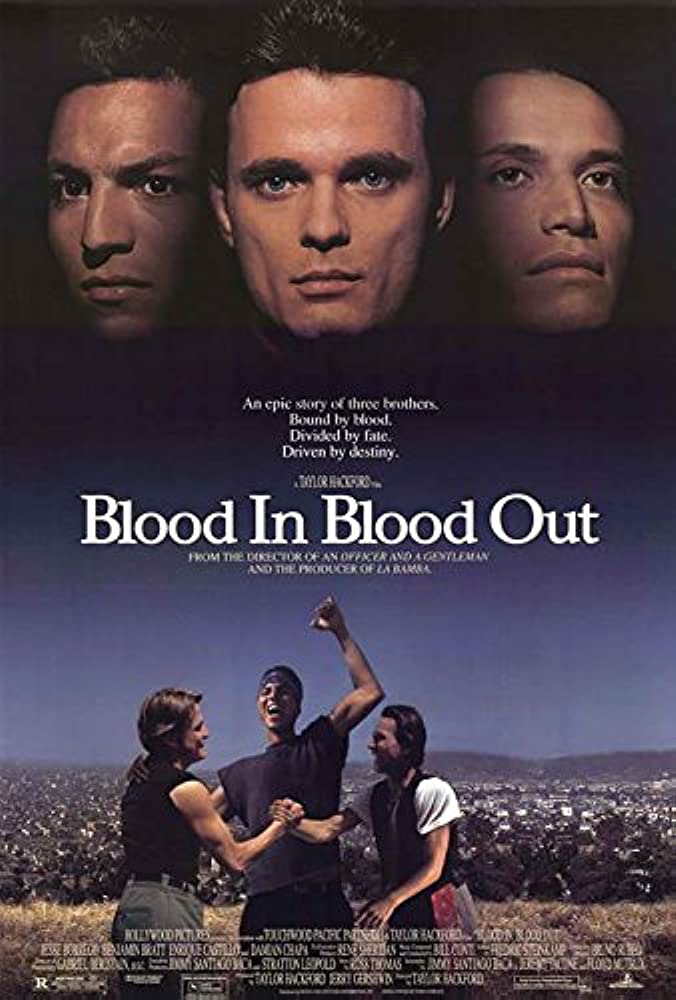
For those who have never seen Blood In Blood Out, it centres on three related Chicanos as they navigate their lives from 1972 to 1984. While all three begin as part of an East Los Angeles street gang, their lives ultimately take very different paths.
The origins of Blood In Blood Out (1993) go back to 1982. Producer Jerry Gershwin, who had produced Harper (1966) and Where Eagles Dare (1968), hired novelist Ross Thomas to write the screenplay. It went into development at New Visions Pictures under director Harold Becker, who had directed such films as The Ragman's Daughter (1972), The Onion Field (1979), and Taps (1981). The August 7 1988 issue of The Los Angeles Times reported that Blood In Blood Out would mark the directorial debut of Edward James Olmos, and that Andy Garcia and Lou Diamond Phillips were set to star in the film. Ultimately, Edward James Olmos, Lou Diamond Phillips, and Andy Garcia would not be a part of Blood In Blood Out.
In the meantime New Vision Pictures folded, after which Edward James Olmos took the project to Taylor Hackford. Taylor Hackford had directed the film An Officer and a Gentleman (1982) and both produced and directed the films Against All Odds (1984) and White Nights (1985). Taylor Hackford had been a producer on La Bamba (1987), the biopic about Chicano rock 'n' roll legend Ritchie Valens. While Mr. Hackford liked the format of Blood In Blood Out, he thought the text of the screenplay did not ring true. He had grown up in Santa Barbara, California around the Mexican American community there, and as a reporter for KCET had covered East Los Angeles with his fellow reporter Jesus Treviño.
Ultimately, Edward James Olmos and Taylor Hackford would part ways, with Olmos citing creative differences. He would go onto produce and direct American Me (1992), a film about similar subject matter. It was then that Taylor Hackford decided he would direct Blood In Blood Out himself. As to the screenplay, it would be rewritten by Floyd Mutux, who also contributed to American Me (1992). Jeremy Iacone would also rewrote the script.
It was famous playwright Luis Valdez, best known for the play Zoot Suit, who directed Taylor Hackford to poet Jimmy Santiago Baca. At the time Jimmy Santiago Baca was not particularly interested in working in the film industry. It took Taylor Hackford visiting the poet in New Orleans to convince him to work on Blood In Blood Out. Jimmy Santiago Baca then moved from Albuquerque, New Mexico to Los Angeles to absorb the Chicano culture of East Los Angeles. Jimmy Santiago Baca also drew upon his own life experiences in working on the screenplay (he had spent five years in prison for drug possession), with characters based on the sorts of people he had known in prison. Taylor Hackford has said that Jimmy Santiago Baca came up with most of the final plot of Blood In Blood Out.
Blood In Blood Out attracted the attention of Ricardo Mestres, president of production for Hollywood Pictures. Hollywood Pictures had been founded by then Disney CEO Michael Eisner and then Disney studio chief Jeffrey Katzenberg, and was meant to release movies with more mature themes than those released by Disney and Touchstone Pictures. Michael Eisner had been at Paramount when Taylor Hackford had directed An Officer and a Gentleman for that studio. It was then that Disney, then as now best known for family films came to produce Blood In Blood Out.
The first of the three leads to be cast was Jesse Borrego, who played artist Cruz Candelara in the movie. At the time he may have been best known as Jesse Velasquez on the TV show Fame. Benjamin Bratt was the second lead to be cast. He played Paco Aguilar in the film, who eventually joins the LAPD. Benjamin Bratt had appeared in two short lived shows, Knightwatch and Nasty Boys. The last of the leads to be cast was Damian Chapa, who played the all important role of Miklo Velka, around whom much of the movie revolves. Like Miklo, Damian Chapa was the child of mixed heritage: he was the son of a Mexican father and an Irish mother.
None of the three leads were from Los Angeles, so to insure authenticity director Taylor Hackford had them move into a house near Hazard Park so they could immerse themselves in the culture of the area. Each night Jesse Borrego would go over the script with Benjamin Bratt and Damian Chapa in what were referred to as "Vatos Locos Tutorials," in which they went over the particulars of Chicano jargon.
Beyond the three leads, Blood In Blood Out featured several cast members who would soon be famous. It was an early credit for Billy Bob Thornton, who may have been best known as Billy Bob Davis on the sitcom Hearts Afire when the movie came out. It was also an early credit for Danny Trejo, who had actually served time in San Quentin State Prison. Ving Rhames had already appeared in such movies as Native Son (1989) and Jacob's Ladder (1990). The year following the release of Blood In Blood Out (1993), he appeared in Pulp Fiction (1994). The cast also included Latino actors who were already well established. Enrique Castillo, who played gang leader Montana, was a founding member of The Latino Theater Company and had guest starred on such shows as The Waltons and The Incredible Hulk. Lupe Ontiveros was already a legend in Latino film, with a career going back to the Seventies. Also among the cast was my dear friend Vanessa Marquez, who had already appeared in the classic Stand and Deliver (1988) and in unaired episodes of the TV show Wiseguy.
The paintings by Jesse Borrego's character Cruz Candelara in Blood In Blood Out were by Chicano artist Adan Hernandez. A native of San Antonio, his art would be displayed in the Metropolitan Museum of Art in New York City and the San Antonio Museum Art.
Blood In Blood Out (1993) was filmed from May 6 1991 to October 4 1991. Perhaps the most famous shooting location in the film is San Quentin State Prison. Director Taylor Hackford got a copy of the script to then warden Dan Vasquez, who was impressed by its authenticity. He then gave permission for Blood In Blood Out to be filmed in the prison. Several of San Quentin's inmates at the time served as extras in the film. Even warden Dan Vasquez appeared as the warden in the movie.
Blood In Blood Out was also filmed at several locations in Los Angeles and East Los Angeles. Among the best known of these is the southwest corner of Folsom Street and N. Indiana Street in East Los Angeles, where the bunya pine known as El Pino is located. The tree appears extensively in the film. Another famous location in the film is the restaurant Los 5 Puntos, located at what was then Brooklyn Avenue and is now East Chavez Avenue. Other locations included St. Mary's Catholic Church on Chicago Street in Los Angeles and Evergreen Cemetery on North Evergreen Avenue in Los Angeles.
The original cut of Blood In Blood Out turned out to be over five hours long. Much too long for theatrical release, the film was then edited down to three hours. The five hour version has never been released and it cannot definitively be said that it even still exists.
It was as Blood In Blood Out was being edited that riots erupted in Los Angeles in late April and early May of 1992 following the acquittal of the police officers who had beaten Rodney King. Michael Eisner, CEO of Disney, grew concerned that following the riots, the release of Blood In Blood Out could then generate bad press for the studio. Because of this, the film's release was delayed. On February 5 1993, test screenings were held in Rochester, New York, Tucson, Arizona, and Las Vegas, Nevada.
It was at a screening in Las Vegas that a fist fight broke out during the film in which no one was injured. According to director Taylor Hackford recalled, the incident was enough to convince Michael Eisner that the film would result in violence. It was Frank Wells, then president of The Walt Disney Company, who would see to it that Blood In Blood Out would be released, although under a new title. After years of being known as Blood In Blood Out, the movie was retitled Bound by Honor. As result, the studio's entire marketing campaign for the film had to be redone, from the trailers to the posters.
It was then on April 30 1993 that Bound by Honor was released in thirty cities across the nation. Before the test screenings in Rochester, Tucson, and Las Vegas, when it was still known as Blood In Blood Out, Disney projected the movie to make $40 million. Instead as Bound by Honor, only made a meagre $4.5 million.
Bound by Honor was not well received by critics either. Kenneth Turan in The Los Angeles Times gave it a negative review, ending his review with "Apparently in love with East L.A., this film succeeds only in getting lost in it." Jonathan Rosenbaum in The Chicago Reader also gave Bound by Honor a negative review, writing that it was an "....ugly three-hour snoozefest is apparently supposed to do for East Los Angeles Chicanos what the Godfather movies did for New York mafiosi…" Roger Ebert's review of Bound by Honor was decidedly mixed. He wrote, "Bound by Honor contains some effective performances, some moments of deeply felt truth, and a portrait of prison life that I assume is accurate. What seems to be missing is a clear idea of why the movie was made, and what the director, Taylor Hackford, wanted to say with it." As might be expected, many reviews compared it to the previous year's American Me (1992).
For its release on home video, the original title of Blood In Blood Out was restored. It was also released under the title Blood In Blood Out...Bound by Honor to such premium cable channels as Showtime and The Movie Channel. Slowly but surely, Blood In Blood Out developed a following. Eventually it became a cult film. A slightly longer "director's cut" would be released on DVD, although the five hour version remains unavailable.

First conceived in 1982, Blood In Blood Out took many years to reach the screen. Once it did, it was all but abandoned by the studio that had released it. Regardless, through its release on VHS and being shown on various premium cable channels, Blood In Blood Out developed a following. Today it is a cult classic, particularly in the Chicano community. It is safe to say that it will be remembered for years to come.
Friday, April 28, 2023
Death Race 2000 (1975)

Death Race 2000 is set in the year of its title. Following the World Crash of '79, during which there was widespread economic and civil unrest, the United States has become a fascist dictatorship. To keep the population complacent, the government offers up its own version of "bread and circuses," the Transcontinental Road Race. During the Transcontinental Road Race, racers cross the country, racking up bonus points for every person they kill along the way. As might be expected, the race is in the year 2000. It is complicated by a plot by a resistance group intent on disrupting the event. As to Frankenstein (David Carradine), the race's reigning champion, he has his own agenda.
In part, Death Race 2000 owes its existence to the novel Damnation Alley by Roger Zelazny. Producer Roger Corman had wanted to adapt Damnation Alley as a movie, but 20th Century Fox held its film rights (the studio would eventually release their adaptation of the novel in 1977). Unable to produce a film based on Damnation Alley, Roger Corman then optioned the film rights to the short story "The Racer" by Ib Melchior. Published in 1956 in the men's magazine Escapade, the story was about a race during which racers earn points for the number of pedestrians they kill. It was at this time that United Artists had announced Rollerball, a big budget, dystopian science fiction movie that also featured a violent, futuristic sport. Roger Corman figured that with Death Race 2000 he could capitalize on the publicity building up to the release of Rollerball.
The first script for Death Race 2000 was written by Robert Thom, who had written such films as All the Fine Young Cannibals (1960) and Wild in the Streets (1968). Director Paul Bartel thought Robert Thom's script could not possibly be filmed, and then wrote his own draft of the screenplay. This was in turn rewritten by Charles B. Griffith, who had written Not of This Earth (1956), Little Shop of Horrors (1960), and The Wild Angels (1966).
The lead role of Frankenstein was ultimately filled by David Carradine,then best known for the TV series Kung Fu. Paul Bartel had seen him in the play The Royal Hunt of the Sun and was suitably impressed. In addition to David Carradine, Death Race 2000 also featured cast members who would shortly become famous. Sylvester Stallone played Frankenstein's chief rival, the Chicago style gangster Machine Gun Joe Viterbo, only a little over two years before the release of Rocky (1976). Martin Kove, who would later play John Kreese, the antagonist in the Karate Kid movies, played the Roman-themed racer Nero the Hero.
Of course, among the biggest stars of Death Race 2000 are the cars themselves. They were designed by James Powers and constructed by Dean Jeffries (who had also been responsible for Black Beauty on The Green Hornet and the Monkeemobile on The Monkees). The cars were constructed using Volkswagen chassis. Unfortunately, none of them could go over 40 miles per hour. The cars were then shot undercranked in long shots to give the illusion of speed.
Director Paul Bartel and producer Roger Corman would come to a disagreement during the shooting of Death Race 2000. Paul Bartel felt that the concept of the movie was inherently violent, so there need be little blood shown on the screen. At the same time, Paul Bartel insisted on humour in the film. Roger Corman thought the audience would want violence in the film. Once Paul Bartel had finished filming Death Race 2000, he sent out a second unit to shoot scenes involving blood that could be inserted into the film. As it turned out, most of the blood inserts could not be used, as the MPAA threatened to rate Death Race 2000 "X." Afterwards the MPAA gave it an "R" rating, some of the blood inserts were put back into the film.
Death Race 2000 ultimately cost $480,000. It made a respectable profit, earning $4.8 million in the Untied States alone. The film received decidedly mixed review from critics. Roger Ebert's review was largely negative and he was surprised by the presence of children in the theatre, stating "... I was torn between walking out immediately and staying to witness a spectacle more dismaying than anything on the screen: the way small children were digging the gratuitous bloodshed." In The New York Times, Lawrence Van Gelder wrote that Death Race 2000 has "....nothing to say beyond the superficial about government or rebellion. And in the absence of such a statement, it becomes what it seems to have mocked—a spectacle glorifying the car as an instrument of violence." On the other hand, Tom Shales of The Washington Post and Kevin Thomas of The Los Angeles Times were more positive with regards to Death Race 2000. Tom Shales called it, "..one of the zippier little B pictures of the year," while Kevin Thomas called it, "a fine little action picture with big idea."
Much of the reason Death Race 2000 may have received mixed reviews upon its initial release is that the film was in some ways something of an anachronism. While Roger Corman cut much of Paul Bartel's humour from the film, it plays like such works of Sixties camp as the 1960s TV show Batman and the movie Barbarella, but with ultraviolence thrown in to boot. The racers are all colourful characters with cars that match their respective personalities. As mentioned above, Sylvester Stallone plays Machine Gun Joe, a racer who acts and looks like a 1920s Chicago gangster, while Martin Kove's Nero the Hero has an ancient Roman theme, right down to his helmet. The other racers are the Western themed "Calamity Jane" Kelly (Mary Woronov) and the neo-Nazi Matilda "The Hun" (Roberta Collins). Not only are the racers over the top, but so too are the numerous deaths throughout the film. While Roger Corman simply wanted an ultraviolent science fiction action movie, Paul Bartel delivered what is at times a cartoonish comedy.
Of course, in addition to being intentionally camp, Death Race 2000 also works as satire. It portrays the media as exploitative, covering every death during the Transcontinental Road Race in detail. The government in Death Race 2000 has gone so insane as to believe its own propaganda, and has no concern for the safety of its citizens. Only the Resistance is treated with some respect in the film. Sadly, in some ways Death Race 2000 seems a bit prescient, given the popularity of reality shows and, even more so, the media's habit of airing bodycam videos of people's deaths.
While Death Race 2000 received mixed reviews upon its release, it has since become a cult film. In 1995 a series of comic books serving as a sequel to the film, Death Race 2020, was published. In 2008 a poorly received remake, Death Race, was released. It was followed by two direct-to-video sequels. In 2017 there was an official sequel to the film, produced by Roger Corman and released direct to video, Death Race 2050. This sequel was somewhat better received than the 2008 remake.
While Death Race 2000 received mixed reviews upon its initial release, its reputation has improved since. It currently has a rating among critics of 81% on Rotten Tomatoes. Of course, it long ago became a cult film. Ultimately, Death Race 2000 is a camp classic that combines gratuitous violence with a sly sense of humour to satirize both the media and the government.

Subscribe to:
Posts (Atom)
