Saturday, January 29, 2022

Black History Month on Turner Classic Movies on Sundays in Feburary

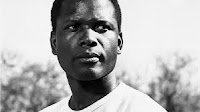
Sidney Poitier in Lilies of the
Field

February is Black History Month. In honour of that occasion, every Sunday night during the month Professor Jacqueline Stewart and special guests will host films celebrating Black History on Turner Classic Movies. The movies range from the documentary Oscar Micheaux: The Superhero of Black Filmmaking (2021), which deals with the legendary filmmaker's career, to the classic Lilies of the Field (1963), starring Sir Sidney Poitier. Also among the films airing on the classic musical Stormy Weather (1943), featuring an incredible dance sequence with the Nicholas Brothers, Selma (2014), Ava Duvernay's film about the Selma-to-Montgomery voting rights march, Oscar Micheaux's Silent classic Within Our Gates (1920), and Agnes Varda's documentary Black Panthers (1968).

The special guests who will host movies alongside Professor Stewart are Dr. Samantha Sheppard, Associate Professor of Cinema and Media Studies in the Department of Performing and Media Arts at Cornell University, Dr. Racquel Gates, Associate Professor of Film at Columbia University, and actor David Oyelowo, who played Dr. Martin Luther King Jr. in the movie Selma.

Below is a schedule of the films showing during TCM's Black History Month celebration. All times are Central.

Sunday, February 6
8:00 Lilies of the Field (1963) with Dr. Samantha Sheppard
10:00 PM: Freedom on My Mind (1994) with Dr. Samantha Sheppard
12:15 AM: Ten Nights in a Barroom (1926) with Dr. Samantha Sheppard

Sunday, February 13
8:00 PM: Stormy Weather (1943) with Dr. Racquel Gates
9:30 PM: Oscar Micheaux: The Superhero of Black Filmmaking (2021) with Dr. Racquel Gates
11:00 PM: Within Our Gates (1920) with Dr. Racquel Gates
12:30 AM: The Symbol of the Unconquered (1922) with Dr. Racquel Gates

Sunday, February 20
8:00 PM: Selma (2014) with David Oyelowo
10:30 PM: Crisis: Behind a Presidential Commitment (1963) with David Oyelowo
12:00 AM: Body and Soul (1925) with Dr. Racquel Gates

Sunday, February 27
8:00 PM: Malcolm X (1992) with David Oyelowo
11:30 PM: Black Panthers (1968) with David Oyelowo
12:15 AM: The Scar of Shame (1929) with Dr. Samantha Sheppard

Friday, January 28, 2022

It's Not You, It's Me--Breakup Classics on TCM on Monday Nights in February

Irene Dunne, Skippy, and
Cary Grant from The Awful
Truth

February is the month of St. Valentine's Day. Given that fact, it might seem odd that Turner Classic Movies is dedicating Monday nights during the month to movies about break-ups. It might not seem so odd when one considers that there are those who don't particularly appreciate St. Valentine's Day because they are single or they have broken up with their sweetheart, not to mention there are many out there who simply enjoy a good movie about the dissolution of a relationship. Regardless, TCM has a particularly fine line-up of movies centred on break-ups.

The movies on  It's Not You It's Me--Breakup Classics are each devoted to a different category. There are Pre-Code Heartbreakers, such as The Divorcee (1930) starring Norma Shearer.  Knowing Me, Knowing You, to which  The Way We Were (1973) belongs. Teenage Tearjerkers, of which Splendour in the Grass (1961) is one, The best known of the movies in  Slow Burns, is the classic Casablanca (1942). And then there is Divorce Remorse, which includes The Awful Truth (1937).

TCM is showing some truly great films for It's Not Me, It's You--Breakup Classics. If you have not seen The Divorcee, by all means you should. And while I do not consider Brief Encounter to be romantic the way many classic film buffs do, it is a very fine film. I also have to recommend Casablanca, which is one of my top five films of all time. February 28 may well be the best night of It's Not Me, It's You--Breakup Classics, featuring as it does The Awful Truth, Divorce American Style, and Adam's Rib.

Below is a schedule of the films airing on Monday nights as part of It's Not Me, It's You--Break Up Classics. All times are Central.

Monday, February 7
7:00 PM The Divorcee (1930)
8:30 PM Goodbye Again (1933)
9:45 Forsaking All Others (1934)
11:15 PM Indiscretion of an American Wife (1954)
12:30 AM  That Uncertain Feeling (1941)
2:00 AM And So They Were Married (1936)

Monday, February 14
7:00 PM The Way We Were (1973)
9:15 PM Brief Encounter (1945)
10:45 PM Kramer vs. Kramer (1979)
1:00 AM Doctor Zhivago (1965)

Monday, February 21
7:00 PM Splendour in the Grass (1961)
9:30 PM A Summer Place (1959)
11:45 PM Casablanca (1942)
1:45 AM Love on the Run (1979)
3:30 AM Scenes from a Marriage (1973)

Monday, February 27
7:00 PM The Awful Truth (1937)
9:00 PM Blume in Love (1973)
11:15 PM Divorce American Style (1967)
1:15 AM Marriage on the Rocks (1965)
3:15 AM Adam's Rib (1949)

Thursday, January 27, 2022

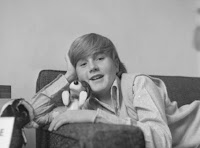
Peter Robbins, the Original Voice of Charlie Brown, Passes On

Peter Robbins, who as the voice of Charlie Brown in the first six Charlie Brown special, was found dead last week from an apparent suicide. He was 65 years old.

Peter Robbins was born Louis Nanasi in Los Angeles on August 10 1956. He started acting when he was only 7 years old. He made his film debut in the film A Ticklish Affair in 1963. The following he made his television debut in an episode of Rawhide. He went on to guest star on the TV shows The Donna Reed Show, The Munsters, The Farmer's Daughter, and The Joey Bishop Show.

Peter Robbins first voiced Charlie Brown in animated segments of the unreleased documentary A Boy Named Charlie Brown (not to be confused with the later feature film of the same name). After wards he voiced the character in the first Charlie Brown special A Charlie Brown Christmas. He continued to voice Charlie Brown until 1969, his final special being It Was a Short Summer, Charlie Brown. He also provided the voice of Charlie Brown in the first Charlie Brown feature film, A Boy Named Charlie Brown (1969). He also played Alexander Bumstead in the short-lived sitcom Blondie.

Peter Robbins also appeared in the movies Moment to Moment  (1966), And Now Miguel (1966), Good Times (1967), and The Boatniks (1970). He guest starred on the shows Love on a Rooftop, ABC Stage 67, The F.B.I., F Troop, Get Smart, and Bracken's World. His last appearance was in an episode of My Three Sons in 1972.

While he had a successful career as a child actor, sadly Peter Robbins struggled with his mental health as an adult. He suffered from both bipolar disorder and paranoid schizophrenia. This led to occasional run-ins with the law. In 2019 he told KSWB in San Diego in an interview, “I would recommend to anybody that has bipolar disorder to take it seriously because your life can turn around in the span of a month, like it did to me.”

When many people think of Charlie Brown , it is Peter Robbins's choice they hear in their head. And this is with good reason. Peter Robbins was prefect as the character. While others have voiced the character over the years, no one did it better.

Wednesday, January 26, 2022

Godspeed Don Wilson of The Ventures

Don Wilson, the rhythm guitarist who co-founded The Ventures died at age 88 on January 22 2022.

Don Wilson was born in Tacoma, Washington on February 10 1933. When he was young he was a fan of country music-and-western music and big band music. He stated out playing the trombone, but switched to the guitar when he was the United States Army. He worked as a car salesman and a construction worker before he co-founded a band called The Versatones with lead guitarist Bob Bogle in the late Fifties. Finding that the name was already taken, the band was renamed The Ventures in 1959.

The Ventures' first single, "Cookies and Coke," was released in 1960, but did not chart. That same year their second single, "Walk, Don't Run" was released. It ultimately went to no. 2 on the Billboard Hot 100. The album of the same title, peaked at no. 11 on the Billboard album chart. Throughout the Sixties The Ventures would have several single reach the Hot 100, and they would have another huge hit with their cover of the theme to the television show Hawaii Five-O, which went to no. 4 on the Hot 100. Their albums also did well, often peaking in the upper reaches of the Billboard album chart.

With the advent of the Seventies, The Ventures' fortunes changed and neither their singles nor their albums were charting. It was with the eighties that the band experienced something of a resurgence, with punk and New Wave bands acknowledging their influence. While The Ventures experienced changes in membership over the years, Don Wilson remained with the group until he retired in 2015.

As The Ventures' rhythm guitarist and the band's most constant member, Don Wilson was very important to the group's sound. He was one of the best rhythm guitarist in rock music, with a style that was direct and powerful and nunlike anyone else. It was largely because of Don Wilson's rhythm guitar that The Ventures became the most successful instrumental group of all time. In 1963 they had five albums at once on the Billboard album chart. The Ventures were certainly influential. They technically pre-dated surf rock and they did not consider themselves a surf rock band, but they had a huge impact on the subgenre nonetheless. They also had an impact on power pop, punk, and New Wave, as well as guitar groups in general. They pioneered both flanging and fuzz guitar. They ultimately had an impact on  bands as diverse as The Beach Boys and Kiss. In the end, Don Wilson was one of the most influential rock musicians of all time.

Friday, January 21, 2022

The Jokers (1967)

 (This post is part of the Odd or Even Blogathon hosted by Reelweegiemidget Reviews and Taking Up Room)

Heist movies (movies about the planning and execution of robberies) emerged in the Fifties with such films as The Asphalt Jungle (1950) and Armoured Car Robbery (1950). Most of the early heist films tended to be serious in tone, but by the Sixties many heist movies elected to follow the lead of the comedies The Lavender Hill Mob (1951) and The Ladykillers (1955). Such heist films done with a comedic tone are known as "caper movies." If there was Golden Age for caper movies, it was likely the Sixties. The decade saw the release of such caper movies as Topkapi (1964), How to Steal a Million (1966), Who's Minding the Mint (1967), and The Italian Job (1969). Among the many caper films released during the Sixties was The Jokers (1967). Although not as well remembered as some of the caper films of the era, there is every reason it should be.

The Jokers centres on the brothers Michael (Michael Crawford) and David Tremayne (Oliver Reed). The two of them are dissatisfied with their lives and long for recognition, even though they don't want to work for it. The two of them then decide to commit a crime as a sort of "grand gesture" that will bring them fame. Realizing that one can't be charged with theft unless they mean to permanently deprive an owner of their property, Michael and David set their sights on robbing the British crown jewels and then returning them.

The Jokers was directed by Michael Winner and based on a story by Michael Winner, with a screenplay by Ben Arbeid and Maurice Foster. In the mid-Sixties Winner was on a bit of a roll. His two movies before The Jokers were The System (1964) and You Must Be Joking! (1965). He would follow The Jokers up with I'll Never Forget What's'isname (1967). He would go onto such films as Death Wish (1974). Sadly, while Michael Winner displayed some talent as a director during his career, it seems that he was not a particularly nice guy. Following his death, in October 2017, three different women accused him of demanding that they show him their breasts. In 2019 actress  Marina Sirtis intimated that she had been abused by Winner.

Winner was not the only person working on The Jokers who was on a bit of a roll in the Sixties. Although now best known for the musical The Phantom of the Opera, in the Sixties Michael Crawford established himself with roles in such films as The War Lover (1962), The Knack …and How to Get It (1965), and A Funny Thing Happened on the Way to the Forum  (1966). By the time he appeared in The Jokers, Oliver Reed could already be considered to be a big name. He established himself with several Hammer Films, among them The Curse of the Werewolf (1961), The Pirates of Blood River (1962), and Captain Clegg (1962). He also appeared in The System. Much of the rest of the cast of The Jokers is notable as well. James Donald, who plays Colonel Gurney-Simms, will be recognized by viewers from such movies as Bridge on the River Kwai (1957) and The Great Escape (1963). Rachel Kempson, who had appeared in such films as Tom Jones (1963) and Georgy Girl (1966), played Michael and David's mother. British actor Peter Graves, who appeared in the films Give Us the Moon (1944), I'll Be Your Sweetheart (1945), and Alfie (1966), played their father.

The Jokers was shot on location in London, with many of the city's best known tourist spots appearing in the film. Among the locations in the film are the Albert Memorial, the London Zoo, the Stock Exchange, Piccadilly Circus, the Old Bailey, and the Tower of London. In shooting The Jokers, Michael Winner would cause some problems for directors wanting to film in London in the future. A smoke bomb was set off during a scene shot at Piccadilly Circus, resulting in chaos around the area. Worse yet, Michael Winner took off in a taxi and left other crew members to be arrested. Because of this incident no movies were allowed to be filmed in Piccadilly Circus until An American Werewolf in London (1981).

The Jokers premiered in New York City on May 15 1967 in New York City. It premiered in London on June 15 1967. It received largely positive reviews. Seen today The Jokers still holds up. For fans of Swinging London, the film offers a great look at many of the famous locations in the city at that particular time. As a caper film it features a particularly original heist. Indeed, while many caper movies see a team assembled for the robbery, in The Jokers it is only the Tremayne brothers who pull it off. As a comedy it is a funny send-up of the British aristocracy, media overkill, and even Swinging London itself.

Wednesday, January 19, 2022

Godspeed Yvette Mimieux

Yvette Mimieux, who appeared in the movies The Time Machine (1960), Where the Boys Are (1960), and The Light in the Piazza (1962), died on January 17 2022 at the age of 80.

Yvette Mimieux was born on January 8 1942 in Los Angeles. Prior to her acting career Miss Mimieux had done some professional modelling. She was only 15 when publicist Jim Byron discovered her on a Hollywood Hills bridle path. She took classes in singing and dancing, and she also acted in local theatre before she was signed by MGM in 1959.

Yvette Mimieux made her television debut in an episode of Yancy Derringer in 1959. In 1960 she guest starred on One Step Beyond and Mr. Lucky. Her first credited role in a film was in Platinum High School in 1960. That same year she appeared in her breakout role as Weena in The Time Machine (1960). She followed it with the movie Where the Boys Are (1960).

Yvette Mimieux began the Sixties with the movie The Light in the Piazza (1962). During the decade she appeared in the films The Four Horsemen of the Apocalypse (1962), The Wonderful World of the Brothers Grimm (1962), Diamond Head (1962), Toys in the Attic (1963), Looking for Love (1964), Joy in the Morning (1965), The Reward (1965), Monkeys, Go Home! (1967), The Caper of the Golden Bulls (1967), The Mercenaries (1968), Three in the Attic (1968), The Picasso Summer (1969), and The Delta Factor (1970). On television she guest starred on Dr. Kildare and appeared in the TV movie The Desperate Hours. In the 1970-1971 season she was part of the cast of the short-lived series The Most Deadly Game.

During the Seventies Yvette Mimieux appeared in the movies Skyjacked (1972), The Neptune Factor (1973), Journey into Fear (1975), Jackson County Jail (1976), and The Black Hole (1979). On television she appeared in the TV movies Death Takes Holiday; Black Noon; Hit Lady; The Legend of Valentino; Bell, Book and Candle; Snowbeast; Ransom for Alice; Outside Chance; Devil Dog: The Hound of Hell; and Disaster on the Coastliner.

In the Eighties Yvette Mimieux was a regular on the short-lived show Berrenger's. She guest starred on the shows The Love Boat and Lime Street. She appeared in the movies Forbidden Law, Night Partners, Obsessive Love, The Fifth Missile, and Perry Mason: The Case of the Desperate Deception. In 1992 She appeared in the TV movie Lady Boss.

I sometimes think Yvette Mimieux was underrated as an actress. She gave an incredible performance in Where the Boys Are as Melanie, whose story took a turn to the tragic. She also did well as Olivia de Havilland's mentally disabled daughter in The Light in the Piazza. Even in her lesser known films, such as Three in the Attic and The Picasso Summer, she could be impressive. Yvette Mimieux's appearance has often been commented on, but I think her talent was much, much more remarkable.

Monday, January 17, 2022

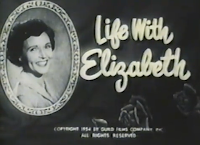
Life with Elizabeth Starring Betty White

Today would have been the 100th birthday of Betty White. She was not simply a beloved actress and comedian whose career spanned 80 years, but also a true television pioneer. It was in 1951 that she appeared in her first sitcom, Life with Elizabeth. She was not only the star of the show, but she was also one of its producers. This made Betty White one of the first women to ever produce a sitcom in American television. Life with Elizabeth would prove to be a groundbreaking show in other ways as well.

Life with Elizabeth centred on a married couple named Elizabeth (Betty White) and Alvin (Del Moore). Elizabeth was a mischievous sort and would often find herself in various misadventures. Usually after one of Elizabeth's various bits of mischief, announcer Jack Narz would ask her, "Elizabeth, aren't you ashamed?" Elizabeth would shake her head, before an impish grin would emerge on her face, showing that she was not ashamed at all. Each episode was divided into three plots, referred to as "incidents," of eight to ten minutes each.

Life with Elizabeth originated as a series of sketches on the talk and variety show Hollywood on Television that aired on KLAC in Los Angeles. The sketches featured Betty White as Elizabeth and her fellow host Al Jarvis as Alvin. Al Jarvis would leave Hollywood on Television in 1951 to be be replaced by Eddie Albert. Eddie Albert would leave after six months when he took another job. It was then in 1951 KLAC station manager Don Fedderson decided to spin-off the Elizabeth and Alvin sketches into their own show. Betty White, George Tibbles (who had been Betty's accompanist on Hollywood on Television), and Don Fedderson formed Bandy Productions to produce the new show.

Initially Life with Elizabeth aired live on KLAC on Saturday night at 8:30 PM Pacific. The show certainly attracted attention, with Betty White receiving the Emmy for Best Actress in 1951. Despite this, Life with Elizabeth was not picked up by any of the networks. While the networks did not pick  up Life with Elizabeth, distribution and production company Guild Films approached Betty White, George Tibbles, and Don Fedderson about launching Life with Elizabeth into nationwide syndication. Ultimately, Bandy Productions and Guild Films entered into an agreement that would bring Life with Elizabeth to the entire United States.

While Life with Elizabeth aired live in front of a studio audience at KLAC, the syndicated version of Life with Elizabeth would be filmed with a single camera. These episodes would then be shown in front of an audience, whose reactions would then be recorded. In this way the episodes of Life with Elizabeth would feature the genuine laughter of an audience rather than a laugh track. Life with Elizabeth proved attractive to television stations, with 27 stations signing up to air the series.

Life with Elizabeth entered syndication in the fall of 1953. It ended its run in 1955 and after 65 episodes. While the show was still popular, Guild Films thought ending the show while it was still popular would help maximize profits for the existing episodes. The show would  be rerun on local stations for years to come.

Although largely forgotten today, Life with Elizabeth was a pioneering sitcom. It certainly gave Betty White her first national exposure and thus launched her long career. As Betty White as also a co-producer on the show, with Life with Elizabeth she also became one of the first women in television to produce a show. Indeed, Betty had nearly total creative control over the show, something that was unusual in the early Fifties. Life with Elizabeth was also groundbreaking in breaking with the standard sitcom format, well-established on radio even before the first television sitcoms aired. Being divided into three "incidents" per show, it was a sharp contrast to such contemporary sitcoms as I Love Lucy and My Little Margie, which concentrated on one plot per episode.

Life with Elizabeth was also the first nationwide show produced by Don Fedderson, who would o onto a long career in television. He would also produce Betty White's next sitcom, Date with the Angels. He would go onto produce such shows as The Millionaire, My Three Sons, and Family Affair, .

Life with Elizabeth deserves to be better known than it is. It is a very funny show, demonstrating that Betty White had wit and comic timing from the very beginning. And it is every bit as much a pioneering sitcom as I Love Lucy is. Episodes of Life with Elizabeth are readily available on various streaming services as well as the Internet Archive. Anyone who loves Betty White, 1950s sitcoms, or classic television is encouraged to check it out.