If there is one drawback to Turner Classic Movies' Summer Under the
Stars in August, it is that Noir
Alley is pre-empted for the whole month. Fortunately there is
usually plenty of film noir to be seeing during Summer Under the Stars,
and this year is no exception. Below is a schedule of the film noirs and neo-noirs
airing next month on Summer Under the Stars.
Tuesday, August 3: Kim Novak
12:45 PM Pushover (1954)
Friday, August 6: Robert Mitchum
6:30 AM The Big Steal (1949)
11:30 AM Angel Face (1953)
1:15 PM Where Danger Lives (1950)
7:00 PM Out of the Past (1947)
9:00 PM Farewell, My Lovely (1975)
Monday, August 16: Robert Young
1:00 AM They Won't Believe Me (1947) (technically the morning of August
17)
Tuesday, August 17: Gloria Grahame
9:30 AM A Woman's Secret (1949)
1:15 PM The Good Die Young (1954)
3:00 PM Odds Against Tomorrow (1959)
7:00 PM The Big Heat (1953)
9:00 PM In a Lonely Place (1950)
11:00 PM Crossfire (1947)
Friday, August 20: Van Heflin
11:00 PM Act of Violence (1949)
12:30 PM The Strange Love of Martha Ivers (1946)
7:00 PM Johnny Eager (1941)
Sunday, August 22: Tyrone Power
11:15 PM Nightmare Alley (1947)
Monday, August 23: Eve Arden
1:30 PM The Unfaithful (1947)
3:30 PM Whiplash (1948)
8:45 PM Mildred Pierce (1945)
Sunday, August 28: Lee Marvin
5:00 AM I Died a Thousand Times (1955)
7:00 PM Point Blank (1967)
Monday, August 30: James Cagney
3:00 PM White Heat (1949)
Saturday, July 24, 2021
Thursday, July 22, 2021
TCM's Summer Under the Stars 2021
Ever since 2003 Turner Classic Movies has devoted the month of August to the programming block known as Summer Under the Stars. From August 1 to August 31, each day is devoted to the films of a single star. For many TCM fans, Summer Under the Stars is the programming block to which they look forward the most. I must admit I look forward to it every year, although I must also admit I miss seeing Noir Alley this week!
As usual, this year's Summer Under the Stars features days dedicated to top name stars as well as some lesser known ones. For whatever reason this year's Summer Under the Stars schedule didn't denote which stars are being featured on Summer Under the Stars for the first time. That having been said, I think they could be Louis Armstrong, Margaret Rutherford, George Segal, and Setsuko Hara. Of course, there are plenty of big names featured this year, including Bette Davis, Robert Mitchum, Abbott & Costello, Kay Francis, Gregory Peck, Judy Garland, Gloria Grahame, Katharine Hepburn, Eve Arden, Tony Randall, Ingrid Bergman, and James Cagney, among others.
With regards to this year's schedule, I probably would have placed some movies in different times and for some stars I would have probably included different movies. That having been said, my only major complaint is with Robert Redford's day on August 18. For the life of me, I don't understand why Out of Africa (1985) is at 7:00 PM and Butch Cassidy and the Sundance Kid (1969) isn't on until 10:00 PM. The latter movie is not only far better than the former movie, it is far more popular as well.
Below are my picks for each day as to the movies you really don't want to miss. All times are Central.
August 1: Bette Davis
5:00 AM Marked Woman (1937)
9:00 AM The Corn is Green (1945)
11:30 AM What Ever Happened to Baby Jane? (1962)
August 2: Richard Burton
6:45 AM Look Back in Anger (1949)
4:15 PM Where Eagles Dare (1968)
7:00 PM Anne of the Thousand Days (1969)
August 3: Kim Novak
10:30 AM Kiss Me, Stupid (1964)
12:45 PM The Notorious Landlady (1962)
5:00 PM Picnic (1955)
7:00 PM Bell, Book and Candle (1958)
10:15 PM Vertigo (1958)
August 4: Louis Armstrong
5:00 AM New Orleans (1948)
9:30 AM Cabin in the Sky (1943)
11:00 AM High Society (1956)
August 5: Margaret Rutherford
10:15 AM The Importance of Being Earnest (1952)
2:00 PM The V.I.P.s (1963)
5:30 PM The Mouse on the Moon (1963)
7:00 PM Murder She Said (1963)
8:45 PM Murder at the Gallop (1963)
10:15 PM Murder Most Foul (1964)
12:00 AM Murder Ahoy (1964)
August 6: Robert Mitchum
6:30 AM The Big Steal (1949)
1:15 PM Where Danger Lives (1950)
7:00 PM Out of the Past (1947)
August 7: Abbott & Costello
3:30 PM The Time of Their Lives (1946)
5:15 PM Buck Privates (1941)
7:00 PM Abbott & Costello Meet Frankenstein (1948)
August 8: Esther Williams
9:00 AM Neptune's Daughter (1955)
5:00 PM Million Dollar Mermaid (1952)
August 9: Kay Francis
6:15 AM Man Wanted (1932)
10:00 AM Mandalay (1934)
7:00 PM One Way Passage (1935)
August 10: George Segal
7:00 AM Act One (1963)
11:00 PM Blume in Love (1973)
3:00 PM Bye, Bye Braverman (1968)
7:00 PM King Rat (1965)
August 11: Kathryn Grayson
7:00 PM Kiss Me Kate (1953)
9:00 PM Show Boat (1951) 11:00 PM Lovely Look At (1952)
August 12: Ramon Novarro
5:00 PM The Student Prince in Old Heidelberg (1927)
7:00 PM Ben Hur (1925)
August 13: Jane Fonda
9:15 AM Period of Adjustment (1962)
11:15 PM Any Wednesday (1966)
5:00 PM Sunday in New York (1963)
11:30 PM Barbarella (1968)
August 14: Gregory Peck
12:00 PM Captain Horatio Hornblower (1951)
10:00 PM The Man in the Grey Flannel Suit (1956)
12:45 AM The Omen (1976)
August 15: Judy Garland
1:30 PM Meet Me in St. Louis (1944)
3:45 PM A Star is Born (1954)
7:00 PM Summer Stock (1950)
3:00 AM In the Good Old Summertime (1949)
August 15: Robert Young
1:00 AM They Won't Believe Me (1947)
August 17: Gloria Grahame
5:00 PM Human Desire (1954)
7:00 PM The Big Heat (1953)
9:00 PM In a Lonely Place (1950)
11:00 PM Crossfire (1947)
August 18: Robert Redford
10:00 PM Butch Cassidy and the Sundance Kid (1969)
August 19: Setsuko Hara
12:30 Late Autumn (1960)
7:00 PM Late Spring (1949)
11:15 PM Tokyo Story (1953)
August 20: Van Heflin
11:00 PM Act of Violence (1949)
12:30 PM The Strange Love of Martha Ivers (1946)
7:00 PM Johnny Eager (1942)
August 21: Katharine Hepburn
11:15 PM Bringing Up Baby (1938)
11:15 PM The Lion in Winter (1968)
August 22: Tyrone Power
2:00 PM The Razor's Edge (1940)
9:15 PM The Mark of Zorro (1940)
11:15 PM Nightmare Alley (1947)
August 23: Eve Arden
5:00 AM Stage Door (1937)
7:00 PM Our Miss Brooks (1956)
8:45 PM Mildred Pierce (1945)
10:45 PM Anatomy of a Murder (1959)
August 24: Maurice Chevalier
10:00 AM Love in the Afternoon (1957)
August 25: Jane Wyman
8:30 AM Brother Rat (1938)
3:00 PM Stage Fright (1950)
7:00 PM Johnny Belinda (1949)
11:00 PM The Yearling (1946)
August 26: Tony Randall
8:45 AM Boys' Night Out (1962)
11:00 PM Pillow Talk (1959)
1:00 PM Lover Come Back (1961)
3:00 PM Send Me No Flowers (1964)
7:00 PM The 7 Faces of Dr. Lao (1964)
11:00 PM Will Success Spoil Rock Hunter? (1957)
August 27: Merle Oberon
5:00 AM The Scarlet Pimpernel (1934)
7:00 PM Wuthering Heights (1939)
August 28: Lee Marvin
12:30 PM The Wild One (1953)
2:15 PM Cat Ballou (1965)
4:15 PM The Dirty Dozen (1967)
August 29: Ingrid Bergman
2:45 PM Gaslight (1944)
5:00 PM Casablanca (1942)
7:00 PM Anastasia (1956)
August 30: James Cagney
3:00 PM White Heat (1949)
7:00 PM Footlight Parade (1934)
11:15 PM Yankee Doodle Dandy (1942)
August 31: Fredric March
5:00 AM Nothing Sacred (1937)
8:30 AM The Barretts of Wimpole Street (1934)
5:00 PM Dr. Jekyll and Mr. Hyde (1932)
7:00 PM The Best Years of Our Lives (1946)
11:45 PM I Married a Witch (1942)
1:15 AM A Star is Born (1937)
Wednesday, July 21, 2021
The Late Great William F. Nolan
Writer William F. Nolan, best known for co-writing the novel Logan's Run with George Clayton Johnson and a wide variety of other works, died on July 15 2021 at the age of 93.
William F. Nolan was born on March 6 1928 in Kansas City, Missouri. As a child, he was an avid reader of comic books, pulp magazines, and books, and he loved movies. He attended the Kansas City Art Institute and worked for Hallmark Cards for a time. Not long after World War II, his family moved to Chula Vista, California. It was after he had been in Los Angeles for a time that he discovered the works of Ray Bradbury. He sought Mr. Bradbury out and befriended him. Their friendship eventually led Mr. Nolan to put out his first book, The Ray Bradbury Review. William F. Nolan was an artist for a time before going into writing. He made his first sale of a short story, "The Darendinger Build-Up," to Playboy. It appeared in the June 1956 issue of the magazine. His short stories would be published in a variety of magazines and anthology books.
William F. Nolan's first novel was Logan's Run, co-written with this friend George Clayton Johnson. Published in 1967, the novel was loosely adapted as the movie Logan's Run (1977). It was followed by two sequel novels (Logan's World and Logan's Search), the novella Logan's Return, and two unpublished sequels. He also wrote four hard-boiled detective novels centred on private eye Bart Challis. His Sam Space series combined the science fiction and hard-boiled detective novel. Mr. Nolan also wrote a series centred on paranormal investigator Kincaid. His series of "Black Mask Boys" mysteries featured Dashiell Hammett, Raymond Chandler, and Erle Stanley Gardner.
William F. Nolan also wrote a number of books on Ray Bradbury, Max Brand, and Dashiell Hammett, as well as biographies on Barney Oldfield, Phil Hill, John Huston, Steve McQueen, and Ernest Hemingway.>br />
William F. Nolan also worked in television. He wrote episodes of the shows Wanted Dead or Alive, Norman Corwin Presents, Darkroom, and 240-Robert. He wrote the TV movies The Norliss Tapes, Melvin Purvis G--MAN, The Turn of the Screw, Sky Heist, The Kansas City Massacre, and Bridge Across Time. He also wrote the teleplays for two of the three stories featured in the classic TV movie Trilogy of Terror, based on the works of Richard Matheson. With regards to feature films, he wrote the screenplay for Burnt Offerings (1976).
William F. Nolan was certainly a remarkable writer. Logan's Run has certainly made an impact on popular culture. That having been said, he wrote many other works and was nothing if not prolific. His works spanned everything from science fiction to horror to hard-boiled detective fiction to non-fiction. He certainly made lasting contributions to literature.
Tuesday, July 20, 2021
Godspeed Charlie Robinson
Charlie Robinson, who played the level-headed clerk Mac on Night Court and appeared in such movies as Sugar Hill (1974), died on July 11 2021 at the age of 75. The cause was a heart attack with organ failure brought on by septic shock and metastatic adenocarcinoma.
Charlie Robinson was born on November 9 1945 in Houston, Texas. When he was a teenager he sang with the Houston based R&B group Archie Bell and The Drells and afterwards a group called Southern Clouds of Joy. Mr. Robinson served in the Army and briefly attended the University of Houston. In the late Sixties, he studied acting at Studio 7, an acting school ran by Chris Wilson at the Houston Music Theatre. He later moved to Los Angeles where he joined the Actors Studio.
Charlie Robinson made his television debut in an episode of Owen Marshall, Counsellor at Law in 1971. In the Seventies he guest starred on such shows as Firehouse, Carbie, Cannon, The White Shadow, and Lou Grant. He appeared in the mini-series King and Roots: The Next Generation. He appeared in the TV movies Set This Town on Fire, Nowhere to Hide, A Killing Affair, Buffalo Soldiers, and Haywire. He made his film debut in Drive, He Said in 1971. He appeared in the movies Sugar Hill (1974), The Black Gestapo (1975), Gray Lady Down (1978), and Apocalypse Now (1979).
It was in 1984, during the second season of Night Court, that Charlie Robinson began played the character of Mac, the easy-going, sensible court clerk. He played Mac for the rest of the show's run. He was also a regular on the shows Flamingo Road and Buffalo Bill. He guest starred on the shows Hill Street Blues, St. Elsewhere and Hotel. He appeared in the TV movies Rehearsal for Murder, Crash Course, and Murder C.O.D. He appeared in the movie The River (1984).
In the Nineties Charlie Robinson was a regular on Love & War, Ink, Home Improvement, and Buddy Faro. He guest starred on the shows CBS Schoolbreak Special, The Fresh Prince of Bel-Air, The John Laroquette Show, In the House, The Crew, Malcolm & Eddie, and Touched by an Angel. He appeared in the TV movies Project: ALF and The Last Dance. He appeared in the movies Set It Off (1996), Land of the Free (1998), Malevolence (1999), Beowulf (1999), and The Playaz Court (2000).
In the Naughts Mr. Robinson had a recurring role on the TV show The Game. He guest starred on the shows Soul Food; First Years; Two Guys, a Girl and a Pizza Place; DAG; The Trouble with Normal; My Wife and Kids; Miss Lettie and Me; Yes, Dear; Abby; Andy Richter Controls the Universe; Carnivàle; The Bernie Mac Show; Committed; Charmed; House M.D.; Cold Case; Still Standing; How I Met Your Mother; The Riches; My Name is Earl; 30 Rock; Big Love; Hank; The Secret Life of the American Teenager; and $#*! My Dad Says. He appeared in the movies Antwone Fisher (2002), Break a Leg (2005), River's End (2005), Easy Money (2006), Mercy Street (2006), Stream (2007), The House Bunny (2008), Jackson (2008), Natural Disasters (2008), and Krews (2010).
In the Teens Charlie Robinson had recurring roles on the TV shows Hart of Dixie, The Guest Book, Mom, and Love in Time of Corona. He guest starred on the shows Harry's Law, The Soul Man, Key and Peele, Reed Between the Lines, Grey's Anatomy, K.C. Undercover, Disjointed, This is Us, NCIS, Better Things, Raven's Home, and Russell Maniac. He appeared in the movies Light, Streets of Redemption (2011), Falling Away (2012), Hoovey (2015), Russell Madness (2015), Sweet Kandy (2015), Heaven Sent (2015), Pee-Wee's Big Holiday (2016), Maybe Someday (2017), and Blindfire (2020).
Charlie Robinson appeared in recurring roles on multiple shows, and there should be no surprise why he was. He was just such a very good actor. As Mac on Night Court he was the show's one practical character among a cast of zany ones, the show's calm centre. On Buffalo Bill he was the brutally honest makeup man Newdell, who tried to keep the show's title character in line. In Sugar Hill he played a character about as far as Mac or Newdell as one can get, the gangster Fabulous, whose tastes in clothing leave a bit to be desired. Throughout his career Charlie Robinson played a wide variety of roles, from law enforcement officers to members of the military to judges. What is more, he did all of them well.
Friday, July 16, 2021
Saturday Morning Musical Kid's Shows of the 1960s and 1970s Part Five
In 1968 The Banana Splits Adventure Hour and The Archie Show, two kid's shows in which music played a large role, debuted on Saturday morning on the American broadcast networks. The two shows proved to be huge hits and as a result sparked an entire cycle towards musical, Saturday morning, kid's shows. The cycle peaked in the 1970-1971 season, with no less than six such shows debuting. By the 1973-1974 season the cycle was very nearly over. Signs that the cycle had been in decline were apparent as early as the 1971-1972 season, when Archie's TV Funnies became the first Archie project in which music did not play a role. It was also in the 1971-1972 that a musical cartoon debuted (The Pebbles and Bamm-Bamm Show) in which none of the songs were released as singles or on albums. Regardless, two new musical cartoons debuted in the 1973-1974 season.
The first of the shows to debut was another Hanna-Barbera cartoon inspired by Scooby-Doo, Where Are You!. Butch Cassidy and the Sun Dance Kids centred on the rock group of that name, who also happened to be government agents. They reported to a self-aware supercomputer named Mr. Socrates. Whereas Scooby-Doo, Where Are You! focused on supernatural mysteries, Butch Cassidy and the Sun Dance Kids focused on various thefts and espionage-style adventures.
Two singles from the show, "Little Miss Magic" and "Rosie was a Good Old Girl," were released on the Romar label under the name "The Sun Dance Kids Featuring Butch Cassidy." That was the extent of The Sun Dance Kid's record releases, as no album was ever released.
Butch Cassidy and the Sun Dance Kids debuted on NBC on September 8 1973. It did not prove to be a success, as it lasted only one season.
The second of the shows to debut in the 1973-1974 season utilized the talents of an existing pop star, Rick Springfield. Mission: Magic! was a spin-off of The Brady Kids.The second season episode of The Brady Kids, "Teacher's Pet," introduced the character of teacher Miss Tickle, who played the central role in Mission: Magic!. On Misson: Magic! Miss Tickle was in charge of an after-school club called The Adventurers Club. Each week Rick Springfield would get in touch with Miss Tickle and The Adventurers Club through a gramophone. Miss Tickle would then create a magic portal by drawing a door on the blackboard. Miss Tickle and The Adventurers Club would then pass through the portal into some fantasy realm. There they would meet up with Rick Springfield and all of them would go on an adventure. Each episode Rick Springfield sang one of his songs.
Rick Springfield's third solo album, Mission: Magic!, was released in association with the show, although it was only released in his native Australia. As to the show Mission: Magic! itself, it did not prove successful. It only aired for one season on ABC.
Here it is worth mentioning a bit of interstitial programming that had debuted on January 6 1973. Schoolhouse Rock! featured songs teaching grammar, science, economics, history, mathematics, and civics.The interstitials proved very successful, running for seven seasons. Since then the series has been revived a few times.
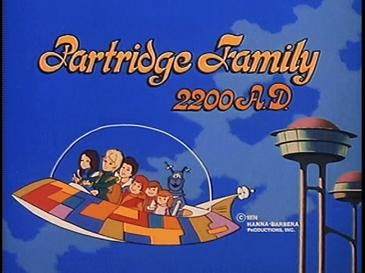
If the 1973-1974 season cannot be counted as the end of the cycle towards musical kid's show, the 1974-1975 season certainly could, with only one musical cartoon debuting. That show owed its existence to the success of The Pebbles and Bamm-Bamm Show. Seeing the success of The Pebbles and Bamm-Bamm Show, Hanna-Barbera decided to do a revival of The Jetsons featuring a grown-up Judy, who was now a reporter, and a teenage Elroy. Hanna-Barbera took this idea to Fred Silverman at CBS, who suggested instead that they do a futuristic show featuring The Partridge Family as well.
Today Fred Silverman's suggestion might seem odd, particularly give The Partridge Family ended its run in 1974. That having been said, the latest trend in Saturday morning cartoons at the time was the revival of primetime television show as cartoons. Among these shows were Jeannie (inspired by I Dream of Jeannie), My Favorite Martians (a continuation of My Favorite Martian), Emergency+4 (a Saturday morning version of the primetime show Emergency!), and Star Trek. Making it even less strange that Fred Silverman would suggest a show based around the Partridge Family is the fact that they had appeared in several episodes of Goober and the Ghost Chasers (another take-off on Scooby-Doo, Where Are You!) in the prior season.
Partridge Family 2200 A.D. found the Partridge Family in the 23rd Century with no explanation. Danny Bonaduce, Suzanne Crough, and Brian Forster all voiced their characters from the original show. Susan Dey only voiced Laurie Partridge for two episodes before Sherry Alberoni took over the role . The characters of mother Shirley and oldest brother Keith were voiced by Joan Gerber and Chuck McLenan respectively. Their manager, Reuben Kinkaid did not appear on the show. Of course, every episode The Partridge Family performed one of their songs.
The Partridge Family 2200 A.D. debuted on September 7 1974. As it turned out, Fred Silverman might have been better off if he had let Hanna-Barbera go ahead with their idea for a revival of The Jetsons. The Partridge Family 2200 A.D. only lasted one season.
It would be a full two years before there would be another kid's show on Saturday morning that incorporated music. The Krofft Supershow debuted on September 11 1976 on ABC. It was essentially a variety show which featured such live-action segments as Dr. Shrinker, Electra Woman and Dyna Girl, Wonderbug, and repeats of The Lost Saucer. The show was hosted by Kaptain Kool and the Kongs, a group put together expressly for the show.
Kaptain Kool and the Kongs were originally portrayed as a glam rock band in the first season. For their second season their image was toned down a bit. Unlike The Monkees before them (who, contrary to popular belief, had talent as musicians), for the most part Kaptain Kool and the Kongs were mere actors. Bert Summer, who played Flatbush in the band, was a musician and had even played with The Left Banke and released his own solo albums prior to the show. Michael McMeel, who played drummer Turkey) was also a musician and would later play with Three Dog Night. Initially Kaptain Kool and the Kongs' songs were written by The Osmonds. This would later change when other songwriters were employed.
Kaptain Kool and the Kongs released one album, Kaptain Kool and the Kongs, on Epic. One single was released, "And I Never Dreamed." They were also featured on the children's album Stories from The Krofft Supershow, which also included comedy sketches from the show. The Krofft Supershow moved to NBC for its third season. It was renamed The Krofft Superstar Hour and Kaptain Kool and the Kongs were replaced by The Bay City Rollers. In this new format it ran one last season.
Ultimately, the boom in musical kid's shows on Saturday morning can be considered as lasting from 1968 to 1973, with The Partridge Family 2200 A.D. and The Krofft Supershow being mere echoes of the original cycle. It is not difficult to understand the emergence of the cycle. During the Sixties the cycle had such predecessors as The Alvin Show, The Beatles, and The Beagles. With the outcry over violence in Saturday morning cartoons growing in the Sixties, the animation studios had to look to genres beyond the superhero and adventure cartoons they had been producing. This would lead to the creation of The Banana Splits Adventure Hour and The Archie Show. The success of those two shows, along with the recording success of The Archies, sparked the cycle that would last for the first part of the Seventies.
It is also not difficult to understand why the cycle ended. With the success of The Banana Splits Adventure Hour and The Archie Show, there was a rush to put even more musical kid's shows on Saturday morning. In the end there was a glut of such shows on the air. In the 1970-1971 season six new musical kid's shows debuted, so that there were no less than eight musical kid's shows on the broadcast networks in that season. This was compounded by the fact that none of the shows (with the exception of Fat Albert and the Cosby Kids) repeated the success of The Archie Show. Certainly, none of them repeated the recording success of The Archies.
Regardless, the cycle towards musical kid's shows in the late Sixties and early Seventies would be remembered. Many of the shows, such as The Banana Splits and The Archie Show, would persist in syndication for years. The Archies' songs, particularly "Sugar Sugar," still receive airplay to this day. The musical kid's shows of the Sixties and Seventies may be gone, but they are not forgotten.
Thursday, July 15, 2021
Saturday Morning Musical Kid's Shows of the 1960s and 1970s Part Four
In 1968 The Banana Splits Adventure Hour and The Archie Show sparked a cycle towards kid's shows incorporating music on the American broadcast network's Saturday morning schedule. The cycle peaked in the 1970-1971, with no less than six such shows debuting that fall. While no other season would see quite that many musical children's shows debut, the cycle would still continue for several more seasons.
For earlier shows in the cycle fictional bands, such as The Banana Splits and The Archies, were created for the shows. In the 1971-1972 season, there would be one inspired by an actual band. The Jackson 5 had proven to be one of Motown's most successful acts of the late Sixties and early Seventies. They had their first no. 1 single, "I Want You Back," in 1969. By the end of 1970 they had four consecutive no. 1 records. With music oriented cartoons dominating Saturday mornings, a cartoon based on The Jackson 5 perhaps seemed like a natural extension of the group's success.
The Jackson 5ive was produced by Rankin/Bass in conjunction with Motown Productions. The animation was provided by British animation firm Halas and Batchelor and the Japanese animation firm of Topcraft. The Jackson Five did not provide their voices for the cartoon, with voice actors assuming their roles. That having been said, each episode would feature songs by The Jackson Five.
The Jackson 5ive debuted on September 11 1971 on ABC. It proved successful, running for two seasons.
Debuting the same day, but on CBS and a later time slot, was The Pebbles and Bamm-Bamm Show. The Pebbles and Bamm-Bamm Show was historic as the first televison spinoff of the highly successful primetime cartoon The Flintstones. On The Pebbles and Bamm-Bamm Show, Fred and Wilma Flintstone's daughter Pebbles and Barney and Betty Rubble's son Bamm-Bamm were now teenagers. The show then centred on Pebbles and Bamm-Bamm, and their friends, rather than their parents.
Music played a role on the show, with Pebbles and Bamm-Bamm having formed a rock group called The Bedrock Rockers. The songs for the musical segments were written by such composers as David Gates of Bread, jazz pianist Elliot Lawrence, and others. They were performed by a group The Ron Hicklin Singers, who also recorded commercials, various television show themes, and even Patridge Family songs. Amazingly enough given the talent involved in the creation of the songs, it appears The Bedrock Rockers released no single nor any albums. Flintstones fans may remember that Pebbles and Bamm-Bamm had seen some recording success when they were still toddlers in the mid-Sixties. In 1965 "Open Up Your Heart," a song performed by the two kids on an episode of The Flintstones was released as a single. That same year a Christmas album featuring Pebbles and Bamm-Bamm was released.
The Pebbles and Bamm-Bamm Show ran for one season before being revamped as The Flintstones Comedy Hour. On the new show the first half hour focused on Fred and Barney, not unlike the original show, with the second half hour centred on the teenaged Pebbles and Bamm-Bamm. The show lasted a single season in the new format.
The Jackson 5ive and The Pebbles and Bamm-Bamm Show were the only new musical cartoons to debut in the 1971-1972 season, but the 1972-1973 season would see four new cartoons debut and a revamp of an old cartoon debut on Saturday mornings. This was the most musical kid's shows to debut on Saturday morning since the 1970-1971 season.
The first to debut was another cartoon based on an actual musical act. The Osmonds had appeared regularly on The Andy Williams Show. Starting with "One Bad Apple," which went to no 1 on the Billboard Hot 100, The Osmonds began seeing success on the music charts. With the success of The Jackson 5ive, it would then perhaps be natural that there would be a cartoon based on The Osmonds as well. The Osmonds was produced by Rankin/Bass with the animation provided by Hass and Batchelor. The Osmonds did not provide their own voices, which were provided by voice actors. That having been said, Osmonds songs did appear in the episodes.
The Osmonds did not meet with the success that The Jackson 5ive had. It only ran one season on Saturday morning before moving to Sunday morning for one final season.
Opposite The Osmonds, on CBS, was The Amazing Chan and the Chan Clan. The Amazing Chan and the Chan Clan was very loosely based on Earl Derr Biggers's original Charlie Chan novels and the many movies made in the Thirties and Forties. The cartoon gave Charlie Chan ten children. While Charlie Chan's "Number One Son," "Number Two Son," and "Number Three Son" all appeared in the movies, on the cartoon Charlie's sons all had different names. While his eldest sons in the movies were Lee (Number One) and Jimmy (Number Two), his sons on the cartoon had names like Henry, Stanley, and Scooter. There was a Tom Chan on the cartoon, whose name would correspond to Charlie's Number Three son in the movies, Tommy Chan.
Given the cycle towards musical cartoons, it should come as no surprise that Charlie Chan's children on The Amazing Chan and the Chan Clan had their own rock group, The Chan Clan. They would perform a song on each episode. The music for the show was produced by Don Kirshner, who had earlier produced the music for The Archie Show. Despite this, no album nor any singles were released in relation to the show.
The Amazing Chan and the Chan Clan did not prove successful. It only lasted one season on CBS.
While The Osmonds was based on an actual music act, a show debuting later that day on ABC was a spinoff of a live-action, primetime sitcom. It was Brady Bunch creator Sherwood Schwartz who approached Filmation about creating an animated series featuring the kids from The Brady Bunch. The end result was The Brady Kids. The Brady Kids centred exclusively on the children from The Brady Bunch, with neither their parents nor the housekeeper Alice appearing o the show. In the first season the child actors from The Brady Bunch (Barry Williams, Maureen McCormick, Christopher Knight, Eve Plumb, Mike Lookinland, and Susan Olsen) voiced their characters, with voice actors taking over the roles in the second season.
As to the music on the show, it is sometimes forgotten that the kids from The Brady Bunch actually recorded albums, the first being a Christmas album in 1970, followed by Meet the Brady Bunch in 1972. The Brady Kids then included a musical segment at the end of each episode. As the children from The Brady Bunch were already recording albums, there were not any albums or singles specifically from the show released, although their 1972 album The Kids From the Brady Bunch used artwork from the show.
Opposite The Brady Kids there was a reboot of a slightly older cartoon on CBS. On Josie and the Pussycats in Outer Space, the band is doing a promotional tour of the launch site of a new spaceship when they are accidentally launched into space. New songs were recorded for the new show, although no album or singles were released. Josie and the Pussycats in Outer Space ran a season and a half on CBS.
It was later on September 9 1972 on CBS that what was the most successful of the cartoons to emerge from the cycle of musical kid's shows debuted. Fat Albert and the Cosby Kids ultimately lasted thirten seasons, although it slightly changed formats during that time. The character of Fat Albert had first appeared on the comedy album Revenge from now disgraced comedian Bill Cosby. On November 12 1969 a primetime special, Hey, Hey, Hey, It's Fat Albert aired on NBC. The animation for the special was provided by Ken Mundie, who had earlier did the animation for the opening titles of the movie The Great Race (1965).
Bill Cosby tried to interest NBC in a Fat Albert series, but the network expressed no interest in it. The project then went to Filmation, who had earlier produced The New Adventures of Superman and The Archie Show. It was then sold to CBS. The images of the characters on Fat Albert and the Cosby Kids were very different from what they had been in the special, Hey, Hey, Hey, It's Fat Albert, particularly Fat Albert himself. The series' episodes featured a live action opening by Bill Cosby, as well as a musical segment at the end of the show. The Junkyard Gang (as Fat Albert and his friends called themselves) would sing a song about the topic that day's episode had dealt with.
The songs on Fat Albert and the Cosby Kids were written by Richard Canada and Sherry Gaden. They were produced by Richard Delvy. An album, Fat Albert and the Cosby Kids, was released on Paramount Records.
In 1979 Fat Albert and the Cosby Kids was renamed The New Fat Albert Show, and the songs were phased out. In 1984 the show moved from CBS to first run syndication, where it was retitled The New Adventures of Fat Albert and the Cosby Kids. It lasted until 1985 in syndication.
The 1972-1973 season would be the second biggest season for musical kid's shows on Saturday morning following the 1970-1971 season. The cycle would continue in following seasons, but never again would as many musical children's shows debut.
Wednesday, July 14, 2021
Saturday Morning Musical Kid's Shows of the 1960s and 1970s Part Three
In 1968 The Banana Splits Adventure Hour and The Archie Show debuted on Saturday morning on the American broadcast networks. The Banana Splits Adventure Hour was essentially a variety show featuring cartoons and musical segment with the show's hosts, the musical group The Banana Splits. The Archie Show was a cartoon based on the popular Archie Comics characters and included a musical segment in addition to two eight minute stories. The two of them ranked among the top rated cartoons of the 1968-1969 seasons. In doing so, they kicked off a cycle of musical kid's shows on Saturday mornings that would last for five years.
In the 1969-1970 season three cartoons debuted that incorporated music into the shows. There would be even more kid's show utilizing music that debuted in the 1970-1971 season. The first to debut could well have been the most bizarre show to have ever aired on Saturday morning. Lancelot Link, Secret Chimp was a live action spy parody that starred real, live chimpanzees. The show centred on secret agent Lancelot Link and his partner Mata Hairi who were agents for A.P.E. (the Agency to Prevent Evil). A.P.E.'s opponents were C.H.U.M.P. (the Criminal Headquarters for Underworld Master Plan), Lancelot and Mata reported to Darwin. Their major opponent on the show was Baron Von Butcher of C.H.U.M.P. The show owed a lot to Get Smart, with Bernie Koppell, who had played Siegfried on Get Smart, providing the voice for Baron Von Butcher. Stan Burns and Mike Marmer, who had written for Get Smart, created the show.
In addition to the spy parodies featured on the show, Lancelot Link, Secret Chimp also featured musical segments with The Evolution Revolution, an all chimp band consisting of Lancelot and his fellow chimps. The songs were written by Steve Hoffman. who would later work on The Muppet Show. An album, Lancelot Link and The Evolution Revolution, was released on ABC/Dunhill. The single, "Sha-La Love You," was a song originally written for The Grass Roots. Neither the album nor the single charted.
Lancelot Link, Secret Chimp debuted on ABC on September 12 1970. It ran for two seasons.
Debuting in the same time slot on September 12 1970, but on CBS instead, was a show that was not entirely new. In 1968 The Archie Show proved enormously successful, so much so that in 1969 it was expanded into The Archie Comedy Hour. Among the segments featured on the show were ones starring Sabrina the Teenage Witch. Sabrina had first appeared in Archie's Madhouse no. 22 (October 1962). Contrary to popular belief, Sabrina did not live in Riverdale alongside Archie and his gang, but in the town of Greendale. For the 1970-1971 season Sabrina was spun-off into her own show, Sabrina and the Groovie Goolies. The Groovie Goolies of the title were not Archie Comics characters, but instead characters created by Filmation. They consisted of parodies of the classic Universal monsters, including Drac (based on Dracula), Frankie (based on Frankenstein's monster), and Wolfie (based on the Wolf Man).
Drac, Frankie, and Wolfie had their own band, The Monster Trio, and they performed in musical segments on the show. What set Sabrina and the Groovie Goolies apart from other musical cartoons is that it featured guest bands each week. Among these were The Bare Bones Band (three skeletons), The Mummies and the Puppies, The Rolling Headstones (three anthropomorphic headstones), and The Spirits of '76. As might be expected, an album, The Groovie Goolies, was released on RCA/Victor. Two singles, "First Annual Semi-Formal Combination Celebration Meet-the-Monster Population Party" and "Save Your Good Lovin' For Me," were released, but neither charted. That is not to say no hits emerged from Sabrina and the Groovie Goolies. "Chick-A-Boom (Don't Ya Jes' Love It)," a song performed by The Rolling Headstones on the show, was reworked by Dick Monda (one of the musicians on the show) and released it as a single in 1971. It reached no. 9 on the Billboard Hot 100.
Sabrina and the Groovy Goolies ran for one season. With the 1971-1972 season Sabrina the Teenage Witch was separated from The Groovie Goolies. Sabrina the Teenage Witch remained on Saturday morning, while The Groovy Goolies moved to Sunday for one more season.
On NBC, competing against the last half hours of Lancelot, Secret Chimp and Sabrina and the Groovie Goolies, was the live-action show The Bugaloos. The Bugaloos was produced by Sid and Marty Krofft and centred on the band of the title. The Bugaloos were four teenagers who wore insect themed outfits. They consisted of I.Q. (John McIndoe), a guitarist, Harmony (Wayne Laryea), the keyboardist, Courage (John Philpott) the drummer, and Joy (Caroline Ellis) on tambourine. They lived in Tranquility Forest, where they were constantly under threat from the witch Benita Bizarre. Supremely untalented as singer, Benita envied The Bugaloos. She lived in a gigantic jukebox from which she would blare her singularly unpleasant music.
For The Bugaloos over 5000 people were auditioned in the spring of 1970. Among those who auditioned for the show was none other than Phil Collins. The show's music director was Hal Yoergler, who wrote many of the songs for The Bugaloos as well. The show's theme was written by Norman Gimbel and Charles Fox, who not only wrote the song "Killing Me Softly with His Song," but the theme songs for such shows as Happy Days and Laverne & Shirley. An album, The Bugaloos, was released on Capitol Records. The single, "For a Friend," actually saw some success. It bubbled under the Billboard Hot 100, peaking at no. 118.
The Bugaloos ran for two seasons on NBC, with the second consisting entirely of reruns.
Following Sabrina and the Groovie Goolies on CBS was another musical cartoon, Josie and the Pussycats. The success Filmation had with The Archie Show in 1968 led rival Hanna-Barbera to try its own musical cartoon. To this end they contacted Archie Comics for one of their titles that could be adapted for just such a cartoon. The character of Josie had appeared in her own title since 1963. The comic book Josie was essentially a teen humour book, not unlike the Archie comic books, following the adventures of Josie and her friends in the small town of Midvale. In anticipation of the cartoon, the comic book Josie was retitled Josie and the Pussycats with issue no. 45 (December 1969). It was in that issue that Josie formed a rock group with her friend Melody and a new girl in school, Valerie. Additional members of the comic book's cast were Alan, the band's roadie, Alexander, the band's manager, Alexandra, Alexander's twin sister and Josie's rival, and Alexandra's cat Sebastian.
Like the comic book, the cartoon focused on Josie and the Pussycats as they performed around the country. It owed a little bit to Hanna-Barbera's own Scooby Doo, Where Are You!, with the band solving mysteries, although theirs were not supernatural in nature as those on Scooby Doo, Where Are You! were.
Music was central to Josie and the Pussycats. The recordings were produced by La La Productions, who auditioned young women who could sing and resembled The Pussycats on the cartoon. Cathy Dougher (also known as Cathy Douglas) was the singing voice of Josie. The singing voice of Valerie was Patrice Holloway, who had recorded singles for Capitol Records in the mid-Sixties and co-wrote the Blood Sweat & Tears hit "You've Made Me So Very Happy." Today the singing voice of Melody is perhaps the best known. Her voice was Cherie Moor, who would become better known as Cheryl Ladd on Charlie's Angels. An album, Josie and the Pussycats, was released on Capitol Records.
Josie and the Pussycats ran for two seasons on CBS. It was then reconceived as Josie and the Pussycats in Outer Space in 1972.
Opposite Josie and the Pussycats on CBS was The Further Adventures of Doctor Doolittle on NBC. 20th Century Fox had earlier produced the animated series Journey to the Center of the Earth, Fantastic Voyage, and The Hardy Boys in conjunction with Filmation. The Further Adventures of Doctor Doolittle was produced in conjunction with DePatie-Freleng. The show was loosely based on Hugh Lofting's original books and the 1967 20th Century Fox movie Doctor Doolittle.
In some respects the musical Doctor Doolittle (1967) might seem like unlikely inspiration for a cartoon. After all, it had bombed so badly at the box office that it very nearly bankrupted 20th Century Fox. That having been said, The Further Adventures of Doctor Doolittle resembled the movie very little. Indeed, Doctor Doolittle did not break into song every five to ten minutes. That having been said, it was not entirely without a musical component or else it would not be included in this post. A rock group consisting of a group of grasshoppers, fittingly called The Grasshoppers, lived in Doctor Dolittle's medicine case. At some point during each episode they would perform a song.
An album, Doctor Doolittle Presents The Grasshoppers, was released in Carousel Records and distributed by Bell Records. The songs were written by Doug Goodwin, who regularly composed music for DePatie-Freleng's theatrical shorts and cartoons.
The Further Adventures of Doctor Doolittle proved to be a bit more successful than the movie upon which it was based, managing to last two seasons on NBC.
Following Josie and the Pussycats on CBS was one of the odder musical cartoons to air in the late Sixties or the Seventies. Harlem Globetrotters followed the adventures of the famous exhibition basketball team. Each episode generally consisted of the Globetrotters becoming involved in some dispute, which would be settled by a basketball game.
It might seem as if music would not play a role in such a show, but in fact it did. Songs were played during the basketball games. Don Kirshner was the show's musical supervisor and he also produced the album that accompanied the show, The Globetrotters. The Globetrotters, was released on Kirshner Records and distributed by RCA Records. A single, "Rainy Day Bells" (a cover of a Neil Sedaka tune) , was released but did not chart. That having been said, the Globetrotters' version of "Rainy Day Bells" would become popular as Carolina beach music.
Before departing the 1970-1971 season and going onto part four in this series, I should mention a change that was made to a cartoon that had debuted in 1969-1970 season. Namely, songs were added to the chase scenes of the new, second season episodes of Scooby-Doo, Where Are You!. Like the songs on Josie and the Pussycats, these songs were produced by LaLa Productions. They were written by Danny Janssen and Austin Roberts. Austin Roberts recorded the songs, as well as a new version of the theme song. If it seems odd that Scooby-Doo, Where Are You! incorporated music into its second season episodes, it must be considered that the cartoon was originally conceived as a musical cartoon. Originally titled Mysteries Five it would have followed the adventures of a rock group who also solve supernatural mysteries. While in development the music angle was dropped and Mysteries Five evolved into Scooby-Doo, Where Are You!.
The 1970-1971 season was the peak of the cycle towards musical kids shows on Saturday morning television. Never again would as many musical children's shows debut on the Saturday morning programming block. That having been said, the cycle was far from over and many more musical kid's shows would debut in the next few years.
Subscribe to:
Posts (Atom)