
Bernard Slade, the creator of the TV shows The Partridge Family and The Flying Nun as well as the author of the play Same Time, Next Year, died on October 30 2019 at the age of 89. The cause was complications from Lewy body dementia.
Bernard Slade was born Bernard Slade Newbound on May 2 1930 in St. Catharines, Ontario. In 1935 his British parents returned to England. During World War II the family frequently moved due to evacuations caused by German bombing. He returned to Canada when he was 18. In Toronto, he took a job as an air steward before he answered an ad for summer stock actors. After several appearances on the Canadian stage, he made his television debut in 1955 in an episode of CBS Summer Theatre. He guest starred on such shows as First Performance, On Camera, General Motors Presents, and First Person. He broke into writing for television with an episode of the show On Camera in 1957. In the late Fifties he wrote episodes of the shows Matinee Theatre, One of a Kind, General Motors Presents, and Festival.
Bernard Slade began the Sixties writing episodes of Quest and Playdate. In 1964 he moved to Los Angeles where he began working for Screen Gems, Columbia Pictures' television subsidiary. He provided dialogue on an episode of My Living Doll and served briefly as the script consultant on the show. Mr. Slade was also the script consultant on Bewitched, writing 17 episodes of the show as well. He left Bewitched in 1966 to create the sitcom Love on a Rooftop with Harry Ackerman. The series ran only one season from September 1966 to August 1967. He developed the sitcom The Flying Nun from the book The Fifteenth Pelican by Tere Rios. He left Screen Gems to serve as the script consultant on The Courtship of Eddie's Father during its first season. Afterwards he returned to Screen Gems where he created The Partridge Family. He drew upon real-life family pop group The Cowsills for inspiration. The Partridge Family proved to be a success, running for four seasons.
In the Seventies Bernard Slade created the short-lived sitcoms Bridget Loves Bernie and The Girl with Something Extra. He also wrote an episode of Good Heavens. He wrote the screenplay for the movie Stand Up and Be Counted (1972). Having grown frustrated with the television industry, he turned attention back to the stage and wrote the play Same Time, Next Year. Same Time, Next Year proved to be a success, with a long run on Broadway. Mr. Slade followed it with two more Broadway plays in the late Seventies: Tribute and Romantic Comedy. Same Time, Next Year was adapted as the 1978 movie of the same name, for which Mr. Slade wrote the screenplay. He was nominated for the Oscar for Best Writing, Screenplay Based on Material from Another Medium. Tribute was adapted as the 1980 movie of the same name, for which Bernard Slade also wrote the screenplay.
In the Eighties he wrote the play Special Occasions, which closed on its opening night on Broadway. He wrote the screenplay for the 1983 adaptation of Romantic Comedy. He also wrote an episode of the TV show Trying Times. Bernard Slade would continue writing plays, including An Act of the Imagination, Fatal Attraction (not to be confused with the movie of the same name), Fling!, I Remember You, and You Say Tomatoes.
Quite simply, Bernard Slade was one of the most talented writers of Sixties sitcoms. He wrote some of the best episodes of Bewitched, including "The Witches Are Out" and "Aunt Clara's Old Flame." In addition to creating the show, he also wrote some of the best episodes of The Partridge Family. Of course, he also displayed his talent as a playwright. Some Time, Next Year was nominated for several Tony Awards and won the Tony for Best Actress. He certainly left a lasting impact, between his work in television and on Broadway.
Thursday, November 7, 2019

Wednesday, November 6, 2019
John Witherspoon Passes On

John Witherspoon was born John Weatherspoon on January 27 1942 in Detroit, Michigan. His older brother, William Weatherspoon, would become a songwriter known for his work with Motown. He began his career as a stand-up comic at the Comedy Store in Los Angeles in 1974. The owner, Mitzi Shore, eventually made him a master of ceremonies. He made his television debut as a regular on The Richard Pryor Show in 1977. In the late Seventies he guest starred on the shows The Incredible Hulk, What's Happening!, Good Times, and Barnaby Jones. He made his film debut in The Jazz Singer in 1980.
In the Eighties Mr. Witherspoon guest starred on such shows as WKRP in Cincinnati, Hill Street Blues, You Again?, 227, What's Happening Now!, Frank's Place, Amen, and L.A. Law. He appeared in the movies Ratboy (1986), Hollywood Shuffle (1987), Kidnapped (1987), Bird (1988), I'm Gonna Git You Sucka (1988), and House Party (1990).
In the Nineties John Witherspoon was a regular on the TV shows Townsend Television and The Wayan Bros. He guest starred on the shows Martin, The Fresh Prince of Bel-Air, Waynehead, Living Single, and Happily Ever After: Fairy Tales for Every Child. He appeared in the movies Friday (1995) and its sequel Next Friday (2000). He also appeared in the movies The Five Heartbeats (1991), Talkin' Dirty After Dark (1991), Killer Tomatoes Strike Back! (1991), Boomerang (1992), Bébé's Kids (1992), The Meteor Man (1993), Fatal Instinct (1993), Vampire in Brooklyn (1995), Killin' Me Softly (1996), Sprung (1997), Fakin' Da Funk (1997), Ride (1998), Bulworth (1998), I Got the Hook Up (1998), High Freakquency (1998), The Ladies Man (2000), and Little Nicky (2000).
In the Naughts John Witherspoon was a regular on the TV shows The Tracy Morgan Show and The Boondocks. He guest starred on such shows as The Proud Family, Kim Possible, and Weekends at the DL. He appeared in the movies Friday After Next (2002), Soul Plane (2004), Little Man (2006), After Sex (2007), and The Hustle (2008). In the Teens he continued as a voice on The Boondocks and continued to appear on The First Family. He was a regular on Black Jesus. He guest starred on the shows Tosh.0, Anger Management, Black Dynamite, Animals, Black-ish, DashieXP, White Famous, and BoJack Horseman. He appeared in the films A Thousand Words (2012), I Got the Hook Up 2 (2019), and Reality Queen! (2019).
He continued to play comedy dates throughout his career, right up to his death.
There can be no doubt that John Witherspoon was very funny. He was certainly outrageous, and at times his comedy could be considered "bathroom humour," but he did in such a way that it was hard to be offended. He was simply that funny. Of course, as over the top and even crude as his humour could often be, John Witherspoon was capable of subtlety. He played plenty of curmudgeons, nearly all of them with soft hearts. He played characters who could be tough, but at the same time tender. Not every one of John Witherspoon's movies were classics. For every Hollywood Shuffle there were movies like Vampire in Brooklyn and Fatal Instinct. That having been said, each one of his movies was better for having him in it.
Tuesday, November 5, 2019
Godspeed Robert Evans

Robert Evans was born Robert J. Shapera on June 29 1930 in New York City. While still a teenager he carved out a niche for himself as an actor on radio. He appeared on such shows as Young Widder Brown, The Aldrich Family, and Let's Pretend. After graduating from high school, he joined Evan-Picone, a women's clothing company co-founded by his older brother Charles. It was while he was at the pool of the Beverly Hills Hotel that he was spotted by Norma Shearer, who got him cast as her late husband Irving Thalberg in the Lon Chaney biopic Man of a Thousand Faces. Robert Evans would appear in three more movies in the late Fifties: The Sun Also Rises (1957), The Fiend Who Walked the West (1958), and The Best of Everything (1959).
Robert Evans was unhappy as an actor and decided to become a producer instead. He bought the rights to the novel The Detective by Roderick Thorp, meaning to produce its film adaptation. Before he could, Mr. Evans came to the attention of Gulf+Western head Charles Bluhdorn, who appointed him as head of Paramount Pictures. At the time Paramount Pictures was a shadow of what it had been during the Golden Age of Hollywood, losing money every year. Robert Evans broke away from the traditional Hollywood films Paramount had been producing to release more daring films. Some, such as The President's Analyst (1967) and Catch-22 (1970), while well regraded today, did not particularly well at the box office. Others, such as Rosemary's Baby (1968), The Odd Couple (1968), The Italian Job (1969), The Godfather (1972), and Chinatown (1974) proved to be hits. In all, Robert Evans held his position at Paramount Pictures for eight years.
While he was the head of Paramount Pictures, Robert Evans struck a deal with the studio so that he could operate as an independent producer. He produced Chinatown (1974) and then stepped down as Paramount's studio head thereafter. In the Seventies he produced such films as Marathon Man (1976), Black Sunday (1977), Players (1979), Urban Cowboy (1980), and Popeye (1980). His career would be derailed in 1980 when he was convicted of cocaine trafficking. Robert Evans would continue to deny the charges for the rest of his life, maintaining he was only a user. The misdemeanour charge of drug trafficking would later be wiped from his record.
A more serious scandal would occur in 1983 when theatrical impresario Roy Radin was murdered. Having been worked with Mr. Radin on a potential movie about The Cotton Club, Mr. Evans became a material witness in his murder. Here it must be point out that there is no substantial evidence that Robert Evans had any knowledge of the murder, let alone any connection to it.
Regardless, The Cotton Club, produced by Robert Evans, was released in 1984. Along with The Two Jakes (1990), it was the only movie he produced in the Eighties. From the Nineties into the Naughts, Robert Evans produced the movies Sliver (1993), Jade (1995), The Phantom (1996), The Saint (1997), The Out-of-Towners (1999), and How to Lose a Guy in 10 Days (2003).
Robert Evans would have cameos in the films Superfights (1995), An Alan Smithee Film: Burn Hollywood Burn (1997), and The Girl from Nagasaki (2013). On television he guest starred on The Simpsons and Just Shoot Me. As the lead voice actor on the animated series Kid Notorious, Robert Evans played himself. He also produced Kid Notorious. For television he also produced a TV movie version of Urban Cowboy.
Robert Evans certainly lived an interesting life, one that was in many ways more outlandish than any melodrama produced by Hollywood. He admitted to being a cocaine addict and had been married multiple times. Regardless of his various problems, such was Robert Evans's personality and creative talent as a producer that many in Hollywood recognised his passing. Even director Francis Ford Coppola, with whom Mr. Evans didn't always get along, paid tribute to him following his death. Documentarian Brett Morgan, who co-directed The Kid Stays in the Picture, a documentary on Mr. Evans, wrote, "He was funnier, sweeter and more charming than the character he created."
There was certainly no denying Robert Evans's talent as a studio head and producer. He turned Paramount Pictures around, saving it with a series of financially successful, now classic films. Even when a particular movie produced on Mr. Evans's watch was not initially successful, such as The President's Analyst, it might eventually develop a following and the respect of critics. Later in his career Robert Evans would not have quite as much luck as a producer, although he would still produce such films as The Two Jakes (1990). Robert Evans was certainly larger than life and he is certainly one of the most legendary characters in the history of Hollywood.
Monday, November 4, 2019
TCM Announces Its First Films at the 2020 TCM Classic Film Festival

I am excited about many of the other movies as well. There will be a 70th anniversary presentation of Harvey (1950), which is my second favourite Jimmy Stewart movie (after It's a Wonderful Life). There will also be the classics The Bishop's Wife (1947) and Lost Horizon (1937), both of which I love. Somewhere in Time (1980) is also being shown. I do love the film, although given the subject matter (writer falls in love with actress), I am not sure I am ready to watch it any time soon! About the only film announced today that I am not excited about is Close Encounters of the Third Kind (1977). I never have liked that film.
As to passes for the festival, there will be a pre-sale for Citi members on Tuesday, November 19. Public passes for the festival go on sale on November 21. I have to warn you that the passes are expensive this year! The cheapest pass is the Palace Pass, which is $349. If you want to at least get access to Club TCM, the panels, and poolside screenings, you will want to get the Classic Pass, which is a whopping $749. Here I must point out that if you run a blog, you can always request media credentials (better known as a press pass). Media credentials will be made available in early 2020.
Anyway, I am sure many are looking forward to the 2020 TCM Classic Film Festival. I am hoping that I can go for the first time this year!
Thursday, October 31, 2019
Happy Halloween 2019
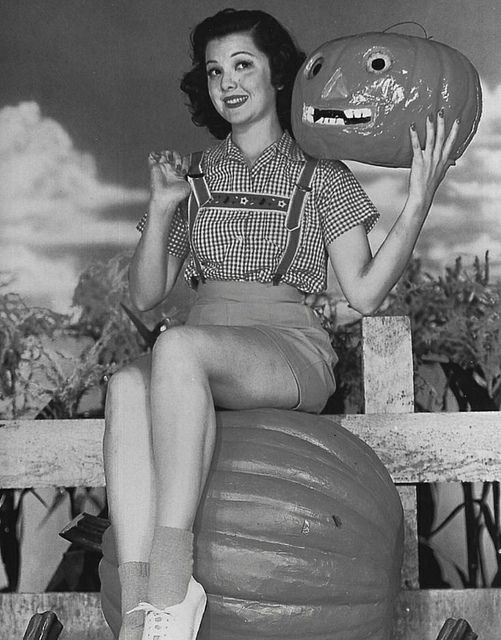
Here at A Shroud of Thoughts I realise that many people might appreciate some cheesecake with their Halloween candy. It is for that reason that every Halloween I post classic pinups. Without further ado, then, here is this year's collection of pinups!


First up is June Knight, who is apparently riding a broom to a Halloween shindig!

Next up is one of the prettiest witches you'll ever see, Janet Leigh!

Witch Kathleen Case is communing with her black cat among the corn shalks and jack o' lanterns.

Anita Page is cradling a jack o' lantern.
 The lovely Ann Rutherford and a jack o' lantern.
 June Haver amongst her Halloween decorations.
 And, of course, it wouldn't be Halloween (or any other holiday, for that matter) without Ann Miller!


Happy Halloween!
Wednesday, October 30, 2019
My Five Favourite Foreign Horror Movies

Nosferatu (1922): The first and arguably the best adaptation of Dracula. It was also an unauthorized version. Bram Stoker's widow won a successful plagiarism suit against the makers of Nosferatu, one of the conditions of which was that all copies of the movie be destroyed! Fortunately for future generations, some copies escaped destruction. By the way, to show you how influential Nosferatu was, the idea that sunlight destroys vampires originated with this movie, not from folklore! While in folkore vampires were creatures of the night, they were never particularly photosensitive prior to Nosferatu.

Les diaboliques (1955): Before Peeping Tom (1960) and Psycho (1960), there was Les diaboliques, better known simply as Diabolique in many Anglophone countries. Les diaboliques is genuinely frightening and would inspire a whole slough of similar movies in the Sixties, Psycho merely being the most famous of them.
Sei donne per l'assassino (1964) Known as Blood and Black Lace in English speaking countries, along with Peeping Tom, Sei donne per l'assassino was a forerunner of the slasher movies of the late Seventies and early Eighties. It not only has a high body count, but was graphic in a way that no other films at the time were. The film was so influential that, along with Mario Bava's earlier film Black Sunday, the entire subgenre of giallo exists because of it.

Tuesday, October 29, 2019
The Witch's Tale
Old Time Radio is remembered for many of its suspense/horror programs, including such classics as Lights Out, Inner Sanctum Mystery, and Suspense. Not so well remembered is a radio show that debuted before all of them. The Witch's Tale was quite possibly the first ever horror radio show. What is more, it was successful in its time. In fact, it ran for seven years.
The Witch's Tale debuted on WOR in New York City on May 21 1931. The show as not a large affair by any measure. Its creator, Alonzo Deen Cole, also wrote and directed the show. His wife, Marie O'Flynn, played the female characters on the show. Its supporting cast consisted only of Mark Smith and Alan Devitte. The undisputed star of the show was its host, Old Nancy, the Witch of Salem. It was Alonzo Deen Cole himself who provided the sounds of her cat, Salem.
Old Nancy claimed to be well over one hundred years old, although her exact age would vary from episode to episode. Originally Old Nancy was played by stage actress Adelaide Fitz-Allen. Miss Fitz-Allen died at age 79 in 1935. She was replaced by Miriam Wolfe, who was only 13 years old. While Miss Wolfe was only 13, she had already had plenty of experience on radio, having appeared on the CBS children's show Let's Pretend. On that show she had played plenty of witches.
Most of the episodes of The Witch's Tale were original, although the show did feature some adaptations of classic horror stories and novels over the years, including "La Vénus d'Ille" by Prosper Mérimée (as "The Bronze Venus") in 1931, "The Bottle Imp" by Robert Louis Stevenson (adapted as "The Wonderful Bottle") in 1934, and Frankenstein by Mary Shelley in 1935.
The Witch's Tale was popular enough to have a pulp magazine based upon it. The Witch's Tales was published by Carwood Publishing Co. It would not repeat the show's success, lasting only two issues. Much of the reason for the failure of The Witch's Tales may have been because, with the exception of one original story by Alonzo Deen Cole in each of the two issues, the stories were entirely reprints from the American version of Pearson's Magazine.
Originally aired on WOR, The Witch's Tale would receive nationwide exposure when it was aired on the Mutual Radio Network starting in 1934. The show ended its run on June 13 1938. That is not to say that The Witch's Tale was gone. An Australian version of the show with a different cast and crew was syndicated to Australian radio stations from 1939 to 1943. The Australian version of The Witch's Tale adapted scripts from the original, American version.
Sadly, very little in the way of The Witch's Tale has survived. In 1961 Alonzo Deen Cole destroyed much of the show's episodes when he moved from New York to California, convinced that there was no market for old radio shows. Fortunately some episodes have survived, as have the 332 scripts for the show.
In On the Air: The Encyclopedia of Old-Time Radio, author John Dunning wrote of The Witch's Tale, "The effects were crude by later standards, and the stories were one-dimensional affairs, calculated for a single effect." Regardless, The Witch's Tale must have been effective to have run seven years. What is more, it was influential. Old Nancy was the first of many hosts of horror-suspense radio shows, predating Raymond of Inner Sanctum Mystery and the Mysterious Traveller of the radio show of the same name. The Witch's Tale may only be remembered by fans of Old Time Radio today, but it would leave a lasting impact on radio shows to come.
The Witch's Tale debuted on WOR in New York City on May 21 1931. The show as not a large affair by any measure. Its creator, Alonzo Deen Cole, also wrote and directed the show. His wife, Marie O'Flynn, played the female characters on the show. Its supporting cast consisted only of Mark Smith and Alan Devitte. The undisputed star of the show was its host, Old Nancy, the Witch of Salem. It was Alonzo Deen Cole himself who provided the sounds of her cat, Salem.
Old Nancy claimed to be well over one hundred years old, although her exact age would vary from episode to episode. Originally Old Nancy was played by stage actress Adelaide Fitz-Allen. Miss Fitz-Allen died at age 79 in 1935. She was replaced by Miriam Wolfe, who was only 13 years old. While Miss Wolfe was only 13, she had already had plenty of experience on radio, having appeared on the CBS children's show Let's Pretend. On that show she had played plenty of witches.
Most of the episodes of The Witch's Tale were original, although the show did feature some adaptations of classic horror stories and novels over the years, including "La Vénus d'Ille" by Prosper Mérimée (as "The Bronze Venus") in 1931, "The Bottle Imp" by Robert Louis Stevenson (adapted as "The Wonderful Bottle") in 1934, and Frankenstein by Mary Shelley in 1935.
The Witch's Tale was popular enough to have a pulp magazine based upon it. The Witch's Tales was published by Carwood Publishing Co. It would not repeat the show's success, lasting only two issues. Much of the reason for the failure of The Witch's Tales may have been because, with the exception of one original story by Alonzo Deen Cole in each of the two issues, the stories were entirely reprints from the American version of Pearson's Magazine.
Originally aired on WOR, The Witch's Tale would receive nationwide exposure when it was aired on the Mutual Radio Network starting in 1934. The show ended its run on June 13 1938. That is not to say that The Witch's Tale was gone. An Australian version of the show with a different cast and crew was syndicated to Australian radio stations from 1939 to 1943. The Australian version of The Witch's Tale adapted scripts from the original, American version.
Sadly, very little in the way of The Witch's Tale has survived. In 1961 Alonzo Deen Cole destroyed much of the show's episodes when he moved from New York to California, convinced that there was no market for old radio shows. Fortunately some episodes have survived, as have the 332 scripts for the show.
In On the Air: The Encyclopedia of Old-Time Radio, author John Dunning wrote of The Witch's Tale, "The effects were crude by later standards, and the stories were one-dimensional affairs, calculated for a single effect." Regardless, The Witch's Tale must have been effective to have run seven years. What is more, it was influential. Old Nancy was the first of many hosts of horror-suspense radio shows, predating Raymond of Inner Sanctum Mystery and the Mysterious Traveller of the radio show of the same name. The Witch's Tale may only be remembered by fans of Old Time Radio today, but it would leave a lasting impact on radio shows to come.
Subscribe to:
Posts (Atom)
