Saturday, September 28, 2019

Robert Cabal

(This post is part of the Hispanic Heritage Blogathon hosted by Once Upon a Screen)
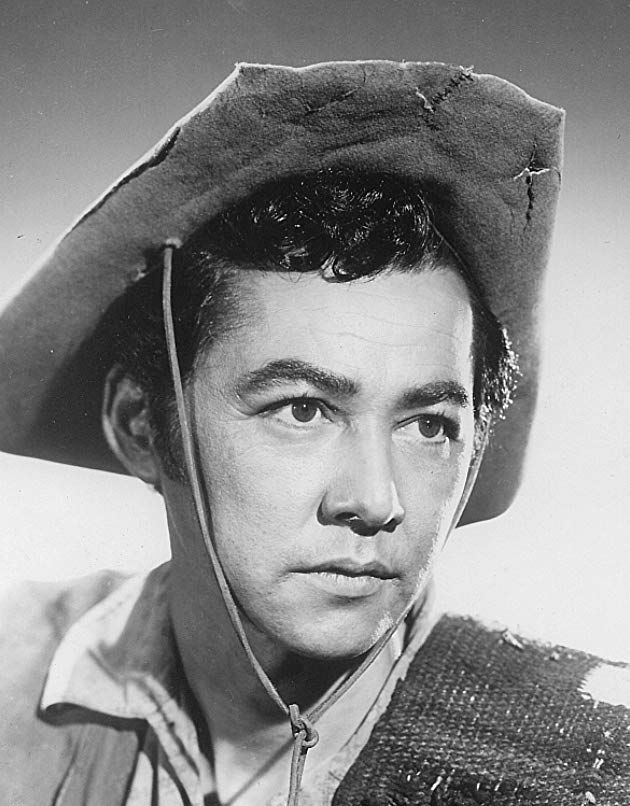
The sad fact is that there were few opportunities for Latino actors in Hollywood in the Forties and Fifties. Most were condemned to playing a succession of stereotypes, from Latin lovers to Mexican bandidos. Only a few, such as the legendary Ricardo Montalbán, were ever able to break free from such casting. Robert Cabal was no different. He spent much of his career playing Latino stereotypes and various "exotic" roles. While there were some aspects of the character that were stereotypical, the role of Hey Soos (given name Jesús) on Rawhide was actually a change of pace for him.

Robert Cabal's heritage is complicated and there appears to be very little that can be said for certain. Much of this is because his father used multiple names. His father is usually given as Clement Hiram McColgan, but he apparently used the name Clement Kalei Hiram and had his name changed to Clement Hiram McColgan.  His father appears to have been Chinese in descent. Clement Hiram McColgan's birth surname appears to have been "Ching."

Robert Cabal's mother was Nina Medeiros, who according to the U.S. Census was part Hawaiian in descent. Robert Cabal was born Harold Christopher Ching on April 7 1917 in Honolulu, Hawaii. His mother Nina divorced his father Clement in 1938, alleging cruel treatment. Robert Cabal would then appear to be Chinese, Hawaiian, and Latinx in descent.

Regardless, after having worked as a filing clerk, young Robert Christopher McColgan began acting, using the stage name "Robert Cabal." His early years were filled with tiny, uncredited roles. He made his film debut in 1947 playing a "Mexican boy" in Ride the Pink Horse. The next several years he would play a variety of small, uncredited roles, including a bell boy in Romance on the High Seas (1948) and a bracero in Border Incident (1948). Mr. Cabal would not receive a credited role until Forbidden Jungle in 1950, in which he played a boy who had been lost in the jungle. Always looking younger than he actually was, Robert Cabal often found himself playing boys and young men. It would not be until 1952 that he would receive another credited role, playing Manuelo in Mara Maru.

It would also be in 1952 that Robert Cabal played a fairly important role in a film. In The Man Behind the Gun (1952) Mr. Cabal played a young gunslinger named Joaquin Murietta (apparently loosely based on famed Robin Hood of the West, Joaquin Murrieta) who helps Major Ransome Callicut (played by Randolph Scott) foil a plot to turn California into a slave state. While the movie itself is not one of Randolph Scott's better Westerns, Robert Cabal does prove once and for all he can play more than Hey Soos. Unfortunately The Man Behind the Gun would not improve the calibre of Robert Cabal's roles. He played a few more "exotic roles": Kumat in Escape to Burma (1955), Kumar in Jungle Hell (1956), an elephant driver in Around the World in 80 Days (1956), and Moani in The Women of Pitcairn Island (1956). In Hell's Island (1955) he was reduced to playing the houseboy Miguel. His last movie role would be in 1960 in Bells Are Ringing, as an uncredited subway passenger.

While Robert Cabal's film career was not the stuff of legends, he did much better on television. He made his television debut in the Cisco Kid episode "Face of Death" in 1952. In the episode he plays Tecia, a young Native American involved with a lost Aztec treasure. While Robert Cabal's role in "Face of Death" is not a large one, it is one that is pivotal to the plot. In 1952 Robert Cabal would guest star in another episode of The Cisco Kid. "Lost City of the Incas" centred on exactly that, a lost city of the Incas. Robert Cabal played one of the Incas, Mathaozin. In both of his appearances on The Cisco Kid, then, Robert Cabal played indigenous people.

It would not be the last time that Robert Cabal played indigenous people on television. He did so again in episodes of Annie Oakley, Sergeant Preston of the Yukon, and Broken Arrow. It was not unusual in the Fifties, Sixties, and Seventies to cast Latinx actors as Native Americans. Indeed, even Ricardo Montalbán played quite a few American Indians in his career. Speaking as someone of Cherokee descent, I really can't complain about the practice too much. People of Mexican descent can trace their heritage back to the Aztecs, Mayans, Nahuas, and other indigenous peoples, making casting an actor of Mexican descent as a Native American preferable to casting an actor of purely European descent.

Robert Cabal appeared in a variety of television shows in the Fifties. As might be expected, he appeared in the anthology shows of the era. He played a Filipino named Jose in the Crossroads episode "With All My Love." He played a native on a tropical island in the Four Star Playhouse episode "The Island." Of course, he also appeared in episodic television shows as well. Among the shows he guest starred on were The Millionaire, The Lineup, Have Gun--Will Travel, Border Patrol, and Cheyenne.

Of course, to this day he is best remembered as "Hey Soos" Patines on Rawhide. Today the spelling of his name as "Hey Soos" would be borderline offensive. As to why it was spelled that way rather the proper "Jesús," reportedly the producers were worried that the average American would be offended if the credits listed a character named "Jesus," even though Jesús is a very common name among Hispanics and Latinxs. I have to confess that when I was younger I always thought it was because cowboys were largely illiterate and probably didn't know how to spell "Jesús!" Robert Cabal would play Hey Soos for very nearly the whole run of Rawhide, from its debut in 1959 to 1965 (at which point series star Eric Fleming left the show and it was largely recast).

Hey Soos is an important character in the history of Latinxs on television, although he is also a complicated one. In the late Fifties, Latinx characters, particularly those of Mexican descent, were almost never regular characters on American television shows. That Hey Soos even appeared on the show on a regular basis was then something revolutionary. It must also be pointed out that Hey Soos departed a good deal from the Mexican and Mexican American characters who sometimes appeared on the many Western TV shows of the era. He was not a bandido. He was not lazy or stupid. In fact, Hey Soos occupied an important position on Rawhide. The show centred on a cattle drive from Texas to Missouri. Hey Soos was the wrangler on the cattle drive. That is, he was in charge of the remuda on the drive (for those not familiar with cattleman jargon, a remuda is a herd of horses used by cowboys on ranches and on cattle drives). What is more, Hey Soos had a true gift for working with horses. Given his skill with horses, Hey Soos certainly was not stupid. Indeed, not only does Hey Soos speak more than one language (English, Spanish, and Nahuatl), but he could read both English and Spanish. Many of the other men on the drive could not read at all.

This is not to say that Hey Soos did not have some stereotypical traits. He was more religious than others on the drive, and he was also more superstitious as well. He often believes things that the other drovers entirely dismiss. An example of this is the second season episode "Incident of the Blue Fire." After St. Elmo's fire appears on the horns of some of the steers (the "blue fire" of the title), Hey Soos tells the drovers that if a stranger should show up, then death will follow. Of course, Hey Soos would not be the only superstitious character to appear on the show. In "Incident with an Executioner", a white townswoman named Madge expresses the idea of "the moon in Capricorn" exerting an evil influence. Regardless, in making Hey Soos superstitious the producers of Rawhide perpetuated the stereotype of the superstitious Mexican. As educated as Hey Soos was, one would not think he would believe such things.

Robert Cabal would not continue acting long after he left Rawhide. He guest starred on the Big Valley episode "Winner Lose All"in 1966 and the Iron Horse episode "The Bridge at Forty-Mile" in 1967. He died in Los Angeles on May 11 2004.

Sadly, Robert Cabal's career would reflect that of many actors of Latinx descent in the mid-20th Century. For the most part he was confined to small parts and often had to play stereotypes. This is made all the sadder with regards to Mr. Cabal as he had real talent. That talent was on display as Joaquin Murietta in The Man Behind the Gun and as Hey Soos in Rawhide. I have to think that if he had been born in a later era, he might have gotten many more good roles. That having been said, in one respect Robert Cabal was luckier than many actors of colour in the mid-20th Century. He will always be remembered as Hey Soos on Rawhide. For an actor to have even one memorable role in quite an accomplishment.

Thursday, September 26, 2019

Jack Donner Passes On

Jack Donner, who guest starred on shows from Star Trek to Buffy the Vampire Slayer, died on September 21 2019 at the age of 90.

Jack Donner was born on October 29 1928 in Los Angeles. He served in the United States Army. In 1948 following his service in the military he enrolled in drama school. He made his television debut in 1960 in an episode of Death Valley Days.

In the Sixties Mr. Donner guest starred on such shows as Dr. Kidare, Have Gun--Will Travel, The Man From U.N.C.L.E., My Favourite Martian, Get Smart, Mission: Impossible, The Monkees, I Dream of Jeannie, Star Trek, Judd for the Defence, The Name of the Game, and The Flying Nun. He made his film debut in Hand of Death in 1962. During the decade he appeared in the movies Escape from Hell Island (1963) and Hotel (1967). In 1966 he founded the Oxford Theatre in Los Angeles with Lee Delano. Mr. Donner ran the theatre until 1976.

In the Seventies Jack Donner guest starred on the TV shows Mission: Impossible, Mannix, The Manhunter, Police Story, Kojak, and The Streets of San Francisco. He appeared in the movies The All-American Boy (1973) and Black Starlet (1974). It was in 1977 that Mr. Donner fell ill and was unable to continue working as an actor. He attended college and later became a psychotherapist.

After being out of the acting profession for years, he returned to it in 1991. In the Nineties he guest starred on such shows as Baywatch, Power Rangers in Space, Frasier, Charmed, Shasta McNasty, G vs. E, The District, and The Privateers, He appeared in the movies The Emissary: A Biblical Epic (1997), Gideon (1998), Stigmata (1999), Family Tree (1999), and The Adventures of Rocky & Bullwinkle (2000).

In the Naughts Jack Donner had a recurring role on the soap opera General Hospital. He guest starred on such shows as Buffy the Vampire Slayer, Malcolm in the Middle, Roswell, The Bernie Mac Show, 7th Heaven, Enterprise, Freddie, Where There's a Will, Alias, Reno 911!, Criminal Minds, Cold Case, Rodney, Ghost Whisperer, Hot in Cleveland, and Bones. He appeared in such movies as Soulkeeper (2001), Exorcism (2003), Imaginary Heroes (2004), Brotherhood of Blood (2007), Farm House (2008), All About Evil (2010), and Vampire (2010).

In the Teens Jack Donner had a recurring role on the series The Guestbook. He guest starred on such shows as Bad Samaritans, Suburgatory, Fear the Walking Dead, and Con Man. He appeared in such movies as J. Edgar (2011), Underground (2011), My Funny Valentine (2012), Night of the Templar (2013), Anatomy of Deception (2014), and Caretakers (2018).


Wednesday, September 25, 2019

Hammer Films on TCM in October 2019

Every October is a treat for fans of both classic horror and Turner Classic Movies. This is particularly true of fans of Hammer Films, as TCM shows several movies from the legendary studio every Halloween season. This year is no different. Among the highlights for me this year are The Nanny, in which Bette Davis plays a nanny about as far from Fran Fine as one can get; the classic Dracula, known as The Horror of Dracula here in the Colonies; and The Plague of the Zombies, one of the best zombie movies ever made (it features real zombies, not the living dead of George Romero and his imitators).

Without further ado, here are the Hammer Films airing on TCM in the coming weeks. All times are Central.

September 27:
2:15 PM The Mummy's Shroud (1967)
5:30 PM The Mummy (1959)

October 3:
10:15 PM The Witches (1966 AKA The Devil's Own)

October 10:
12:00 Noon She (1966)
2:00 PM The Vengeance of She (1968)
3:45 PM The Viking Queen (1967)
11:15 PM The Devil Rides Out (1968 AKA The Devil's Bride)

October 11
2:45 AM Dracula A.D. 1972 (1972)

October 20:

2:45 PM The Nanny (1965)

October 24
7:00 PM Dracula (1958 AKA Horror of Dracula)
8:30 PM The Gorgon (1964)
10:15 PM  The Plague of the Zombies (1966)

November 1
4:15 AM The Curse of Frankenstein (1957)
5:45 AM Dracula, Prince of Darkness (1965)

Tuesday, September 24, 2019

The Late Great Sid Haig

Sid Haig, who appeared in numerous movies and episodes of television shows and became a horror movie icon, died on September 21 2019 at the age of 80. The cause was complications from a lung infection following a fall in his home.

Sid Haig was born Sidney Eddie Mosesian in Fresno, California on July 14 1939. His parents were Armenian. His career in entertainment all began because of his size. He was already five foot seven by the time he was nine years old. Because he had grown so fast he tended to be uncoordinated and as a result he took dance lessons. In high school he took to acting. He also took up drumming. He and some friends formed a Country Western group. Eventually he would play drums for the vocal group The T-Birds.

It was not long afterwards that he enrolled at the Pasadena Playhouse. It was while he was there that he noticed people had difficulty pronouncing his name. He then adopted the easier to pronounce "Sid Haig" as his stage name. He made his film debut in directors Jack Hill's short student film "The Host" in 1960. It was in 1962 that he made his feature film debut in The Firebrand. That same year he made his television debut in an episode of The Untouchables, "The Case Against Eliot Ness."

In the Sixties Sid Haig guest starred on several television shows, including The Lucy Show, Batman, Mission: Impossible, Laredo, Star Trek, The Man From U.N.C.L.E., Iron Horse, The Danny Thomas Hour, Daniel Boone, Death Valley Days, The Flying Nun, Here's Lucy, Gunsmoke, Get Smart, Here Come the Brides, and Mannix. He also appeared in several movies during the decade, including Blood Bath (1966), It's a Binkini World (1967), Point Blank (1967), Spider Baby or, the Maddest Story Ever Told (1967), The Hell with Heroes (1968), Pit Stop (1969), Che! (1969), and C.C. & Company (1970).

In the Seventies Mr. Haig appeared in such movies as THX 1138 (1971), The Big Doll House (1971), Diamonds Are Forever (1971), Beware! The Blob (1972), The Big Bird Cage (1972), The Woman Hunt (1972), Black Mama White Mama (1973), Emperor of the North Pole (1973), Coffy (1973), The Don is Dead (1973), Foxy Brown (1974), Swashbuckler (1976), and Loose Shoes (1978). On television he had a recurring role on Mary Hartman, Mary Hartman. He played the primary villain, Dragos, on the Saturday morning children's show Jason of Star Command. He guest starred on such shows as Alias Smith and Jones, McMillan & Wife, Get Christie Love!, The Rockford Files, Emergency!, Delvecchio, Police Story, Police Woman, Charlie's Angels, Switch, and Hart to Hart.

In the Eighties Sid Haig guest starred on such shows as Quincy M.E., Buck Rogers in the 25th Century, The Dukes of Hazard, Bret Maverick, T.J. Hooker, Fantasy Island, The A-Team, Scarecrow and Mrs. King, The Fall Guy, Hill Street Blues, MacGyver, Sledge Hammer!, and Just the Ten of Us. He appeared in such movies as Chu Chu and the Philly Flash (1981), Galaxy of Terror (1981), The Aftermath (1982), Commando Squad (1987), Warlords (1988), Wizards of the Lost Kingdom II (1989), and The Forbidden Dance (1990).

In the early Nineties Sid Haig temporarily retired from acting as he was tired of playing "stupid heavies." He returned to acting with a role as the judge in Jackie Brown (1997). In the Naughts he played what might be his best known role, that of Captain Spaulding in Rob Zombie's movie House of 1000 Corpses (2003). During the decades he appeared in the films Kill Bill: Vol. 2 (2004), The Devil's Rejects (2005), Night of the Living Dead 3D (2006), Little Big Top (2006), Dead Man's Hand (2007), Halloween (2007), Brotherhood of Blood (2007), and Dark Moon Rising (2009). On television he appeared in the TV movie House of Dead 2.

In the Teens Mr. Haig appeared in the films Creature (2011), Mimesis (2011), The Infliction (2012), The Lords of Salem (2012), The Sacred (2012), Hatchet III (2013), Devil in My Ride (2013), The Penny Dreadful Picture Show (2013), Zombex (2013), Bone Tomahawk (2015), Death House (2017), Razor (2017), Suicide for Beginners (2018), Cynthia (2018), High on the Hog (2019), and Three from Hell (2019).

Many of Sid Haig's roles during his career could be measured in a matter of minutes. Particularly in the early days of his career, he might appear only briefly in any given movie. That having been said, even in the earliest days of his career, it was clear that Sid Haig was a gifted actor. He could take a role and in a brief amount of time make that role seem like a full-fledged character. It was this gift, as much as his size, that made him very much in demand as a guest star on television in the Sixties, Seventies, and Eighties. He appeared on everything from Batman to McGyver.

While Sid Haig was known for playing heavies and his best known character (Captain Spaulding) was a homicidal maniac, in real life he was one of the gentlest men one could ever meet. While I never had the honour of meeting Sid Haig, I know many people who did. Every single one of them have said the same thing, that he was one of the nicest, sweetest, and friendliest people they had ever met. He was known to talk to fans as if he had known them his whole life. Sid Haig was both a talented actor and a true gentleman.

Sunday, September 22, 2019

Border Incident (1949)

(This post is part of the Hispanic Heritage Blogathon hosted by Once Upon a Screen)


 In the mid to late Forties Anthony Mann established himself as one of the foremost directors of what would later become known as film noir with such films as T-Men (1947), Railroaded! (1947), Desperate (1947), and Raw Deal (1949). Among his most remarkable film noirs was Border Incident (1949). In many respects Border Incident would be a revolutionary movie. Not only was it the first non-musical that Ricardo Montalbán made in Hollywood, but it featured his first leading role. It was among the earliest films in a relatively new genre, that of the police procedural, released only a year after such pioneering procedurals as The Naked City (1948) and He Walked by Night (1948). What is more, Border Incident (1949) presented a sympathetic view of Mexicans as human beings at a time when Hollywood was still filled with Latinx stereotypes.

To a degree Border Incident (1949) was "ripped from the headlines," much like episodes of the TV show Law & Order later would be. On August 4 1942 the United States signed the Mexican Farm Labour Agreement with Mexico, beginning what was known as the "bracero program (a bracero being a worker from Mexico allowed in the United States for a time for seasonal work in agriculture)." Unfortunately, the bracero program was open to abuse. Even though the Mexican government insisted on a minimum wage, good living conditions, decent food, and access to medical care, braceros sometimes found themselves provided with substandard living conditions, no access to medical care, and wages lower than the minimum (that is, if they weren't cheated out of their wages entirely). Because only a limited number of braceros would be permitted to enter the United States, workers sometimes bribed officials to be chosen to work there. Also because only a limited number of guest workers were allowed, some years there would be actually be an increase in undocumented workers. Because braceros could only be used in areas where there was a shortage of domestic farm workers, employers sometimes misrepresented the availability of local workers in order to use guest workers. It was due to the treatment of braceros and the widespread corruption in the program that the United Farm Workers was later founded by César Chávez and Dolores Huerta.

Border Incident (1949) centred on Pablo Rodriguez (played by Ricardo Montalbán), an agent of Mexico's Policía Judicial Federal (the Federal Judicial Police), and Jack Bearnes, an inspector for the United States' Immigration and Naturalization Service. The two are assigned to investigate a conspiracy whereby migrant workers are smuggled into the United States. Both men go undercover, Rodriguez as a bracero and Bearnes as a criminal who sells forged immigration permits.

Border Incident (1949) is a remarkable achievement in film noir. Much of this is because the film features several great performances. After playing in musicals, Ricardo Montalbán proves himself as a dramatic actor as Rodriguez. George Murphy also does an excellent job as Bearnes. While it is regrettably an example of brownface, James Mitchell does an excellent job of playing Juan Garcia, a poor bracero who simply wants to make a living for his family. Border Incident also boasts some beautiful cinematography. This should come as no surprise as it was shot by John Alton, who shot several film noirs before winning the Academy Award for Cinematography for An American in Paris (1951). It also benefits from an excellent script, with a taut plot and no shortage of action.

Indeed, Border Incident (1949) is not only a gritty film, but one that can be brutal at times. Characters are not simply stabbed or shot in Border Incident (1949). The climax is a gunfight set in a swamp filled with quicksand. In one memorable scene a character dies after being run over by a harrow. Even if one is accustomed to violence in film noir, Border Incident (1949) can be at times be difficult to watch.

What makes Border Incident (1949) even more remarkable is not its violence, it  is that, at a time when Mexican stereotypes were still all too common in Hollywood cinema, it treats the braceros with sympathy. The braceros are not criminals. They are not rapists. They are human beings who simply want to make a living for their families, no different from farmers living in the American Midwest. Indeed, despite the presence of George Murphy, there can be no doubt that Ricardo Montalbán as Pablo Rodriguez is the hero of Border Incident (1949). Rodriguez is a man who is dedicated to his job and has a strong sense of right and wrong, but at the same time he is very sympathetic to the plight of the braceros. While Border Incident (1949) does not make a strong political statement on the bracero program, in treating its Mexican characters as human beings it was in many respects a revolutionary movie for the time.

I think an argument can be made that Border Incident (1949) is one of the best film noirs ever made. It is a tough, gritty police procedural that pulls no punches and has never a slow moment. At the same time it has three dimensional characters played by actors giving some of the best performances of their careers. That having been said, what makes it truly remarkable is that it treats its Mexican characters with sympathy at a time when Mexican characters were often reduced to stereotypes.

Saturday, September 21, 2019

3 Doors Down's "Kryptonite" Video and the Rosslyn Hotel

Today I solved a mystery that has haunted me since 2000. A portion of 3 Doors Down's video to their song "Kryptonite" is set atop what is clearly a hotel. The problem is that one does not get a really good look at the signage or the surrounding buildings. There are several hotels I could rule out, such as the Hollywood Roosevelt Hotel, because of the sign, but until today I could not definitively identify the hotel.

Of course, here I should offer up some background to the song and video. "Kryptonite" was the debut single of 3 Doors Down, released on January 11 2000. The song clearly references Superman and draws upon his relationship with Lois Lane for inspiration. Quite naturally, the video utilises a superhero theme. It centres on an elderly man who was a superhero in the Forties or Fifties. At the start of the video in his apartment there is footage of him in his prime battling a supervillain atop a hotel. As the video progresses our elderly superhero dons his costume again to save a damsel in distress.

Watching the video on YouTube, I could pause it to get a better look at the sign. I could make out the words "million dollar" and "hotel." From there all it took was a Google search of the phrase "million dollar hotel" and "sign" to learn that the hotel is the Rosslyn Hotel in Los Angeles. The Rosslyn Hotel was built in 1914 and initially called "the New Rosslyn Hotel" because an older hotel of the same name stood beside it. It cost one million dollars to build, hence the sign that reads "Million Dollar Hotel." It was nine years later, in 1923 that an annex was built across the street.  According to the Los Angeles Conservancy, the Rosslyn Hotel had such amenities as ice water from the tap and ventilated phone booths. At the same time, however, its price range was within that of the average person.

Despite its reputation, the Rosslyn Hotel closed in 1959. In 1979 the two buildings would be reopened as two separate hotels, with the Rosslyn Hotel becoming the Frontier and the Annex retaining the name "Rosslyn Hotel." In this century the Rosslyn Hotel would become affordable housing and was renamed "Rosslyn Lofts."

For those of you who want to see the historic Rosslyn Hotel as the site of a superhero battle, here is the video to "Kryptonite" by 3 Doors Down.


Thursday, September 19, 2019

ER Turns 25

It was 25 years ago today, on September 19 1994, that ER debuted on NBC. While ER would eventually degenerate into a rather typical medical soap opera, for its first several years it was a revolutionary medical drama. It differed from other medical dramas before it in that it often featured a great deal of medical jargon with little to no explanation of what that jargon meant. It could often be much more graphic than other TV shows of the time, going even further in portraying surgeries than M*A*S*H had. The show also had an unusually fast pace, with the show's doctors and other medical personnel going from case to case. Multiple subplots were featured in each episode. Until viewers adjusted to just how much was going on in any given episode of ER, it could be difficult for viewers to keep track of everything going on in any given episode of the show. In fact, in his review of ER in The Hollywood Reporter, Miles Beller commented that the show's debut episode ("24 Hours") could be "...at times confused and confusing."

ER centred on the emergency room of the fictional County General Hospital in Chicago. It differed from many earlier medical dramas in that it featured a rather large ensemble cast, including several leads and several supporting characters. In its early days, at least, the focus of the series was upon the various cases and issues faced by the emergency room staff from day to day.

ER was created by Michael Crichton, the best selling author of such novels as The Andromeda Strain and Jurassic Park and the screenwriter of such films as Westworld (1974) and The Great Train Robbery (1979). In 1974 Michael Crichton had written a screenplay drawing upon his experiences as a medical student at Harvard. The screenplay generated no interest at any of the studios and Michael Crichton went onto other things. It was then in 1993 that he started work with Steven  Spielberg on bringing his 1990 novel Jurassic Park to the big screen. Mr. Spielberg had read Michael Crichton's old screenplay and expressed interest in it. It was an employee at Steven Spielberg's production company, Amblin, who suggested that it might work better as a pilot for a television series than as a movie.

ER was pitched to NBC. Warren Littlefield, then the head of NBC Entertainment, admitted, "We were intrigued, but we were admittedly a bit spooked in attempting to go back into that territory a few years after St. Elsewhere." Regardless, the network agreed to six episodes of the new series. The pilot for ER, "24 Hours," aired on September 19 1994 opposite Monday Night Football, where it did remarkably well in the ratings. Afterwards ER aired in its regularly scheduled timeslot at 8:00 PM Eastern/9:00 PM Central on Thursday. There it not only exceeded expectations, but it did spectacularly well in the ratings. Not only did it beat CBS's rival medical drama, Chicago Hope, soundly in the ratings, but it ranked no. 2 in the Nielsen ratings for the year. The following season it would be the no. 1 show on the air. It would continue to rank in the top five shows for the year for its next six seasons and ranked in the top ten for its first ten seasons on the air.

Even in its earliest years the cast of ER would change. Gloria Reuben joined the cast as physician assistant Jeanie Boulet in the 14th episode of the first season, "Long Day's Journey into Night." Originally a recurring character, she became a regular character in season 2. Jeanie was unique as a character at the time in having HIV, which she had contracted from her ex-husband. What is more, Jeanie was still alive and living with HIV when Miss Reuben left the show in 1999 and when she returned for a single episode in 2008. Laura Innes would also join ER early in the show's run as Dr. Kerry Weaver. She would ultimately remain with the show for twelve years.

While various characters were added in the show's early years, ER would also see some departures in its early years, departures which would, in my humble opinion, hurt the show in the long run. The first of these was Sherry Stringfield, who played Dr. Susan Lewis. Miss Stringfield had tired of the gruelling filming schedule of ER and also expressed a desire to live a normal life. She left at the start of the third season, only to return at the beginning of the eighth season. Other members of the lead cast beyond Sherry Stringfield would also leave over time. George Clooney, who played paediatrician Doug Ross, left the show in its fifth season. Julianna Margulies, who played Nurse Carol Hathaway, left the show at the end of the sixth season. Anthony Edwards, who played Dr. Mark Greene (more or less the main character on the show), left the show at the end of its eighth season. In an unusual move for TV shows of the time, Dr. Greene was written off the show as having died of brain cancer.

As much as lead characters leaving ER may have hurt the show, it was also hurt when popular supporting members of the show left the cast. Vanessa Marquez played one of the most popular supporting characters on ER, Nurse Wendy Goldman. Nurse Wendy was frequently featured in humorous subplots during the early years of the show. Unfortunately, Vanessa experienced both sexual harassment and racial slurs used against her while on the show. When she reported the harassment and the racial slurs, she was fired. Nurse Wendy last appeared in the show's third season. What the producers apparently did not realise at the time is that many people missed Nurse Wendy, as well as the humorous subplots on the show, which appeared less and less after the third season. I know I missed her (of course, here I must point out that Vanessa and I were very close, as my long time readers know). Another popular supporting character, desk clerk Jerry Markovic (played by Abraham Benrubi) suddenly stopped appearing at the end of the fifth season. He was absent from the show until the 8th season, when he rejoined the cast. Over time other supporting characters would also disappear from the show. This would ultimately hurt ER in the long run, as many viewers tuned into the show not simply to see the lead characters, but to see the many of the supporting characters as well.

Of course, ER was not only hurt by the departure of several popular characters, but also by the fact that the quality of the writing began to decline as well. More and more the show began to focus on the character's personal lives rather than work in the emergency room itself. Eventually there would even be episodes set entirely away from the hospital. The seventh episode of the fourth season, "Fathers and Sons," had Mark Greene and Doug Ross travelling to California by car. County General Hospital did not appear at all in the episode. The 16th episode of the fifth season, "Middle of Nowhere," had Peter Benton travel to Mississippi. Unlike "Fathers and Sons," the hospital does appear in the episode.

Not only did episodes eventually emerge that departed from the hospital setting of ER, but eventually characters would begin, well, acting out of character. The perfect example of this for me is the romance and eventual marriage of Mark Greene and Elizabeth Corday (played by Alex Kingston). Now I like both Dr. Greene and Dr. Corday. I think both Anthony Edwards and Alex Kingston are talented actors. That having been said, the characters of Dr. Greene and Dr. Corday had very little in common and had absolutely no chemistry together. It always appeared to me that the writers on ER did not know what to do with either of the characters and simply took the easy way out of forcing a romance upon them. Sadly, this would become all the more common as the show progressed. In fact, between cast departures and declining story quality, I ceased watching ER, once one of my favourite shows on the air, around the fifth or sixth season. I would tune in occasionally for episodes now and again, but it just seemed to me to be getting worse and worse.

That having been said, while ER would slowly decline in quality, for its first several seasons it was one of the best shows on the air. The show's original premise, fast paced and full of medical jargon, was far different from anything that had come before it. Furthermore, ER was not afraid to take risks. At a time when it was unusual for shows to kill of characters, ER did so. Mark Greene was not the only regular character to die on the show. Indeed, Lucy Knight (played by Kellie Martin) was stabbed to death by a schizophrenic patient (the stabbing took place in the episode "Be Still My Heart" and she died in the following episode, "All in the Family'). In addition to HIV (which the show dealt with beyond the character of Jeanie Boulet), ER also addressed such issues as child abuse, domestic violence, drug addiction, euthanasia, poverty, racism, sexual assault, suicide, and more. It also addressed medical conditions only rarely seen on previous medical dramas as well, including various mental conditions, chlamydia, human papilloma virus, meningitis, Parkinson's disease, and a variety of unusual injuries.

What is more, it has to be pointed out that it is very rare for a long-running show not to decline in quality at some point. What is more, there are even fewer shows that ever reached the level of quality that ER did in its first several seasons. In fact, at 124 nominations  ER held the record for the most Emmy nominations of any show until A Game of Thrones broke that record with 161 nominations. ER also won several SAG Awards, including ones for Outstanding Performance by an Ensemble in a Drama Series, Outstanding Individual Achievement in Writing for a Drama Series, and so on. 

Of course, it should be little wonder that ER won so many awards, as it produced some of the best episodes of any television show ever made. "24 Hours" still numbers among the best pilots ever produced. In the first season it was followed by yet more remarkable episodes. "Chicago Heat" took place during a heat wave when the hospital's air conditioning failed and Dr. Greene was forced to bring his daughter Rachel to work with him. "Blizzard" portrayed the exact opposite in weather, as a blizzard takes place resulting in a 40 car pile-up that nearly overwhelms the emergency room. "Love's Labour Lost" placed Dr. Greene in a predicament no emergency room physician would want to be in. "Motherhood" was directed by Quentin Tarantino and saw the ER staff have multiple personal crises.

Arguably, the first season of ER was its best, but the following seasons would also produce great episodes. "Welcome Back, Carter" saw the ER dealing with victims of a gang shoot out. "Hell and High Water" saw Doug Ross rescue a boy from a flooded storm drain and the resultant media coverage that ensues. "It's Not Easy Being Greene" saw Dr. Greene come into work on his day off, a decision he soon regrets. "Night Shift" saw most of the emergency staff working the night shift, during which Dr. Greene must treat a woman with meningitis. In its first three seasons ER produced many other excellent episodes beyond these, and would continue to produce solid episodes into its fifth season. During this period ER compares favourably with such esteemed shows as The Sopanros and  Mad Men.

While it is my own personal opinion that ER declined enough in quality after its fifth season that it was no longer worth watching, clearly many people disagreed with me. Indeed, the show would continue to be nominated for several Emmy Awards well into its seventh season and would still receive nominations until it went off the air. ER would also be the longest running medical drama in the United States, having run fifteen seasons, until its record will inexplicably be broken by Grey's Anatomy (which will begin its 16th season later this month). The show still has a loyal following. What is more, since Pop TV started rerunning it a few years ago and Hulu picked it up more recently, ER has developed a following among younger viewers. There should be little wonder why. ER was not only different from any medical drama that debuted before it, but from any medical drama that has aired ever since.