
Evelyn Keyes, one of the last surviving cast members of Gone With the Wind passed on July 4 at the age of 91. The cause was ovarian cancer.
Keyes was born November 20, 1916 in Port Arthur, Texas. She grew up in Atlanta, Georgia. While still a teenager she danced in nightclubs. She left for Hollywood at the age of 17. She was discovered by director Cecile B. DeMille. He cast her in his 1938 film The Buccaneer. Keyes played several uncredited parts in movies, as well as more substantial parts in Sons of the Legion, Sudden Money,and Union Pacific. It was in 1939 that she was cast in the part for which she was best known, that of Scarlet O'Hara's younger sister Suellen in Gone With the Wind.
Although never a major star, Keyes would go onto several significant roles in film. She was the female lead in Before I Hang in 1940. In 1941 she starred in Here Comes Mr. Jordan. She appeared in A Thousand and One Nights, The Jolson Story, and Mrs. Mike. She appeared in several low budget films noir, including Johnny O'Clock, The Prowler, and The Big Combo. In the Fifties she appeared in The Seven Year Itch and in a small part in Around the World in Eighty Days. Keyes retired in 1956, but would make a few appearances on film and television afterwards. She appeared in Return to Salem's Lot and Wicked Stepmother, and guest starred in Murder She Wrote.
Keyes was nearly as well known for her personal life as she was her movie roles. Among others, she married directors King Vidor, John Huston, bandleader Artie Shaw, and producer Mike Todd. She wrote a popular autobiography, Scarlett O'Hara's Younger Sister, as well as the novel I Am a Billboard and the memoir I'll Think About It Tomorrow.
Evelyn Keyes was a fairly talented actress. She starred in a variety of films, from epics to horror. In some ways, however, she was even more talented as a writer. Her autobiography, Scarlett O'Hara's Younger Sister was a funny and witty look at Hollywood during the Golden Age of movies. She will probably be remembered best as Scarlet O'Hara's younger sister, but she should be remembered for more.
Saturday, July 12, 2008

Friday, July 11, 2008
Ride Lonesome
If I had to name my favourite Western star, it would not be John Wayne, as hard as that may be to believe. Instead, I believe I would choose Randolph Scott. He did not begin his career as a Western star. In fact, he played a rather wide variety of roles. But after World War II he would become the Western star par excellence, Most often he played the lone, hard bitten hero who lived by a code all his own.
Among the best Western movies Randolph Scott ever made were those directed by Budd Boetticher. And among the finest Westerns Scott made with Boetticher was Ride Lonesome. Directed by Boetticher from a script by Burt Kennedy, it is a movie that is often overlooked in the annals of Western films.
In fact, describing the plot of Ride Lonesome hardly does it justice. In some respects its plot even sounds somewhat typical. Randolph Scott plays ageing lawman Ben Brigade, who must protect a recently widowed woman (Karen Steele) as he transports a prisoner (James Best) to Santa Cruz to be hanged. Along the way he must contend with outlaw Sam Boone (Pernell Roberts), who wants the reward money for the prisoner for himself, and Boone's sidekick Whit (James Coburn). To make matters worse, the small group is pursued by the prisoner's brother (Lee Van Cleef) and his gang.
What sets Ride Lonesome apart is the strength of essentially a character study spiced up with plenty of action. It features some of the richest dialogue and some excellent characterisation. Ride Lonesome is very much a psychological Western. Kennedy's script is given life by one of the best casts of any of the Boetticher/Scott collaborations. In fact, Ride Lonesome is interesting to watch as a historical document alone. Pernell Roberts received third billing in this film to Randolph Scott and Karen Steele, appearing in it only a year before he would assume the role of Adam on Bonanza. James Coburn appeared in his first feature film role, only a few years before he would be a major star. James Best played in a number of movie Westerns and television Westerns, this well before he would become familiar to audiences as Roscoe P. Coltrane on The Dukes of Hazzard. Finally, there is Lee Van Cleef in one of his earliest roles as a Western villain.
Adding to the high quality of both the script and cast is Boetticher's use of the camera. He used CinemaScope to its full advantage here, with travelling shots and long takes. Ride Lonesome was shot entirely outdoors, and Boetticher uses the wide landscapes to give the film the feel of existing well outside of civilisation. It is almost as if the film takes place in a world all its own, a world to which Ben Brigade has been condemned.
Ultimately, Ride Lonesome is a Western at its most basic. Unlike High Noon or The Searchers, there is no social commentary to be had here. Instead it is simply a riveting look at dangerous men living in a dangerous land at a dangerous time. Strangely enough, in creating a very basic Western on a low budget, Boetticher and Scott succeeded in making a film that in many respects truly epic.
Among the best Western movies Randolph Scott ever made were those directed by Budd Boetticher. And among the finest Westerns Scott made with Boetticher was Ride Lonesome. Directed by Boetticher from a script by Burt Kennedy, it is a movie that is often overlooked in the annals of Western films.
In fact, describing the plot of Ride Lonesome hardly does it justice. In some respects its plot even sounds somewhat typical. Randolph Scott plays ageing lawman Ben Brigade, who must protect a recently widowed woman (Karen Steele) as he transports a prisoner (James Best) to Santa Cruz to be hanged. Along the way he must contend with outlaw Sam Boone (Pernell Roberts), who wants the reward money for the prisoner for himself, and Boone's sidekick Whit (James Coburn). To make matters worse, the small group is pursued by the prisoner's brother (Lee Van Cleef) and his gang.
What sets Ride Lonesome apart is the strength of essentially a character study spiced up with plenty of action. It features some of the richest dialogue and some excellent characterisation. Ride Lonesome is very much a psychological Western. Kennedy's script is given life by one of the best casts of any of the Boetticher/Scott collaborations. In fact, Ride Lonesome is interesting to watch as a historical document alone. Pernell Roberts received third billing in this film to Randolph Scott and Karen Steele, appearing in it only a year before he would assume the role of Adam on Bonanza. James Coburn appeared in his first feature film role, only a few years before he would be a major star. James Best played in a number of movie Westerns and television Westerns, this well before he would become familiar to audiences as Roscoe P. Coltrane on The Dukes of Hazzard. Finally, there is Lee Van Cleef in one of his earliest roles as a Western villain.
Adding to the high quality of both the script and cast is Boetticher's use of the camera. He used CinemaScope to its full advantage here, with travelling shots and long takes. Ride Lonesome was shot entirely outdoors, and Boetticher uses the wide landscapes to give the film the feel of existing well outside of civilisation. It is almost as if the film takes place in a world all its own, a world to which Ben Brigade has been condemned.
Ultimately, Ride Lonesome is a Western at its most basic. Unlike High Noon or The Searchers, there is no social commentary to be had here. Instead it is simply a riveting look at dangerous men living in a dangerous land at a dangerous time. Strangely enough, in creating a very basic Western on a low budget, Boetticher and Scott succeeded in making a film that in many respects truly epic.
Wednesday, July 9, 2008
After July 4th
I don't guess I am the only one who feels just a little down when a holiday is over. After all, holidays are a break from the everyday, workday routine. A good many of us have time off from work on holidays, They are times of celebration which families usually spend together. It is perhaps natural then for someone to hate to see a holiday go.
In some respects, I think this is more so with July 4th than most holidays. Halloween ends, only to have Thanksgiving right around the corner. Thanksgiving ends, only to have the Yuletide less than a month away. Christmas might end for many with December 25, but New Year's Day is only a week away. July 4th is a different case entirely. Once July 4th is over, there is nothing left but the long, hot days of summer. It is true Labour Day comes in September, but in my mind it's not a real holiday. It is simply a day off from work, and it is not even that for many.
It is times like these that I think the American holiday calendar may be poorly designed. Between July 4th and Halloween, there are no holidays of importance. There are no days when families gather together for celebration. No holidays with strong traditions attached to them. Most places in the United States have county fairs, but they vary widely as to when they are scheduled. For Randolph County, Old Settlers does not arrive until mid-September (there is the County Fair, but it comes too soon after July 4th, and has never really impressed me).
Sadly, I am not sure if there is much solution to this problem. There is a holiday in August that the United States could have celebrated had the English speaking world not given up many of its old festivals. Lammas was a festival celebrating the first wheat harvest of the year, traditionally held on August 1. Indeed, its name derives from Old English hlaf "loaf" and mæsse "mass." On that day it was customary to bring the first loaf of bread made from the new wheat into the church on this day. And it was traditional for tenants to present their landlords with some of the freshly harvested wheat. It was generally celebrated as the holy day of St. Peter in Chains, but given its emphasis on the harvested wheat it might actually date back to the days of paganism. Celebrating Lammas would give Americans a holiday in August.
The only question is whether or not Americans would even celebrate Lammas. The sad fact is that many modern Americans do not give much thought as to where their food actually comes from. I seriously doubt they give much thought to wheat or how the bread they eat is made from wheat grown right here in the United States. Lammas may then not be a good choice for an August holidays.
Regardless, it seems to me that there is a need for one. After all, the time between July 4th and Labour Day is rather long, and often hot, dreary, and drab. Worse yet, Labour Day is actually not much of a holiday. It seems to me that there is a real need for a real holiday that falls in August.
In some respects, I think this is more so with July 4th than most holidays. Halloween ends, only to have Thanksgiving right around the corner. Thanksgiving ends, only to have the Yuletide less than a month away. Christmas might end for many with December 25, but New Year's Day is only a week away. July 4th is a different case entirely. Once July 4th is over, there is nothing left but the long, hot days of summer. It is true Labour Day comes in September, but in my mind it's not a real holiday. It is simply a day off from work, and it is not even that for many.
It is times like these that I think the American holiday calendar may be poorly designed. Between July 4th and Halloween, there are no holidays of importance. There are no days when families gather together for celebration. No holidays with strong traditions attached to them. Most places in the United States have county fairs, but they vary widely as to when they are scheduled. For Randolph County, Old Settlers does not arrive until mid-September (there is the County Fair, but it comes too soon after July 4th, and has never really impressed me).
Sadly, I am not sure if there is much solution to this problem. There is a holiday in August that the United States could have celebrated had the English speaking world not given up many of its old festivals. Lammas was a festival celebrating the first wheat harvest of the year, traditionally held on August 1. Indeed, its name derives from Old English hlaf "loaf" and mæsse "mass." On that day it was customary to bring the first loaf of bread made from the new wheat into the church on this day. And it was traditional for tenants to present their landlords with some of the freshly harvested wheat. It was generally celebrated as the holy day of St. Peter in Chains, but given its emphasis on the harvested wheat it might actually date back to the days of paganism. Celebrating Lammas would give Americans a holiday in August.
The only question is whether or not Americans would even celebrate Lammas. The sad fact is that many modern Americans do not give much thought as to where their food actually comes from. I seriously doubt they give much thought to wheat or how the bread they eat is made from wheat grown right here in the United States. Lammas may then not be a good choice for an August holidays.
Regardless, it seems to me that there is a need for one. After all, the time between July 4th and Labour Day is rather long, and often hot, dreary, and drab. Worse yet, Labour Day is actually not much of a holiday. It seems to me that there is a real need for a real holiday that falls in August.
Tuesday, July 8, 2008
Character Actor Don S. Davis Passes On
Character actor Don S. Davis, who had roles on Twin Peaks and Stargate SG-1, passed on June 29 at the age of 65. The cause was a heart attack.
Davis was born in Aurora, Missouri on August 4, 1942. Davis attended Southwest missouri State University in Springfield, where he majored in theatre and art. He received a Bachelor of Science in theatre at Southwest Missouri State College in Springfield. His college career would be interrupted by a stint in the U. S. Army. He served three years in Korea. Afterwards, he received a Masters in theatre at Southern Illinois University Carbondale. Davis taught at that university for seven years before receiving a Phd there. Davis would later move to Vancouver, where he taught at the University of British Columbia.
It was while he was at the the University of British Columbia that he began acting. He made his television debut in 1982, guest starring on Joanie Loves Chachi. He appeared in The Journey of Natty Gann in 1985 and made appearances on various TV movies throughout 1986. In 1987 he left academia to pursue acting full time. Davis appeared in the movies Malone, Stakeout, and Watchers. He also guest starred on The New Adventures of Beans Baxter, MacGyver, Wiseguy, and 21 Jump Street. He was a regular on the cult TV show Twin Peaks, playing Major Garland Briggs.
Davis would spend the Nineties making a number of guest appearances on such shows as Highlander, Northern Exposure, The X-Files (as Scully's father), The Outer Limits, and Profit. He was a regular on the series Madison. He appeared in the films A League of Their Own, Cliffhanger, Needful Things, Hideaway, and The Fan. It was in 1998 that Davis assumed the role he would play the longest, that of Major General George Hammond on Stargate SG-1. In all, he would spend ten years on the show. In the naughts Davis would appear in the movie Seed, The Still Life, and Woodshop.
Davis was one of the best character actors of recent years. His speciality was authority figures, playing Major Briggs on Twin Peak, Scully's father Captain Scully on The X-Files, and General Hammond on Stargate SG-1. No one could be quite as convincing in a uniform. Although best known for playing authority figures, Davis was quite capable in any role he took. Indeed, in the movie Savage Island he played Keith Young, the patriarch of a family involved in a long running feud with the Savages, a family of hillbillies who lived up to their name. Davis was a very versatile actor and one of the most talented character actors to come down the pike in a while. It is sad that he died so soon.
Davis was born in Aurora, Missouri on August 4, 1942. Davis attended Southwest missouri State University in Springfield, where he majored in theatre and art. He received a Bachelor of Science in theatre at Southwest Missouri State College in Springfield. His college career would be interrupted by a stint in the U. S. Army. He served three years in Korea. Afterwards, he received a Masters in theatre at Southern Illinois University Carbondale. Davis taught at that university for seven years before receiving a Phd there. Davis would later move to Vancouver, where he taught at the University of British Columbia.
It was while he was at the the University of British Columbia that he began acting. He made his television debut in 1982, guest starring on Joanie Loves Chachi. He appeared in The Journey of Natty Gann in 1985 and made appearances on various TV movies throughout 1986. In 1987 he left academia to pursue acting full time. Davis appeared in the movies Malone, Stakeout, and Watchers. He also guest starred on The New Adventures of Beans Baxter, MacGyver, Wiseguy, and 21 Jump Street. He was a regular on the cult TV show Twin Peaks, playing Major Garland Briggs.
Davis would spend the Nineties making a number of guest appearances on such shows as Highlander, Northern Exposure, The X-Files (as Scully's father), The Outer Limits, and Profit. He was a regular on the series Madison. He appeared in the films A League of Their Own, Cliffhanger, Needful Things, Hideaway, and The Fan. It was in 1998 that Davis assumed the role he would play the longest, that of Major General George Hammond on Stargate SG-1. In all, he would spend ten years on the show. In the naughts Davis would appear in the movie Seed, The Still Life, and Woodshop.
Davis was one of the best character actors of recent years. His speciality was authority figures, playing Major Briggs on Twin Peak, Scully's father Captain Scully on The X-Files, and General Hammond on Stargate SG-1. No one could be quite as convincing in a uniform. Although best known for playing authority figures, Davis was quite capable in any role he took. Indeed, in the movie Savage Island he played Keith Young, the patriarch of a family involved in a long running feud with the Savages, a family of hillbillies who lived up to their name. Davis was a very versatile actor and one of the most talented character actors to come down the pike in a while. It is sad that he died so soon.
Sunday, July 6, 2008
The Different Looks of Blackhawk
Having written about Quality Comics yesterday, today I thought I would do a pictorial on what might be their third longest running title. Blackhawk debuted in Military Comics #1, August 1941. It proved to be one of Quality Comics' most popular features. Blackhawk received his own title in winter 1944.
 This is Blackhawk #9, winter 1944. Although it is the first issue of Blackhawk's own title, it is numbered "9" because it took over the numbering of Uncle Sam Quarterly. It was in Jim Steranko's History of Comics that artist Chuck Cuidera explained the look of the Blackhawks' the uniforms. He said, "The Germans had designed such great costumes, we decided to use them ourselves. It was like fighting fire with fire." By this time Blackhawk was very popular, selling as much as superheroes such as The Flash and Captain America. Here I feel like I must apologise for the very stereotypical Chinese man conducting the Blackhawks. That is Chop-Chop, the Blackhawks' cook in the early days of the series and hence the squadron's sidekick. Sadly, Chop-Chop was a very typical portrayal of Asians during World War II. It is to be noted that over the years Chop-Chop would change to the point where he would also wear a Blackhawk uniform and pilot his own plane.
 This is Blackhawk #57, October 1952. The Blackhawk Squadron would change very little in appearance after World War II, although Chop-Chop was drawn more realistically, even if he was still a stereotype. Their opponents did change. With the War over, they could no longer fight Nazis. Of course, an exception was made for Blackhawk's archnemesis, Killer Shark. A Nazi operative still loyal to the cause after the fall of Hitler's regime, he would return even decades after the war to fight the Blackhawk Squadron. Other than Killer Shark, however, The Blackhawks' chief opponents would now be from the Soviet Union and Communist China. It must be kept in mind that this was the height of the Cold war and the same time period as the Red Scare.
 This is Blackhawk #133, February 1959. It is the first appearance of Lady Blackhawk. Even after DC Comics acquired Blackhawk, the squadron's appearance would not change for many years. DC Comics would make some other, more drastic changes. One was in the enemies they faced. For whatever reason, DC chose to no longer pit the Blackhawks against Commies, instead giving them a variety of opponents, from crime cartels to pirates. Most popular at DC Comics were science fiction menaces such as mad scientists, robotic opponents, and alien invaders. Increasingly, Blackhawk became rather silly. To a degree, this was typical of DC Comics at the time. As early as the late Forties, DC Comics would add science fiction-type plots to titles that were far from science fiction in genre, such as the frontier drama Tomahawk. In the Fifties they even did it to Batman, who had faced gangsters and supervillains in his heyday. The addition of a female character to a previously all male comic strip was also typical. This was the era when Batwoman joined the cast of Batman and Supergirl was introduced. Lady Blackhawk was Zinda Blake, a woman who wanted to become the first female Blackhawk. She continued to appear in the pages of Blackhawk until nearly the end of the book's run.
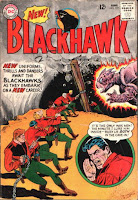 With Blackhawk #197, June 1964, the Blackhawks received new uniforms. Many fans hate these new uniforms. They prefer the original uniforms, which had a total black colour scheme, to these red, black, and green ones. Myself, I actually like them. I must confess that while I love the originals, by 1964 they were looking a bit dated. That having been said, I do not approve of the other change this issue brought. Having started as a private, paramilitary squadron, the Blackhawks were now attached to a secret government agency. Personally, I preferred them as freelancers. Despite the fact that they now worked for the government, the Blackhawks still faced silly, science fiction menaces.
 Blackhawk #226, November 1966, is a case in point. This issue features the story "The Secret Monster of Blackhawk Island." That's the right. The Blackhawks have been on Blackhawk Island, located somewhere in the North Atlantic, for 25 years and they never knew they had a monster! The next two issues wouldn't be much better, featuring "The Perilous Positive-Negative Man" and "Chop-Chop the Warlock." Here I must say a few words about Chop-Chop. Although still bearing that demeaning name, he had become less of a stereotype. With Blackhawk #197, June 1964, he slimmed up, received a uniform, and was no longer drawn as a stereotype (although he was sort of a jaundice orange now). He even received his own plane!
 This is it, the lowest point in the Blackhawks' history, Blackhawk #230, March 1967. Sales for the title had been declining for the past several years. Instead of realising that the pseudo-science fiction plots were probably what was hurting sales, DC Comics decided instead that the Blackhawks must become superheroes. After all, this was the era of the Batman TV show. To this end, the Blackhawks received silly powers and equally bad uniforms in what was deemed "The New Blackhawk Era." The process took three issues, beginning with Blackhawk #228, January 1967 and culminating with #230. In this three part story, the government agency was back and demanded the Blackhawks disband or become superheroes.
 The silly superhero phase seriously hurt Blackhawk's sales. To save the book, DC Comics then returned the Blackhawks to their original uniforms and their status as a paramilitary group. This occurred in Blackhawk #242, August-September 1968, shown here. This issue was scheduled to feature art by Reed Crandall, who had worked on the book at Quality Comics, but he had to bow out of the project. In the story, the government agency is destroyed by the villain, the Black Mask. Their superhero costumes having also been destroyed, they become what they once were. It turns out that the Black Mask is none other than Blackhawk's brother, who was badly injured in World War II but repaired by the Nazis. Sympathetic to the Nazis and angry at his brother, he now seeks to destroy Blackhawk.
 Blackhawk was cancelled with #243, October-November 1968. It returned with #244, January-February 1976. The Blackhawks had new uniforms and various new opponents, Among their new enemies were Anti-Man, a villain with anti-matter powers, and the Bio-Lord, a machine intelligence wanting to kill all humans. The Blackhawks would also face Nazis again. One was the Sky Skull, a Nazi war criminal. Of course, another was Killer Shark, who returned in Blackhawk #250, January-February 1977. Sadly, this would be the final issue of this revival. The series is important as it was the very last one in which the Blackhawks were featured in contemporary times. Every revival every since has featured them in their glory days, World War II.
Because of that, every revival has also featured the Blackhawks in their original uniforms. There was another short lived revival in 1982, with stories by Mark Evanier. This revival was actually more successful, lasting from #251, October 1982 to #273, November 1984. In 1987 Howard Chaykin wrote a Blackhawk mini-series which was very revisionist. It gave Blackhawk a real name, Janos Prohaska. It also made him a rather vulgar drunk. A Blackhawk series followed in 1988 in Action Comics. It received its own title in March 1989. It lasted until #16, August, 1990. Since then Blackhawk has only appeared in Blackhawk Special #1, 1999. This one-shot was set in Vietnam and written by John Ostrander. Since then Blackhawk and his squadron have only made cameos in various DC titles. It is safe to say, however, that they will probably be revived again one day.
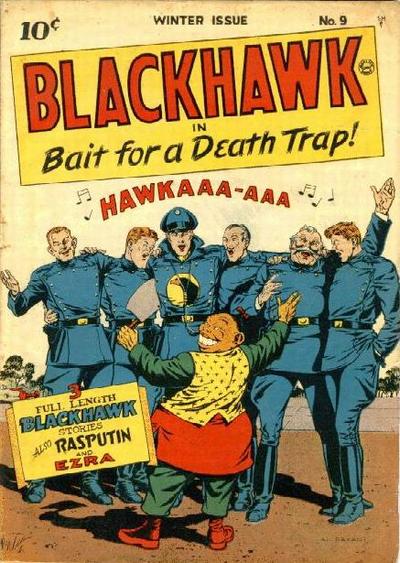 This is Blackhawk #9, winter 1944. Although it is the first issue of Blackhawk's own title, it is numbered "9" because it took over the numbering of Uncle Sam Quarterly. It was in Jim Steranko's History of Comics that artist Chuck Cuidera explained the look of the Blackhawks' the uniforms. He said, "The Germans had designed such great costumes, we decided to use them ourselves. It was like fighting fire with fire." By this time Blackhawk was very popular, selling as much as superheroes such as The Flash and Captain America. Here I feel like I must apologise for the very stereotypical Chinese man conducting the Blackhawks. That is Chop-Chop, the Blackhawks' cook in the early days of the series and hence the squadron's sidekick. Sadly, Chop-Chop was a very typical portrayal of Asians during World War II. It is to be noted that over the years Chop-Chop would change to the point where he would also wear a Blackhawk uniform and pilot his own plane.


Because of that, every revival has also featured the Blackhawks in their original uniforms. There was another short lived revival in 1982, with stories by Mark Evanier. This revival was actually more successful, lasting from #251, October 1982 to #273, November 1984. In 1987 Howard Chaykin wrote a Blackhawk mini-series which was very revisionist. It gave Blackhawk a real name, Janos Prohaska. It also made him a rather vulgar drunk. A Blackhawk series followed in 1988 in Action Comics. It received its own title in March 1989. It lasted until #16, August, 1990. Since then Blackhawk has only appeared in Blackhawk Special #1, 1999. This one-shot was set in Vietnam and written by John Ostrander. Since then Blackhawk and his squadron have only made cameos in various DC titles. It is safe to say, however, that they will probably be revived again one day.
Saturday, July 5, 2008
Quality Comics
Since the Sixties people have been accustomed to think of there being only two monolithic comic book companies: DC and Marvel. During the Golden Age of Comics (roughly 1938 to 1949), however, this was not the case. There were several prominent comic book publishers during those early years. The forerunner of DC Comics, National Comics, was the giant even then, owning as they did both Superman and Batman. Their sister company, All-American, may well have been the second biggest, owning as they did The Flash, Green Lantern, Wonder Woman, and the Justice Society of America. I am not sure who the number three comic book publisher was. It could have been Fawcett Publications, whose Captain Marvel even outsold the Man of Steel at times. That having been said, it is also possible that it could well have been a long defunct publisher known as the Quality Comics Group.
If the name "Quality Comics" doesn't sound familiar, then perhaps some of the characters it published will. Quality Comics was the home of such big names as Blackhawk, Plastic Man, Doll Man, and reprints of The Spirit. All four characters were so popular that they outlasted the Golden Age. Indeed, Plastic Man would barely survive into the Silver Age. The last issue of Plastic Man was cover dated November 1956, one month after the Barry Allen version of The Flash had debuted in Showcase #4, October 1956. Blackhawk would survive into the Silver Age, National Periodical Publications (AKA DC Comics) continuing to publish it until November 1968.
Quality Comics was founded by printer Everett "Busy" Arnold in 1937. Arnold had received his nickname "Busy" as a boy because he talked so much in class that his teachers were always calling him a "busybody." Receiving a degree in economics from Brown University in 1921, Arnold entered the printing business when he became a sales representative for printing press manufacturer Goss Printing Company. He would sell presses to both Eastern Color Printing (who would later publish Famous Funnies #1, May 1934--the first American comic book) and the McClure Syndicate. It was in the Twenties that Arnold learned about colour printing.
Around 1930 Arnold would become the vice president of Greater Buffalo Press after its president Walter Koessler invested in a colour press so as to print Sunday newspaper comics sections. It would be in 1936 that Arnold would have his first brush with the comic book industry. That year he helped John Mahon and Bill Cook, both of whom had worked for National Allied Publications (the ancestor of DC Comics), set up Comics Magazine Inc. Their first comic book, The Comics Magazine, published in May 1936, included both reprints and original features such as Dr. Mystic (the work of Jerry Schuster and Joe Siegel, creators of Superman--Dr. Mystic was essentially the same character as Dr. Occult at DC). The Comics Magazine was renamed The Funny Pages in September of that year. In its November 1936 issue it would featured the first appearance of The Clock, the first masked comic book character.
By 1937 Busy Arnold realised that comic books were a medium which could soon be making a good deal of money. To this end he founded Comic Favorites, Inc in conjunction with the newspaper syndicates the McNaught Syndicate, the Frank J. Markey Syndicate and the Register and Tribune Syndicate in October 1937. That month the company published their first comic book, a collection of reprinted newspaper strips called Feature Funnies. Initially, Harry "A" Chelser would provide the magazine with original material, although eventually Arnold would turn to the famous Eisner-Iger shop for his original material.
 Arnold's entry into the world of comic book publishing would not be without its battles. Almost immediately he found himself sued by Eastern Color Printing over the name Feature Funnies, which they maintained infringed upon their own Famous Funnies. Arnold successfully defeated the lawsuit by proving that the word "funnies" had been used for comic strips long before Eastern Color Printing's initial publication of Famous Funnies. Despite the lawsuit from Eastern Color, Comic Favorites Inc. was doing well. The company would acquire The Clock, who made his first appearance in Feature Funnies #3, December 1937. This made The Clock the first masked hero published by what would become Quality Comics. The company would continue to publish him until Crack Comics #35, Autumn, 1944.
Nineteen thirty nine would be a historic year for Arnold's company. Busy Arnold and the Cowles Brothers (who owned the Register and Tribune Syndicate) bought out the shares of both the McNaught and Markey syndicates in Comic Favorites, Inc. Renamed Comic Magazines, Inc., the company would go through a few other changes as well. Feature Funnies was renamed Feature Comics with its twenty first issue, June 1939. It was two months later that the company published Smash Comics #1, August 1939, its first magazine with all new material. In December 1939 the company would also have one of its first big hits, a character who may have also been the company's first superhero. Debuting in Feature Comics #27, December 1939, Doll Man was the creation of Will Eisner, although the character would be most closely associated with artist Reed Crandall. Doll Man was the first hero with the ability to shrink in size, although he kept the strength of a full grown man even at his doll size. Doll Man proved to be very popular, getting his own title, the first issue cover dated autumn 1941. He was published until 1953.
 As historic as 1939 would be for Comic Magazines, Inc., 1940 would be even more so. Late in 1939 and early in 1940 Everett Arnold began exploring the idea of a Sunday supplement for newspapers roughly in comic book form. He used his connections with the Greater Buffalo Press to make contact with various editor and showed them a presentation using features already published by Comics Magazines Inc. While nearly all the editors liked the idea, it was an editor from the Washington Star who stated that while he liked The Clock by George Brenner, he did not like the art. He much preferred the art in Lou Fine's comic strip in the presentation. For his part, Busy Arnold was concerned about that Lou Fine might work too slow to meet newspaper deadlines. It was then that Arnold turned to Will Eisner. Eisner then developed The Spirit. The Spirit was a detective named Denny Colt, who was presumed dead. It was with the blessing of his friend the police commissioner that Colt became The Spirit, a masked vigilante operating out of Wildwood Cemetery. Arnold and Eisner worked out an agreement whereby Eisner would essentially retain ownership of The Spirit. The same agreement would apply to the eventual backup features, Lady Luck and Mr. Mystic. "The Spirit Section," as it came to be called, was first published on June 2 1940. "The Spirit Section" proved very popular, lasting until October 5, 1952. From October 1941 to March 1944 there was a daily Spirit strip. The Spirit would also be reprinted in Quality comics titles, including Police Comics starting with #11, October 1942 and running in that title until #42, May 1950, and in his own title from its first issue in 1944 until its twenty second and final issue in August 1950. He has been revived frequently since then, and next year he will have his own major motion picture.
It was in February of 1940 that Comic Magazines Inc. moved from New York City to the Gurley Building in Stamford, Connecticut. It was perhaps because of the move to that city that the company and Arnold's other companies and imprints (such as E.M. Arnold Publications) would become known collectively as "the Quality Comics Group," the Connecticut Historical Society theorising that he perhaps drew the name from Stamford's nickname of the "Quality City." The "Quality Comics Group" imprint would first appear on Crack Comics #5, September 1940. The year would also see the debut of some of Quality's most popular superheroes: Uncle Sam (created by Will Eisner and debuting in National Comics #1, July 1940), The Ray (created by Lou Fine, debuting in Smash Comics #14, September 1940), and Quicksilver (created by Jack Cole and Chuck Mazoujian, first appearing in National Comics #5, November 1940).
By the end of 1940 Quality Comics was established as one of the most successful comic book companies in the industry, with popular characters such as Doll Man and Uncle Sam to its name. Much of the company's success was no doubt due to Everett M. Arnold himself. Busy Arnold could be a bit of a curmudgeon with his artists, alternating between flattering his artists and delivering them stinging criticisms. At the same time, however, Arnold was widely considered the fairest publisher in the industry at the time. He was well known for frequently giving his artists bonuses when he felt that they had done particularly good work. For all his strengths and weaknesses, Arnold attracted the best artists to Quality Comics and most of them worked for him for years. Eisner himself worked with Arnold from 1939 to 1950. Jack Cole worked for him from 1940 to 1953.
 It was in August 1941 that two comic books would debut which would insure that Quality Comics would be one of the top companies in the industry during the Golden Age. That month was the cover date for Military Comics #1, which featured the premiere of Blackhawk. Blackhawk was created by Will Eisner, Chuck Cuidera, and Bob Powell. Blackhawk was the otherwise unnamed leader of the Blackhawk Squadron, also called the Blackhawks, a team of ace pilots of several different nationalities (Andre was French, Olaf was Norwegian, Chuck was Texan, and so on). The group appeared in Military Comics until that book became Modern Comics in November 1945. They received their own title in 1944 when Uncle Sam Quarterly became Blackhawk. Blackhawk was popular enough that his title not only survived the Golden Age, but would continue to be published until November 1968 (although after December 1956 it was published by DC, not Quality). Blackhawk would be licensed for publication in the United Kingdom and Australia. It would also inspire a short lived radio show on ABC that ran from September 1950 to December 1950, and a 1952 Columbia serial with Kirk Alyn in the lead role.
 Of course, August 1941 also saw the publication of Police Comics #1, which featured the debut of Plastic Man. Plastic Man was the creation of Jack Cole. Cole initially wanted to call the character "India Rubber Man." Busy Arnold disagreed, suggesting that he should name the character after a substance that brought to mind the future--he should call him "Plastic Man." Plastic Man was not the first stretching hero, but he was certainly the most versatile Golden Age character of the type and the only one who lasted beyond an issue or two. He was also strikingly original, as one would expect from Jack Cole. Plas (as he was called for short) started out as "Eel" O'Brian, a petty hoodlum. He and his gang were robbing a a chemical plant when they were surprised by the night watchman. O'Brien escaped, but only after he had been wounded and covered in chemicals. Realising that his fellow gang members had abandoned him, he turned his back on crime and used his new powers (to stretch into any shape) to fight it. The following issue he received a sidekick in the form of Woozy Winks, who was bumbling and overweight, but blessed by a gypsy so no harm would ever become him. Together the two fought some of the most bizarre supervillains ever. Cole wrote Plastic Man in a half serious, half humorous style with a completely off the wall visual sense. Plastic Man could literally become anything. Plastic Man proved to be very popular. He received his own title in 1943. He lasted in Police Comics until it became a crime comic book with #102, October 1950. His own title would survive exactly one month into the Silver Age, ending with issue #64, November 1956. Strangely, despite the character's popularity, it would take DC ten years before they revived him. Despite this fact, he would influence such Silver Age characters as Mr. Fantastic of the Fantastic Four and the Elongated Man of DC Comics.
Already owning such popular characters as Doll Man and Uncle Sam, the addition of Blackhawk, Plastic Man, and The Spirit only added to the company's success. Quality would add one more successful character to its roster before the end of World War II. Kid Eternity debuted in Hit Comics #25, December 1942, a book which, despite its title, was in much need of a hit. Created by Otto Binder and Sheldon Moldoff, Kid Eternity proved to be the hit the title needed. He was an unnamed kid who died when Germans sunk the ship he was on. About to enter the afterlife, the Gatekeeper decided that he must have died by mistake and so Mr. Keeper, the entity who had made the clerical error, was charged with the responsibility for the kid. It was Mr. Keeper who gave him a unique superpower. Using the word "Eternity" he could summon any historical or mythological figure to come to his aid. Kid Eternity proved popular. He starred in Hit Comics until it ended its run with #60, September 1949. He received his own magazine in Spring 1946. It lasted until November 1949. He has been revived by DC Comics from time to time since then.
 The end of World War II also saw superheroes begin a slow decline in popularity. Quality then began to expand into other genres. Among those genres was humour. Tall, leggy, blonde Torchy had been created by artist Bill Ward while in the military and her strip had been carried by Army newspapers around the world. When Ward returned from the war, it was Quality Comics who published Torchy. She started as a backup in Doll Man with issue #8, Spring 1946. She appeared there until #28, May 1950. She also appeared in Modern Comics from issue #53, September 1946 to September 1949 and her own title from November 1949 to September 1950. Another enduring humour character at Quality was Marmaduke Mouse. The chief lackey of King Louie (a lion), he first appeared in Hit Comics #35, Spring 1944. He received his own title in Spring 1946. Ultimately, it would last until #65, December 1956, making it the last comic book ever published by Quality. In the end, Marmaduke Mouse would be Quality Comic's fourth longest lasting feature, after Blackhawk, Plastic Man, and Doll Man. Quality had other humour titles as well, including All-Humor Comics, which ran from 1946 to 1949. Candy was their teen humour feature. She debuted in Police Comics #37, December 1944. She received her own title in Autumn 1947. She lasted in Police Comics until it became a crime title in 1950. Her own title lasted until #64, July 1956. Other humour titles included Gabby and Jonesy.
Like many comic book companies at the time, Quality Comics would also take to publishing Westerns. Crack Comics became Crack Western with #63, November 1949. Quality Comics would take an even bigger leap into the burgeoning romance genre. Starting in 1949, they published such titles as Campus Loves and Flaming Love. In all, the Quality Comics Group would publish over 15 different romance titles before it closed its doors. Its most successful romance title would be Heart Throbs first published in August 1949. The final issue published by Quality was #46, December 1956, making it one of the last titles published by the company. DC published it thereafter, until #146, October 1972. It was then retitled Love Stories and lasted until #152, November 1973. This makes it one of Quality's longest running titles (alongside Blackhawk) when its DC run is counted as well--over 24 years.
 Quality also expanded into crime comic books, although their titles were always much tamer than those published by Lev Gleason (Crime Does Not Pay) and E.C. Comics (Crime SuspenStories). Police Comics became a crime anthology with #103, December 1950. It would last in that format until its cancellation with #127, October 1953. One of the characters featured in its new format, private eye Ken Shannon, would receive his own title in October 1951. It lasted until April 1952. Another character, Treasury Agent Trask, appeared in Police Comics with #103, December 1950 as well. His feature was renamed "T-Man" after two issues. Trask received his own title, T-Man #1, in September 1951. T-Man #38, December 1956, was among the last titles Quality ever published. Oddly enough, despite the popularity of T-Man, DC Comics did not pick up the title. Quality Comics' other crime features never received their own books, but included Inspector Denver and Dan Leary, State Trooper.
 Quality Comics would also expand into, for lack of any better term, the adventure genre. These were titles that might be set in different time periods, but can be more or less classified together because of their emphasis on derring-do. In some ways such swashbuckling adventures were nothing new for Quality Comics. The Gallant Knight was featured in early issues of Feature Comics. Abdul the Arab had a home in Smash Comics. The Fifties would see Quality Comics publish titles that specialised in swashbuckling adventure. Buccaneers lasted for eight issues from 1950 to 1951. A much more successful title was Robin Hood Tales, beginning with #1, February 1956. In fact, Robin Hood Tales would last until the very end of the Quality Comics Group, #6, December 1956 being among the last magazines published by the company. It became one of the few titles that was continued by National Periodical Publications. who published it for seven more issues, until #14, April 1958. It may have been possibly cancelled due to sales, although it is also possible that it was discontinued becuase National Periodical Publications had already been publishing its own Robin Hood stories in the pages of The Brave and the Bold (its own adventure title) since #5, April-May 1956. Quality Comics also published The Exploits of Daniel Boone from #1, November 1955 to #6, October 1956, nine years before the Fess Parker TV show debuted.
 Quality Comics would also publish war comics. Of course during World War II Military Comics included such features as Blackhawk, The Death Patrol, and The Sniper. And Blackhawk had been published for years. The Fifties would see an important new war title. G.I. Combat debuted in October 1952. It had started out with an anti-Communist bent, but moved more towards World War II stories as time wore on. It proved popular enough that after Quality published its last issue with #43, December 1956, DC Comics picked it right up, publishing it until #281, January 1986. Counting in its run under DC Comics, G.I. Combat would be the longest running Quality title of all time, surviving a full 34 years. While at DC Comics, G.I. Combat would see the debut of some of its most popular war features, including Sgt. Rock and The Haunted Tank. Quality also published Yanks in Battle for a mere four issues in 1956. It was not picked up by DC Comics.
In 1950 Busy Arnold would buy out the Cowles Brothers shares in Quality, making him the sole owner. Sadly, for Arnold there were dark days ahead for comic books. The late Forties saw the beginning of the outcry over violence in comic books. Such protests would only become more pronounced as the Fifties progressed. The loudest voice in this anti-comic book hysteria was Dr. Frederic Wertham, a liberally leaning psychiatrist who was convinced sex and violence in comic books caused delinquency in children. Quality was much more responsible than many other comic book companies of the time. In fact, Dr. Wertham's notorious book Seduction of the Innocent, only refers to one Quality title. Even DC Comics, whose magazines of the time are generally considered the tamest outside of Archie Comics, were mentioned more!
 Still, even Quality Comics would come under attack. Torchy had been one of Quality Comics' most popular features. Sadly, while the feature was totally innocent (Torchy Todd was guilty of no more than being pretty), Torchy was listed by Dr. Frederic Wertham in 1950 as being among the comic book titles that was unacceptable for children to read. Quality Comics stopped publishing Torchy for that reason. Another attack upon another Quality title would come a few years later. With Web of Evil #1, November 1952, the company would make its only entry in the horror genre. Web of Evil was tamer than other horror titles of the time, but even it would be mentioned in Seduction of the Innocent. Web of Evil would not be a success at any rate. It only lasted until #21, December 1954. Supposedly, the final issue of The Spirit, #22, August 1951, was mentioned in the New York State Joint Legislative Committee to Study Comic Books as well. Other than those three titles, the only time Quality Comics came under attack was when an ad appearing in their magazines for books called How to Hypnotize--A Master Key to Hypnotism was mentioned by Wertham in front of the Senate Subcommittee on Juvenile Delinquency.
Regardless, in the end the anti-comic book hysteria would hurt the sales of all comic book titles, particularly from 1954 to 1956. And in many respects Quality Comics was not the powerhouse it had been in the Golden Age of comic books. Their greatest strength was always their superhero line. When the superhero craze began to fade away after 1945, Quality would lose what were once some of their most popular characters. It was a perhaps a sign of the times that in 1950 Quality Comics published 153 titles, but by 1951 they were down to publishing only 84 titles (the bulk of cancelled titles were from their romance line). Even the two juggernauts the company published, Blackhawk and Plastic Man did not sell as they once did. Blackhawk had started out as tied to World War II. When the Blackhawk Squadron no longer had Nazis to fight, the series lost something of its former glory. Jack Cole had left Plastic Man in 1950. While such talents as Alex Kotzky and John Spranger took over in his stead, no one could truly replace Jack Cole on Plastic Man. The title suffered in comparison to what it had once been with Cole on the book, and this was reflected in its sales.
Other matters would make it even more difficult for comic book companies to survive in 1956. The American News Company was the largest and oldest magazine distributor in the United States. With the exception of National Periodical Publications (AKA DC Comics), which was distributed by Independent News (owned by DC itself), the vast majority of comic book publishers were carried by the American News Company. It was in 1956 that the Department of Justice found the American News Company guilty of restraint of trade. As a result, it had to divest itself of every newsstand it owned. The effect on the comic book companies was devastating. Some companies simply went out of business. What would become Marvel Comics nearly did; they had to cut back on the number of titles they published and go to DC Comics and Independent News for distribution. I have never read if Quality Comics was among the companies affected by the collapse of the American News Company, but it would not surprise me in the least.
With sales in decline, Everett M. "Busy" Arnold decided to leave the comic book industry. He sold Quality Comics--lock, stock, and barrel--to National Periodical Publications (DC Comics). Quality Comics published its last magazines in December 1956, surviving only two months into the Silver Age. DC Comics continued to publish Blackhawk, G.I. Combat, and Heart Throbs for years. They would revive Plastic Man in 1966 and yet more times over the years. In the Seventies they would bring back many of the other Quality Comics characters, from Kid Eternity to Doll Man. But sadly, Quality Comics was gone after 19 years of existence.
As to Busy Arnold, having sold Quality Comics, he founded Arnold Magazines Inc. and entered the Men's Adventure field. He published such titles as Homicide Detective Story Magazine and Crime and Justice Detective Story Magazine. Arnold's magazine, Classic Photography, would be deemed obscene by the U.S. Postal Service in 1957, innocuous as it would seem now.
Of course, the question remains, how different would comic book history be if Busy Arnold had not closed the Quality Comics Group in 1956? It is possible that Arnold could have sought another solution other than selling his titles and characters to National Periodical Publications. What would become Marvel survived by cutting back on titles and going to Independent News for distribution. The American Comics Group, the small company known for Herbie and Adventures into the Unknown, cut back on their titles after 1956 and editor Richard Hughes wrote nearly every story from that time forward. Charlton, a small publisher also based out of Connecticut, survived because they kept their operating costs exceedingly low (it was notorious as the company which paid its artists the lowest rates in the industry). It is then conceivable that Quality Comics could have survived.
 Indeed, as of 1956, the Quality Comics Group was still publishing several titles. Candy, Marmaduke Mouse, Plastic Man, T-Man, and several romance titles survived to the very end. Blackhawk, G.I. Combat, Heart Throbs, and Robin Hood Tales would survive the demise of the company, published by National Periodical Publications (although Robin Hood Tales only lasted another year). Quality Comics could have survived, especially if they had cut back on titles (a few of the romance titles could have easily have gone). Indeed, it was in October 1956 that an event occurred that turned the fortunes of comic books around for the next decade. That month was the cover date of Showcase #4, the comic book which launched the Silver Age with the debut of the Barry Allen version of The Flash. With a staple of Golden Age characters much richer than most companies, the Quality Comics Group could have eventually joined the new rush for superheroes. Plastic Man was still being published at the end of 1956. They could have revived such classic heroes as Doll Man, Kid Eternity, Quicksilver, The Ray, and Uncle Sam. And with the roster of artists that Busy Arnold always employed, the company could have easily produced brand new superheroes. In the end, with National Periodical Publications publishing new superheroes, Quality Comics could have made the industry too crowded for Marvel Comics to have risen from the ashes. Today we might still speak of two monolithic comic book companies, but instead it would be DC Comics and the Quality Comics Group.
Even though the Quality Comics Group did not survive the year 1956, it would be Quality Comics that would be Busy Arnold's greatest legacy. The Spirit is one of the most famous characters to emerge from the Golden Age of comics, and has been published on and off ever since. Both Blackhawk and Plastic Man survived the Golden Age and are still relatively well known characters. G. I. Combat became one of the longest running war titles in the history of comics, although it spent the vast majority of its years at DC. Although few today would recognise its name, Quality Comics was a giant in the comic book field in the Golden Age, and its influence continues to be felt even today.
If the name "Quality Comics" doesn't sound familiar, then perhaps some of the characters it published will. Quality Comics was the home of such big names as Blackhawk, Plastic Man, Doll Man, and reprints of The Spirit. All four characters were so popular that they outlasted the Golden Age. Indeed, Plastic Man would barely survive into the Silver Age. The last issue of Plastic Man was cover dated November 1956, one month after the Barry Allen version of The Flash had debuted in Showcase #4, October 1956. Blackhawk would survive into the Silver Age, National Periodical Publications (AKA DC Comics) continuing to publish it until November 1968.
Quality Comics was founded by printer Everett "Busy" Arnold in 1937. Arnold had received his nickname "Busy" as a boy because he talked so much in class that his teachers were always calling him a "busybody." Receiving a degree in economics from Brown University in 1921, Arnold entered the printing business when he became a sales representative for printing press manufacturer Goss Printing Company. He would sell presses to both Eastern Color Printing (who would later publish Famous Funnies #1, May 1934--the first American comic book) and the McClure Syndicate. It was in the Twenties that Arnold learned about colour printing.
Around 1930 Arnold would become the vice president of Greater Buffalo Press after its president Walter Koessler invested in a colour press so as to print Sunday newspaper comics sections. It would be in 1936 that Arnold would have his first brush with the comic book industry. That year he helped John Mahon and Bill Cook, both of whom had worked for National Allied Publications (the ancestor of DC Comics), set up Comics Magazine Inc. Their first comic book, The Comics Magazine, published in May 1936, included both reprints and original features such as Dr. Mystic (the work of Jerry Schuster and Joe Siegel, creators of Superman--Dr. Mystic was essentially the same character as Dr. Occult at DC). The Comics Magazine was renamed The Funny Pages in September of that year. In its November 1936 issue it would featured the first appearance of The Clock, the first masked comic book character.
By 1937 Busy Arnold realised that comic books were a medium which could soon be making a good deal of money. To this end he founded Comic Favorites, Inc in conjunction with the newspaper syndicates the McNaught Syndicate, the Frank J. Markey Syndicate and the Register and Tribune Syndicate in October 1937. That month the company published their first comic book, a collection of reprinted newspaper strips called Feature Funnies. Initially, Harry "A" Chelser would provide the magazine with original material, although eventually Arnold would turn to the famous Eisner-Iger shop for his original material.

Nineteen thirty nine would be a historic year for Arnold's company. Busy Arnold and the Cowles Brothers (who owned the Register and Tribune Syndicate) bought out the shares of both the McNaught and Markey syndicates in Comic Favorites, Inc. Renamed Comic Magazines, Inc., the company would go through a few other changes as well. Feature Funnies was renamed Feature Comics with its twenty first issue, June 1939. It was two months later that the company published Smash Comics #1, August 1939, its first magazine with all new material. In December 1939 the company would also have one of its first big hits, a character who may have also been the company's first superhero. Debuting in Feature Comics #27, December 1939, Doll Man was the creation of Will Eisner, although the character would be most closely associated with artist Reed Crandall. Doll Man was the first hero with the ability to shrink in size, although he kept the strength of a full grown man even at his doll size. Doll Man proved to be very popular, getting his own title, the first issue cover dated autumn 1941. He was published until 1953.

It was in February of 1940 that Comic Magazines Inc. moved from New York City to the Gurley Building in Stamford, Connecticut. It was perhaps because of the move to that city that the company and Arnold's other companies and imprints (such as E.M. Arnold Publications) would become known collectively as "the Quality Comics Group," the Connecticut Historical Society theorising that he perhaps drew the name from Stamford's nickname of the "Quality City." The "Quality Comics Group" imprint would first appear on Crack Comics #5, September 1940. The year would also see the debut of some of Quality's most popular superheroes: Uncle Sam (created by Will Eisner and debuting in National Comics #1, July 1940), The Ray (created by Lou Fine, debuting in Smash Comics #14, September 1940), and Quicksilver (created by Jack Cole and Chuck Mazoujian, first appearing in National Comics #5, November 1940).
By the end of 1940 Quality Comics was established as one of the most successful comic book companies in the industry, with popular characters such as Doll Man and Uncle Sam to its name. Much of the company's success was no doubt due to Everett M. Arnold himself. Busy Arnold could be a bit of a curmudgeon with his artists, alternating between flattering his artists and delivering them stinging criticisms. At the same time, however, Arnold was widely considered the fairest publisher in the industry at the time. He was well known for frequently giving his artists bonuses when he felt that they had done particularly good work. For all his strengths and weaknesses, Arnold attracted the best artists to Quality Comics and most of them worked for him for years. Eisner himself worked with Arnold from 1939 to 1950. Jack Cole worked for him from 1940 to 1953.


Already owning such popular characters as Doll Man and Uncle Sam, the addition of Blackhawk, Plastic Man, and The Spirit only added to the company's success. Quality would add one more successful character to its roster before the end of World War II. Kid Eternity debuted in Hit Comics #25, December 1942, a book which, despite its title, was in much need of a hit. Created by Otto Binder and Sheldon Moldoff, Kid Eternity proved to be the hit the title needed. He was an unnamed kid who died when Germans sunk the ship he was on. About to enter the afterlife, the Gatekeeper decided that he must have died by mistake and so Mr. Keeper, the entity who had made the clerical error, was charged with the responsibility for the kid. It was Mr. Keeper who gave him a unique superpower. Using the word "Eternity" he could summon any historical or mythological figure to come to his aid. Kid Eternity proved popular. He starred in Hit Comics until it ended its run with #60, September 1949. He received his own magazine in Spring 1946. It lasted until November 1949. He has been revived by DC Comics from time to time since then.

Like many comic book companies at the time, Quality Comics would also take to publishing Westerns. Crack Comics became Crack Western with #63, November 1949. Quality Comics would take an even bigger leap into the burgeoning romance genre. Starting in 1949, they published such titles as Campus Loves and Flaming Love. In all, the Quality Comics Group would publish over 15 different romance titles before it closed its doors. Its most successful romance title would be Heart Throbs first published in August 1949. The final issue published by Quality was #46, December 1956, making it one of the last titles published by the company. DC published it thereafter, until #146, October 1972. It was then retitled Love Stories and lasted until #152, November 1973. This makes it one of Quality's longest running titles (alongside Blackhawk) when its DC run is counted as well--over 24 years.


In 1950 Busy Arnold would buy out the Cowles Brothers shares in Quality, making him the sole owner. Sadly, for Arnold there were dark days ahead for comic books. The late Forties saw the beginning of the outcry over violence in comic books. Such protests would only become more pronounced as the Fifties progressed. The loudest voice in this anti-comic book hysteria was Dr. Frederic Wertham, a liberally leaning psychiatrist who was convinced sex and violence in comic books caused delinquency in children. Quality was much more responsible than many other comic book companies of the time. In fact, Dr. Wertham's notorious book Seduction of the Innocent, only refers to one Quality title. Even DC Comics, whose magazines of the time are generally considered the tamest outside of Archie Comics, were mentioned more!

Regardless, in the end the anti-comic book hysteria would hurt the sales of all comic book titles, particularly from 1954 to 1956. And in many respects Quality Comics was not the powerhouse it had been in the Golden Age of comic books. Their greatest strength was always their superhero line. When the superhero craze began to fade away after 1945, Quality would lose what were once some of their most popular characters. It was a perhaps a sign of the times that in 1950 Quality Comics published 153 titles, but by 1951 they were down to publishing only 84 titles (the bulk of cancelled titles were from their romance line). Even the two juggernauts the company published, Blackhawk and Plastic Man did not sell as they once did. Blackhawk had started out as tied to World War II. When the Blackhawk Squadron no longer had Nazis to fight, the series lost something of its former glory. Jack Cole had left Plastic Man in 1950. While such talents as Alex Kotzky and John Spranger took over in his stead, no one could truly replace Jack Cole on Plastic Man. The title suffered in comparison to what it had once been with Cole on the book, and this was reflected in its sales.
Other matters would make it even more difficult for comic book companies to survive in 1956. The American News Company was the largest and oldest magazine distributor in the United States. With the exception of National Periodical Publications (AKA DC Comics), which was distributed by Independent News (owned by DC itself), the vast majority of comic book publishers were carried by the American News Company. It was in 1956 that the Department of Justice found the American News Company guilty of restraint of trade. As a result, it had to divest itself of every newsstand it owned. The effect on the comic book companies was devastating. Some companies simply went out of business. What would become Marvel Comics nearly did; they had to cut back on the number of titles they published and go to DC Comics and Independent News for distribution. I have never read if Quality Comics was among the companies affected by the collapse of the American News Company, but it would not surprise me in the least.
With sales in decline, Everett M. "Busy" Arnold decided to leave the comic book industry. He sold Quality Comics--lock, stock, and barrel--to National Periodical Publications (DC Comics). Quality Comics published its last magazines in December 1956, surviving only two months into the Silver Age. DC Comics continued to publish Blackhawk, G.I. Combat, and Heart Throbs for years. They would revive Plastic Man in 1966 and yet more times over the years. In the Seventies they would bring back many of the other Quality Comics characters, from Kid Eternity to Doll Man. But sadly, Quality Comics was gone after 19 years of existence.
As to Busy Arnold, having sold Quality Comics, he founded Arnold Magazines Inc. and entered the Men's Adventure field. He published such titles as Homicide Detective Story Magazine and Crime and Justice Detective Story Magazine. Arnold's magazine, Classic Photography, would be deemed obscene by the U.S. Postal Service in 1957, innocuous as it would seem now.
Of course, the question remains, how different would comic book history be if Busy Arnold had not closed the Quality Comics Group in 1956? It is possible that Arnold could have sought another solution other than selling his titles and characters to National Periodical Publications. What would become Marvel survived by cutting back on titles and going to Independent News for distribution. The American Comics Group, the small company known for Herbie and Adventures into the Unknown, cut back on their titles after 1956 and editor Richard Hughes wrote nearly every story from that time forward. Charlton, a small publisher also based out of Connecticut, survived because they kept their operating costs exceedingly low (it was notorious as the company which paid its artists the lowest rates in the industry). It is then conceivable that Quality Comics could have survived.

Even though the Quality Comics Group did not survive the year 1956, it would be Quality Comics that would be Busy Arnold's greatest legacy. The Spirit is one of the most famous characters to emerge from the Golden Age of comics, and has been published on and off ever since. Both Blackhawk and Plastic Man survived the Golden Age and are still relatively well known characters. G. I. Combat became one of the longest running war titles in the history of comics, although it spent the vast majority of its years at DC. Although few today would recognise its name, Quality Comics was a giant in the comic book field in the Golden Age, and its influence continues to be felt even today.
Friday, July 4, 2008
Happy July 4th, 2008!
This is a holiday, so I thought I would keep this post to a short simple message for my American readers!

I want you to have a Happy 4th of July!

Subscribe to:
Posts (Atom)
