Wednesday, October 11, 2023
The 15th TCM Classic Film Festival Dates Set
The dates for the 15th TCM Classic Film Festival have been set. Next year's festival will take place from April 18 to April 21 2024 at the Hollywood Roosevelt Hotel. The Hollywood Roosevelt Hotel has served as the headquarter of the film festival since the very beginning, which is fitting given its place in the history of Hollywood. It was the site of the first Academy Awards ceremony in 1929. Among the hotel's guests have been such stars as Charlie Chaplin, Montgomery Clift, Clark Gable, Carole Lombard, Mary Martin, and many others. Marilyn Monroe lived at the hotel for two years early in her career.
The theme of the 15th TCM Classic Film Festival is "Most Wanted: Crime and Justice in Film."
Tuesday, October 10, 2023
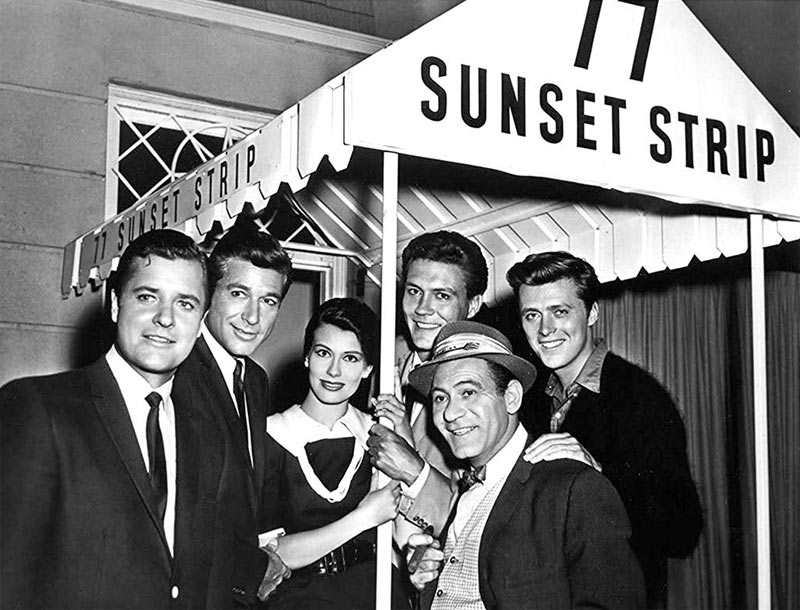
The 65th Anniversary of 77 Sunset Strip
It was 65 years ago today that the detective television series 77 Sunset Strip debuted on ABC. The show originally centred on Stuart Bailey (Efrem Zimbalist Jr.), a former secret agent for the OSS during World War II and foreign languages professor, and attorney Jeff Spencer (Roger Smith), who operate a detective agency out of fashionable offices in Suites 101 and 102 at 77 Sunset Strip. Suzanne Fabray (Jacqueline Beer), a French switchboard operator for the Sunset Answering Service, handled many of Bailey & Spencer's calls and sometimes got involved in cases. Kookie (Edd Byrnes) was a parking attendant at Dino's Lodge (Dean Martin's real-life lounge). He also became involved in cases and was later made a detective in the agency. Racetrack tout Roscoe (Louis Quinn) often hung out at the Bailey & Spencer offices and sometimes even did some work for the detectives. The contact at the Los Angeles Police Department on which they most frequently relied was Lieutenant Roy Gilmore (Byron Keith).
The origins of 77 Sunset Strip go back to the 1946 novel The Double Take by Roy Huggins, who would go onto create such shows as Maverick, The Fugitive, and The Rockford Files. The Double Take differed a bit from 77 Sunset Strip. For one thing, in Double Take Stuart Bailey has no partner. For another thing, Stu Bailey in The Double Take is not nearly as sophisticated, nor as hip, as Stu Bailey on 77 Sunset Strip. The Double Take would be adapted with a script by Roy Huggins himself as the 1948 film I Love Trouble, starring Franchot Tone as Stuart Bailey. Roy Huggins wrote no more novels featuring Stuart Bailey, although the detective did appear in the short stories "Now You See It" (1946), "Appointment with Fear" (1946), and "Death and the Skylark" (1952).
By the Fifties Roy Huggins was a producer for Warner Bros. While there he served as producer on the shows Cheyenne (the first hour-long Western) and Conflict. He created and produced the classic Western TV series Maverick and created the Western Colt .45. Given Warner Bros.' Western TV shows had proven successful, it occurred to him that an hour-long detective show could also prove successful. Roy Huggins then drew upon his novel The Double Take and his Stuart Bailey short stories to create 77 Sunset Strip.
It was William T. Orr, then head of Warner Bros. Television, who suggested to Roy Huggins that they could expand the initial story that Roy Huggins had written for 77 Sunset Strip and expand it into a ninety-minute movie in case they could not sell it as a television series. Marion Hargrove, who was writing the script for the initial 77 Sunset Strip episode, "Girl on the Run," then expanded the script for a ninety-minute movie also titled Girl on the Run. The movie was shot in ten days and, according to Roy Huggins in an Archive of American Television interview, was shown for a week at a theatre in the Caribbean. Warner Bros. Television then showed Girl on the Run to ABC, who picked up 77 Sunset Strip as a series. Unfortunately, the production of the theatrical film Girl on the Run allowed Warner Bros. to claim 77 Sunset Strip was based on the movie and as a result cheat Roy Huggins out of both a creator credit and his royalties. This despite the fact that it was inspired by Roy Huggins's novel The Double Take and the Stuart Bailey short stories, and used a story by him that had been adapted by writer Marion Hargrove as a screenplay.
Girl on the Run would be shown as the first episode of 77 Sunset Strip, even though it differed somewhat from the regular series. Of the show's regular characters, only Stuart Bailey (played by Efrem Zimbalist Jr.) and Suzanne (played by Jacqueline Beer) appear in the movie. Edd Byrnes does appear in the film, but he plays a very different character from Kookie. Instead he played a violent killer named Kenneth Smiley who is constantly combing his hair. Edd Byrnes made such an impression on younger viewers that ABC wanted Mr. Byrnes added to the cast of regulars on 77 Sunset Strip. He was then added to the cast as Gerald Lloyd "Kookie" Kookson III .
Roy Huggins had originally intended for 77 Sunset Strip to be a grim and gritty detective show, close in spirit to his novel The Double Take. The 23rd episode of the show's first season would see 77 Sunset Strip gradually take on a lighter tone. That episode, "The Pasadena Caper," also marked the first of several episodes in which the word "caper" was used in the title. Originally very much in the tradition of hard-boiled detective stories, 77 Sunset Strip developed an often self-deprecating sense of humour.
It was also during the first season that Kookie grew in popularity, proving to be the show's breakout character. As time passed, Kookie played a larger and larger role on the show. Actor Edd Byrnes realized the importance of the popularity of Kookie to 77 Sunset Strip, and during the second season Kookie was absent from 16 episodes as he held out for money money and a bigger role on the show. He eventually returned to the show later in the second season.
77 Sunset Strip proved to be a hit for ABC, particularly with younger views. Dell and later Gold Key produced several issues of a 77 Sunset Strip comic book. Bell, Lowell Toy Mfg. produced a 77 Sunset Strip board game. The three short stories featuring Stuart Bailey were compiled into a novel by Roy Huggins and published under the title 77 Sunset Strip as a paperback by Dell. Perhaps the most famous bit of promotion for 77 Sunset Strip was the novelty song "Kookie, Kookie (Lend Me Your Comb)" by Edward Byrnes and Connie Stevens. Released in March 1959, it reached no. 4 on the Billboard Hot 100. As to Connie Stevens, she was no stranger to Warner Bros. detective shows. She ultimately made four guest appearances on 77 Sunset Strip and played photographer Cricket Blake on Hawaiian Eye.
The success of 77 Sunset Strip would lead to the show essentially being "cloned" by Warner Bros. as yet other detective shows that were set in exotic locales; featured young, handsome detectives; and an attractive female regular. The 1959-1960 season saw the debut of Hawaiian Eye (set in Honolulu) and Bourbon Street Beat (set in New Orleans). The 1960-1961 season saw the debut of Surfside 6, set in Miami Beach. Many times scripts for 77 Sunset Strip episodes would be rewritten for these various shows. Like Warner Bros.' Western shows before them, 77 Sunset Strip and its clones were set in a shared universe, so that characters from one show might appear on episodes of another show. For example, two of Connie Stevens's guest appearances on 77 Sunset Strip were as Cricket Blake on Hawaiian Eye. It is also possible that the shared universe of the Warner Bros. detective shows was the same as the shared universe of the Warner Bros. Westerns. In the Maverick episode "Hadley's Hunters" Bart Maverick (Jack Kelly) encounters a stable hand played by Edd Byrnes at a stable called "77 Sunset Strip." While the stable hand could not possibly be Kookie (not unless he had found the fountain of youth), he could well be Kookie's grandfather or great grandfather.
77 Sunset Strip would see some cast changes throughout its run. Richard Long had played detective Rex Randolph on the TV show Bourbon Street Beat. When that show was cancelled, Richard Long joined the cast of 77 Sunset Strip, moving into Suite 104 at 77 Sunset Strip as part of Stuart Bailey and Jeff Spencer's detective agency for the show's third season. Rex Randolph would be gone by the fourth season of 77 Sunset Strip, and Kookie was finally promoted to a full-fledged detective, taking over Suite 104. Robert Logan was cast as the new parking attendant, J. R. Hale.
If anything, 77 Sunset Strip proved to be even more popular in its second season. It ranked no. 6 in the Nielsen ratings for the year. For its third season it ranked no. 13 in the Nielsen ratings for the season. By its fourth season it had dropped to no. 30 for the year. The fifth season would see 77 Sunset Strip no longer ranking in the top thirty in the Nielsens for the year. It was with the show's ratings declining that 77 Sunset Strip was entirely revamped. Jack Webb was brought in as executive producer and William Conrad was brought in as a producer and director. An even greater change is that the entire cast, except for Efrem Zimbalist Jr. as Stuart Bailey, was dismissed. Furthermore, no explanation was given for the absence of Jeff Spencer, Kookie, and the other regular characters. For all extents and purposes, Stuart Bailey was a different character. His past with the OSS was never mentioned and he was an overall more dour character. Stuart Bailey's office was different as well, even though the address was still "77 Sunset Strip." Even the tone of the show was now darker. For all extents and purposes, 77 Sunset Strip was now an entirely different show in which the lead character had the same name and was still played by the same actor.
Long-time fans of 77 Sunset Strip apparently did not appreciate the changes to the show. Ratings for 77 Sunset Strip dropped and the show ended its run in February 7 1964 after only twenty episodes. While 77 Sunset Strip was gone, it was hardly forgotten. It proved successful as a syndicated rerun. It would later air on TV Land and MeTV. There had been an plaque in the sidewalk at 8524 Sunset Boulevard, between La Cienega Boulevard and Alta Loma Road, in honour of the show (I don't know if it is still there or not). Prior to the launch of The WB, there was a proposed revival of 77 Sunset Strip that would air on the new network. A 25 minute presentation film was even shot for the spring 1995 upfronts, but nothing ever came of it.
77 Sunset Strip would be a historic show. Years before Law & Order, CSI, NCIS, and Chicago Fire/Chicago PD/Chicago Med, it pioneered the concept of shows and spinoffs set in the same reality. Along with Richard Diamond, Private Detective and Peter Gunn, it sparked a cycle towards detective show on American television that would last into the early Sixties. Perhaps most importantly, along with Cheyenne and Maverick, it was one of the early successes for Warner Bros. Television, which would go onto produce such shows as F Troop, The Streets of San Francisco, Night Court, and ER.
Monday, October 9, 2023
The 70th Anniversary of the TV Show Topper
![]() |
| Topper and the Kerbys |
Topper did very well in the ratings, ranking no. 24 for the year in the Nielsen ratings for its second season. Despite this, it ended its run after only two seasons because CBS could not find a sponsor for the show after Camel cigarettes had dropped out. While it only lasted two seasons, it would do well as a rerun in syndication. Much of this may have been because Topper was the first fantasy sitcom, and so was unique for its era. As such it would have an impact, even if it was not felt right away. After the success of My Favorite Martian in 1963, American airwaves would be filled with sitcoms about an ordinary human being living with such unusual characters as a witch, a robot, an angel, a car that was the reincarnation of his mother, a genie, and so on. If it had not been for the initial success of Topper and its subsequent success as a syndicated rerun, we might not have My Favorite Martian, Bewitched, I Dream of Jeannie, and the many other fantasy sitcoms that have aired ever since.
In 2014 I wrote a detailed post on the history of Topper, so I won't repeat myself here. You can read my original post on the TV series Topper here.
Saturday, October 7, 2023
Why I Don't Complain About Noir Alley
On October 1, Eddie Muller made a post to his Facebook page addressing complaints about a few "duds" airing on Noir Alley in September. I won't quote Mr. Muller's entire post here, as I feel as if readers can always visit his Facebook page to do so, but in part he wrote, "...I show a wide range of films within the elastic category 'Noir' because my personal taste does not dictate what I show--many viewers express enjoyment, even affection, for movies I don't find 'great.' But as a host, I'm not going to tell you something is 'fantastic' or 'legendary' or even 'good' if I don't actually believe it. My opinion doesn't discount the film, or the fact that someone else might think it's sensational." As someone who has watched Noir Alley from the very beginning and only missed a few editions of the programming block, I can understand what Mr. Muller is saying in his post.
Indeed, I am a bit puzzled by people complaining about "duds" being shown on Noir Alley in September 2023. On September 2, The Secret Fury (1950) was shown. Now I am not sure that I would say that The Secret Fury is outright noir, but it is definitely a psychological thriller with noirish elements. It was shot by cinematographer Leo Tover, who was also the cinematographer on such noirs as The Woman on the Beach (1947) and Dead Reckoning (1947), as well as the sci-fi classic The Day the Earth Stood Still (1951). On September 9, The Wrong Man (1956) was shown on Noir Alley. This film is an Alfred Hitchcock classic and about as close to Noir as Hitch ever came beyond Shadow of a Doubt (1943). I definitely would not consider it a "dud." On September 16 we were shown Out of the Fog (1941). Now I would consider Out of the Fog more proto-noir than pure Noir, but it benefits from a good plot and solid performances from John Garfield, Ida Lupino, and Eddie Albert. It also boasts great cinematography from the Master himself, James Wong Howe. Mr. Howe would be no stranger to Noir, shooting such films as Nora Prentiss (1947), Body and Soul (1947), and Sweet Smell of Success (1957). Perhaps the only movie I could see anyone rightfully calling a dud was Whiplash (1948), which aired on September 30. Now in my modest opinion (and apparently many others as well), Whiplash is not a good film. The plot seems cobbled together from other, better movies, and at times seems convoluted. There is a bit of miscasting in the form of Zachary Scott, who we are led to believe was in an occupation that no one would expect any of Mr. Scott's characters (or Mr. Scott himself) to ever be in. Even so, Whiplash has Eve Arden giving a great performance to make it worth watching. Anyway, as I see it, there was only one dud that aired on Noir Alley in September, and even it had some redeeming qualities.
Anyway, Eddie said of Noir Alley in his post, "It's a once-a-week affair, and it's a crap shoot as to what's coming next: big budget A picture? Poverty Row quickie? Foreign language classic? It's like life ... you can't be too sure about what's around the corner ... but we try to make it as entertaining and edifying as possible." And I think that is one of the most wonderful things about Noir Alley. One never knows what to expect in any given edition of the programming block. Will it be a classic like Out of the Past (1947)? Or will it be z-grade dreck like Wicked Woman (1953)? This sets Noir Alley apart from many movie anthologies that have aired in the past. Not every film that airs on Noir Alley is necessarily a classic or even a good movie, but I enjoy seeing all of them. Indeed, it can be almost as fun heckling a film like Wicked Woman as it is marvelling at a classic like Out of the Past.
Of course, another advantage in Noir Alley showing bad films as well as classics is that one actually gets the whole scope of the Film Noir movement. If only classics produced by the major studios were shown on Noir Alley, I think one would fail to grasp the sheer breadth of the movement. It did not just include great films produced by the major studios, but also good films produced by the smaller studios, such as Suspense (1946) from Monogram. It also included bad films from the major studios, such as the aforementioned Whiplash, as well as bad films from the smaller studios, such as Fear (1946) from Monogram. .
Aside from the wide variety of films shown on Noir Alley giving people a better idea of the sheer breadth of the Film Noir movement, I do think it is good for movie lovers to watch bad movies from time to time. Quite simply, I think by watching movies that are poorly made one develops a better appreciation for great films. Indeed, by examining what makes a particular movie "bad," one can also figure out why truly great films are, well, great. Quite simply, watching a movie like Wicked Woman makes one appreciate a movie like Out of the Past all the more.
Of course, here I must also point out that what is a "dud" for one person may be a truly great film for others. Eddie Muller states in his post that "many viewers express enjoyment, even affection, for movies I don't find 'great.'" I know that I have found myself at odds with my fellow film noir fans from time to time with regards to a particular movie. A perfect example of this for me is the movie Detour (1945). I have seen many, many people refer to it as a classic. I even know people who consider it among those film noirs one must absolutely see. As many readers of this blog already know, I do not consider Detour to be a good movie, let alone a classic. Does that mean other film noir fans are wrong? Does it mean I am wrong? The answer to both questions is, "No." Whether one considers a movie good or not is highly subjective. The old aphorism "One man's trash is another man's treasure" is all too true. I am sure that there are those film noirs I consider exceptional that others might consider just plain bad.
I certainly won't pretend to like every single film aired on Noir Alley. There have been films I have thoroughly disliked. There have been films I thorough enjoyed, but that I don't necessarily consider Noir. That having been said, I am not about to say none of them should have been shown on Noir Alley or that Eddie Muller is somehow dropping the ball in curating Noir Alley. I appreciate the wide variety of movies programmed on Noir Alley, from the greatest of classics to worst of the worst. Indeed, I think my appreciation of film noir as a movement is all the better for having watch the wide array of movies aired on Noir Alley.
Indeed, I am a bit puzzled by people complaining about "duds" being shown on Noir Alley in September 2023. On September 2, The Secret Fury (1950) was shown. Now I am not sure that I would say that The Secret Fury is outright noir, but it is definitely a psychological thriller with noirish elements. It was shot by cinematographer Leo Tover, who was also the cinematographer on such noirs as The Woman on the Beach (1947) and Dead Reckoning (1947), as well as the sci-fi classic The Day the Earth Stood Still (1951). On September 9, The Wrong Man (1956) was shown on Noir Alley. This film is an Alfred Hitchcock classic and about as close to Noir as Hitch ever came beyond Shadow of a Doubt (1943). I definitely would not consider it a "dud." On September 16 we were shown Out of the Fog (1941). Now I would consider Out of the Fog more proto-noir than pure Noir, but it benefits from a good plot and solid performances from John Garfield, Ida Lupino, and Eddie Albert. It also boasts great cinematography from the Master himself, James Wong Howe. Mr. Howe would be no stranger to Noir, shooting such films as Nora Prentiss (1947), Body and Soul (1947), and Sweet Smell of Success (1957). Perhaps the only movie I could see anyone rightfully calling a dud was Whiplash (1948), which aired on September 30. Now in my modest opinion (and apparently many others as well), Whiplash is not a good film. The plot seems cobbled together from other, better movies, and at times seems convoluted. There is a bit of miscasting in the form of Zachary Scott, who we are led to believe was in an occupation that no one would expect any of Mr. Scott's characters (or Mr. Scott himself) to ever be in. Even so, Whiplash has Eve Arden giving a great performance to make it worth watching. Anyway, as I see it, there was only one dud that aired on Noir Alley in September, and even it had some redeeming qualities.
Anyway, Eddie said of Noir Alley in his post, "It's a once-a-week affair, and it's a crap shoot as to what's coming next: big budget A picture? Poverty Row quickie? Foreign language classic? It's like life ... you can't be too sure about what's around the corner ... but we try to make it as entertaining and edifying as possible." And I think that is one of the most wonderful things about Noir Alley. One never knows what to expect in any given edition of the programming block. Will it be a classic like Out of the Past (1947)? Or will it be z-grade dreck like Wicked Woman (1953)? This sets Noir Alley apart from many movie anthologies that have aired in the past. Not every film that airs on Noir Alley is necessarily a classic or even a good movie, but I enjoy seeing all of them. Indeed, it can be almost as fun heckling a film like Wicked Woman as it is marvelling at a classic like Out of the Past.
Of course, another advantage in Noir Alley showing bad films as well as classics is that one actually gets the whole scope of the Film Noir movement. If only classics produced by the major studios were shown on Noir Alley, I think one would fail to grasp the sheer breadth of the movement. It did not just include great films produced by the major studios, but also good films produced by the smaller studios, such as Suspense (1946) from Monogram. It also included bad films from the major studios, such as the aforementioned Whiplash, as well as bad films from the smaller studios, such as Fear (1946) from Monogram. .
Aside from the wide variety of films shown on Noir Alley giving people a better idea of the sheer breadth of the Film Noir movement, I do think it is good for movie lovers to watch bad movies from time to time. Quite simply, I think by watching movies that are poorly made one develops a better appreciation for great films. Indeed, by examining what makes a particular movie "bad," one can also figure out why truly great films are, well, great. Quite simply, watching a movie like Wicked Woman makes one appreciate a movie like Out of the Past all the more.
Of course, here I must also point out that what is a "dud" for one person may be a truly great film for others. Eddie Muller states in his post that "many viewers express enjoyment, even affection, for movies I don't find 'great.'" I know that I have found myself at odds with my fellow film noir fans from time to time with regards to a particular movie. A perfect example of this for me is the movie Detour (1945). I have seen many, many people refer to it as a classic. I even know people who consider it among those film noirs one must absolutely see. As many readers of this blog already know, I do not consider Detour to be a good movie, let alone a classic. Does that mean other film noir fans are wrong? Does it mean I am wrong? The answer to both questions is, "No." Whether one considers a movie good or not is highly subjective. The old aphorism "One man's trash is another man's treasure" is all too true. I am sure that there are those film noirs I consider exceptional that others might consider just plain bad.
I certainly won't pretend to like every single film aired on Noir Alley. There have been films I have thoroughly disliked. There have been films I thorough enjoyed, but that I don't necessarily consider Noir. That having been said, I am not about to say none of them should have been shown on Noir Alley or that Eddie Muller is somehow dropping the ball in curating Noir Alley. I appreciate the wide variety of movies programmed on Noir Alley, from the greatest of classics to worst of the worst. Indeed, I think my appreciation of film noir as a movement is all the better for having watch the wide array of movies aired on Noir Alley.
Friday, October 6, 2023
¿Qué Pasa, USA?
Prior to the Seventies, Cubans and Cuban Americans were a rarity on American television. Perhaps the only Cuban character of any importance on a television show was Ricky Ricardo, played by Desi Arnaz, on the classic sitcom I Love Lucy. That would change in 1977 with the debut of ¿Qué Pasa, USA? on PBS. ¿Qué Pasa, USA? was a sitcom centred on the Peña family, a family of Cuban Americans living in Little Havana in Miami. T Pepe Peña (Manolo Villaverde) was the father and male head of the family. Juana (Ana Margarita Martínez-Casado) was the mother and female head of the family. Antonio (Luis Oquendo) was Juana's father, who spoke primarily Spanish and spoke English very poorly, so he often had to rely on Pepe and Juana as a translators. Adela (Velia Martinez), was Juana's mother, who was also primarily fluent in Spanish and had to rely on her children as translators. Joe (Steven Bauer) was Pepe and Juana's son. Carmen (Ana Margo) was Pepe and Juana's daughter. The primary followed the Peñas as they were torn between traditional Cuban values and the pressures of living in a primarily Anglo-American society. ¿Qué Pasa, USA? was not only historic as the first American sitcom based around a Cuban American family, but also as the first bilingual sitcom. Given the grandparents did not speak English, it was not unusual for episodes of the show to switch between Spanish and English. It was also the first sitcom produced exclusively for PBS.
The origins of ¿Qué Pasa, USA? go back to the Emergency School Aid Act of 1972, which essentially a Federal incentive program to encourage schools to desegregate. It was Senator Walter Mondale who introduced legislation that would create a program under the Emergency School Aid Act that would create educational television programming that would help children of diverse racial backgrounds connect with each other. The program came to be called ESAA-TV. It was ESAA-TV that would lead Manny Mendoza, a professor at Miami-Dade Community College, to create a show centred around a Cuban American family. Professor Mendoza had conducted studies for the Community Action and Research Group in Miami that indicated Cuban American teenagers were often isolated. He thought that an educational program that was also entertaining could alleviate this problem.
Professor Mendoza and his partner Julio Avello, along with Miami PBS station WPBT-2, then co-wrote a proposal for what would become ¿Qué Pasa, USA?. Professor Mendoza and WPBT-2 then secured Federal funding under ESAA-TV to go forward with the show. He approached Jose Bahamonde to serve as executive producer on the show. The budget for ¿Qué Pasa, USA? was miniscule compared to that of broadcast network sitcoms of the time. The first two seasons, with about ten episodes each, were budgeted at only $250,000 apiece. According to Jose Bahamonde, because of the low budget, he actually decorated the set with his own personal items and things he had bought at thrift stores. The limited budget would also have another impact on ¿Qué Pasa, USA?. At a time when shows on the commercial networks produced around 24 episodes per season, ¿Qué Pasa, USA? produced around 10 episodes per season.
Produced in Miami on a low budget, ¿Qué Pasa, USA? did not have access to actors well-known in the United States at the time. Velia Martinez, who played Abuela Adela, had a career going back to the Forties, having appeared in such Mexican films as El capitán Malacara (1945) and Loco y vagabundo (1946), and American films such as The Big Boodle (1957). Like Velia Martinez, Luis G. Oquendo, who played Abuelo Antonio, had appeared in Mexican films. Perhaps the member of the cast best known today is Steven Bauer, who played Joe. For the show he was billed under the name "Rocky Echevarria," and it was under that name that he guest stared on a 1978 episode of The Rockford Files. Steven Bauer left the show after its third season to pursue a Hollywood career. Joe was written off the show as having left to attend Miami University in Oxford, Ohio. Steven Bauer would go onto star in the final season of Wiseguy and would he would have recurring roles on such shows as Hacienda Heights, Ray Donovan, and Queen of the South.
¿Qué Pasa, USA? was created to be broadcast on local stations in the Miami and Tampa areas. In the end, the show proved to be popular, so that it would be broadcast on 70 PBS stations throughout the United States. It ultimately reached 20 million viewers. Not only did audiences love ¿Qué Pasa, USA?, but it was also well received by critics. Despite its popularity, ¿Qué Pasa, USA? ended after four seasons and 39 episodes when its funding ran out.
¿Qué Pasa, USA? was not gone, however, as it has continued to be rerun to this day. In 2018 the continued popularity of the show would result in a stage production titled ¿Qué Pasa, USA? Today...40 Years Older, which reunited some of the original cast members.
¿Qué Pasa, USA? would have a lasting impact beyond having launched Steven Bauer's career. It has never left the air and it is currently available on both YouTube and Vix. ¿Qué Pasa, USA? was the first real exposure Cuban Americans had on American television, and in the years since Cuban Americans have been more visible on American television. At a time when Cuban Americans were invisible on American television, ¿Qué Pasa, USA? broke down barriers.
The origins of ¿Qué Pasa, USA? go back to the Emergency School Aid Act of 1972, which essentially a Federal incentive program to encourage schools to desegregate. It was Senator Walter Mondale who introduced legislation that would create a program under the Emergency School Aid Act that would create educational television programming that would help children of diverse racial backgrounds connect with each other. The program came to be called ESAA-TV. It was ESAA-TV that would lead Manny Mendoza, a professor at Miami-Dade Community College, to create a show centred around a Cuban American family. Professor Mendoza had conducted studies for the Community Action and Research Group in Miami that indicated Cuban American teenagers were often isolated. He thought that an educational program that was also entertaining could alleviate this problem.
Professor Mendoza and his partner Julio Avello, along with Miami PBS station WPBT-2, then co-wrote a proposal for what would become ¿Qué Pasa, USA?. Professor Mendoza and WPBT-2 then secured Federal funding under ESAA-TV to go forward with the show. He approached Jose Bahamonde to serve as executive producer on the show. The budget for ¿Qué Pasa, USA? was miniscule compared to that of broadcast network sitcoms of the time. The first two seasons, with about ten episodes each, were budgeted at only $250,000 apiece. According to Jose Bahamonde, because of the low budget, he actually decorated the set with his own personal items and things he had bought at thrift stores. The limited budget would also have another impact on ¿Qué Pasa, USA?. At a time when shows on the commercial networks produced around 24 episodes per season, ¿Qué Pasa, USA? produced around 10 episodes per season.
Produced in Miami on a low budget, ¿Qué Pasa, USA? did not have access to actors well-known in the United States at the time. Velia Martinez, who played Abuela Adela, had a career going back to the Forties, having appeared in such Mexican films as El capitán Malacara (1945) and Loco y vagabundo (1946), and American films such as The Big Boodle (1957). Like Velia Martinez, Luis G. Oquendo, who played Abuelo Antonio, had appeared in Mexican films. Perhaps the member of the cast best known today is Steven Bauer, who played Joe. For the show he was billed under the name "Rocky Echevarria," and it was under that name that he guest stared on a 1978 episode of The Rockford Files. Steven Bauer left the show after its third season to pursue a Hollywood career. Joe was written off the show as having left to attend Miami University in Oxford, Ohio. Steven Bauer would go onto star in the final season of Wiseguy and would he would have recurring roles on such shows as Hacienda Heights, Ray Donovan, and Queen of the South.
¿Qué Pasa, USA? was created to be broadcast on local stations in the Miami and Tampa areas. In the end, the show proved to be popular, so that it would be broadcast on 70 PBS stations throughout the United States. It ultimately reached 20 million viewers. Not only did audiences love ¿Qué Pasa, USA?, but it was also well received by critics. Despite its popularity, ¿Qué Pasa, USA? ended after four seasons and 39 episodes when its funding ran out.
¿Qué Pasa, USA? was not gone, however, as it has continued to be rerun to this day. In 2018 the continued popularity of the show would result in a stage production titled ¿Qué Pasa, USA? Today...40 Years Older, which reunited some of the original cast members.
¿Qué Pasa, USA? would have a lasting impact beyond having launched Steven Bauer's career. It has never left the air and it is currently available on both YouTube and Vix. ¿Qué Pasa, USA? was the first real exposure Cuban Americans had on American television, and in the years since Cuban Americans have been more visible on American television. At a time when Cuban Americans were invisible on American television, ¿Qué Pasa, USA? broke down barriers.
Thursday, October 5, 2023
The Best Roles of Glynis Johns
Today legendary actress Glynis Johns turned 100 years old. She had a remarkable career that lasted decades, from the late Thirties to the late Nineties. She appeared on stage, in film, and on television. With an ethereal beauty, Glynis Johns could have made a good living simply playing romantic interests on stage and in film, but instead she played a wide variety of roles. Over the years she played everything from a mermaid to a suffragette to a famed author. What is more, she played all of them well. For that reason, choosing Glynis Johns's best roles is not an easy task.
Glynis Johns was born on October 5 1923 in Pretoria, Union of South Africa. It would be accurate to say that acting was in her blood. Her father was Welsh actor Melvyn Johns, perhaps most familiar to viewers today from his role in the horror classic Dead of Night (1945). Her mother was Alyce Steele-Wareham, an esteemed concert pianist and an accomplished violinist. Her family having returned to the United Kingdom not long after her birth, she started training in ballet when she was only five years old. At eight years old she played Sonia Kuman in the play Judgement Day at the Phoenix Theatre in London. She was only fifteen when she made her film debut in South Riding in 1938. Coming from a theatrical family and trained nearly from birth to perform, there is little wonder that Glynis Johns should be a remarkable talent.
Without further ado, here are what I consider to be Glynis Johns's five best roles, although I could list many more.
Miranda (1948): Based on the play by Peter Blackmore, Miranda starred Glynis Johns as the mermaid of the title. Miranda has an incredible power over men, complicated by the fact that she tends to flirt with every single man she meets. Naturally, this arouses jealousy in the wives of these men. Much to the misfortune of Claire Martin (Googie Withers), Miranda is most interested in her husband, Dr. Paul Martin (Griffith Jones). A lesser actress may have depended primarily upon their looks to play Miranda, but Glynis Johns endows the character with a real personality, making the mermaid all the more seductive. Miranda was released the same year as the Hollywood classic Mr. Peabody and the Mermaid (1948), starring William Powell and Ann Blyth. As much as I love Ann Blyth and as good a job as she did in Mr. Peabody and the Mermaid, I think Glynis Johns was actually the better of the two.
The Court Jester (1955): In The Court Jester, Danny Kaye plays Hubert Hawkins, a minstrel of a band of rebels led by the Black Fox. To infiltrate the castle, the rebels meet and then knock unconscious tyrannical King Roderick's new court jester, Giacomo (John Carradine), so Hubert can assume his identity and infiltrate the king's castle. Among the captains of the rebels is Maid Jean, played by Glynis Johns. Jean is a far cry from Maid Marian in The Adventures of Robin Hood (1938). Jean is skilled with the sword and with the bow, and fight better than most men. At the same time Jean is sweet natured and it is her love for justice that found her among the rebels to begin with. As a trained dancer, Glynis Johns easily pulls off Jean's physicality, while at the same time infusing her with both a passion for justice and genuine concern for her fellow human beings.
The Sundowners (1960): In The Sundowners Glynis Johns played a role that was well removed from Miranda or Jean. She played Mrs. Firth, the owner of the local pub in Cawndilla. Mrs. Firth is feisty, loud, talkative, and very flirtatious. While Mrs. Firth does not have a lot of screen time, Glynis Johns makes her easily the most interesting character in the film, through her body language, her eyes, and her voice.
Mary Poppins (1964): There can be no doubt that Glynis Johns is perhaps best known as Winifred Banks, the wife of banker George Banks (David Tomlinson) in Mary Poppins. The movie was the highest grossing film of 1964, beating out both My Fair Lady and Goldfinger And it has remained popular ever since. Much of the reason for the film's success was its cast, in particular Julie Andrews as the nanny of the title, who was "practically prefect in every way." While Julie Andrews was the star of Mary Poppins, the rest of the cast got to shine as well. Glynis Johns delivers a fine performance as Winifred Banks. Winifred is easily distracted and nearly all-consumed by the suffrage movement, to the point that she sometimes does not pay that much attention to her children. At the same time she tries to be a model mother and wife, something complicated by her husband George Banks's demand for an overly efficiently run household. Winifred is not given a lot to do in Mary Poppins, but Glynis Johns brings her to life wonderfully.
The Vault of Horror (1973): The Vault of Horror is one of the portmanteau horror movies made by Amicus Productions. It was a follow-up to Tales from the Crypt (1972), and both films were inspired by classic EC Comics stories. Glynis Johns appears in the segment "The Neat Job," once more playing a wife and homemaker. In this case she is Eleanor Critchit, the trophy wife of Arthur Critchit (Terry-Thomas). To say Arthur is obsessive-compulsive when it comes to neatness might be an understatement. Unfortunately, housekeeping is not among Eleanor's talents, and she sometimes makes more of a mess than she cleans things up. Of course, this leads to constant nagging from Arthur. This being based on an EC Comics story, Eleanor does eventually get her revenge. Glynis Johns does a wonderful job of playing Eleanor, endowing the character with a personality and generating a good deal of sympathy for her in the brief time she has on screen.
Glynis Johns was born on October 5 1923 in Pretoria, Union of South Africa. It would be accurate to say that acting was in her blood. Her father was Welsh actor Melvyn Johns, perhaps most familiar to viewers today from his role in the horror classic Dead of Night (1945). Her mother was Alyce Steele-Wareham, an esteemed concert pianist and an accomplished violinist. Her family having returned to the United Kingdom not long after her birth, she started training in ballet when she was only five years old. At eight years old she played Sonia Kuman in the play Judgement Day at the Phoenix Theatre in London. She was only fifteen when she made her film debut in South Riding in 1938. Coming from a theatrical family and trained nearly from birth to perform, there is little wonder that Glynis Johns should be a remarkable talent.
Without further ado, here are what I consider to be Glynis Johns's five best roles, although I could list many more.
Miranda (1948): Based on the play by Peter Blackmore, Miranda starred Glynis Johns as the mermaid of the title. Miranda has an incredible power over men, complicated by the fact that she tends to flirt with every single man she meets. Naturally, this arouses jealousy in the wives of these men. Much to the misfortune of Claire Martin (Googie Withers), Miranda is most interested in her husband, Dr. Paul Martin (Griffith Jones). A lesser actress may have depended primarily upon their looks to play Miranda, but Glynis Johns endows the character with a real personality, making the mermaid all the more seductive. Miranda was released the same year as the Hollywood classic Mr. Peabody and the Mermaid (1948), starring William Powell and Ann Blyth. As much as I love Ann Blyth and as good a job as she did in Mr. Peabody and the Mermaid, I think Glynis Johns was actually the better of the two.
The Court Jester (1955): In The Court Jester, Danny Kaye plays Hubert Hawkins, a minstrel of a band of rebels led by the Black Fox. To infiltrate the castle, the rebels meet and then knock unconscious tyrannical King Roderick's new court jester, Giacomo (John Carradine), so Hubert can assume his identity and infiltrate the king's castle. Among the captains of the rebels is Maid Jean, played by Glynis Johns. Jean is a far cry from Maid Marian in The Adventures of Robin Hood (1938). Jean is skilled with the sword and with the bow, and fight better than most men. At the same time Jean is sweet natured and it is her love for justice that found her among the rebels to begin with. As a trained dancer, Glynis Johns easily pulls off Jean's physicality, while at the same time infusing her with both a passion for justice and genuine concern for her fellow human beings.
The Sundowners (1960): In The Sundowners Glynis Johns played a role that was well removed from Miranda or Jean. She played Mrs. Firth, the owner of the local pub in Cawndilla. Mrs. Firth is feisty, loud, talkative, and very flirtatious. While Mrs. Firth does not have a lot of screen time, Glynis Johns makes her easily the most interesting character in the film, through her body language, her eyes, and her voice.
Mary Poppins (1964): There can be no doubt that Glynis Johns is perhaps best known as Winifred Banks, the wife of banker George Banks (David Tomlinson) in Mary Poppins. The movie was the highest grossing film of 1964, beating out both My Fair Lady and Goldfinger And it has remained popular ever since. Much of the reason for the film's success was its cast, in particular Julie Andrews as the nanny of the title, who was "practically prefect in every way." While Julie Andrews was the star of Mary Poppins, the rest of the cast got to shine as well. Glynis Johns delivers a fine performance as Winifred Banks. Winifred is easily distracted and nearly all-consumed by the suffrage movement, to the point that she sometimes does not pay that much attention to her children. At the same time she tries to be a model mother and wife, something complicated by her husband George Banks's demand for an overly efficiently run household. Winifred is not given a lot to do in Mary Poppins, but Glynis Johns brings her to life wonderfully.
The Vault of Horror (1973): The Vault of Horror is one of the portmanteau horror movies made by Amicus Productions. It was a follow-up to Tales from the Crypt (1972), and both films were inspired by classic EC Comics stories. Glynis Johns appears in the segment "The Neat Job," once more playing a wife and homemaker. In this case she is Eleanor Critchit, the trophy wife of Arthur Critchit (Terry-Thomas). To say Arthur is obsessive-compulsive when it comes to neatness might be an understatement. Unfortunately, housekeeping is not among Eleanor's talents, and she sometimes makes more of a mess than she cleans things up. Of course, this leads to constant nagging from Arthur. This being based on an EC Comics story, Eleanor does eventually get her revenge. Glynis Johns does a wonderful job of playing Eleanor, endowing the character with a personality and generating a good deal of sympathy for her in the brief time she has on screen.
Tuesday, October 3, 2023
Godspeed Sir Michael Gambon
Sir Michael Gambon, who starred on the TV series Maigret and played Albus Dumbledore in various "Harry Potter" movies, died on September 27 2023 at the age of 82 following a bout of pneumonia.
Michael Gambon was born in Cabra, a suburb of Dublin, on October 19 1940. When he was six years old, his family moved to London. He attended St Aloysius Boys' School in Somers Town and St Aloysius' College in Highgate. He later attended Crayford Secondary School, but left at age 15. He apprenticed as a toolmaker with Vickers-Armstrongs at age 16. He was a qualified engineering technician by the time he was 21.
Michael Gambon made his debut as a professional actor in a production of Othello at the Gate Theatre in Dublin. He later joined Lord Laurence Olivier's National Theatre Company, which included such other actors as Frank Finlay, Derek Jacobi, and Robert Stephens. He made his film debut in Othello in 1965. It was in 1967 that he made his television debut in an episode of Softly, Softly. In the late Sixties he guest starred on Public Eye, Fraud Squad, and Confession. He was one of the leads on the TV series The Borderers.
In the Seventies he was a regular on the TV shows Eyeless in Gaza, The Challengers, and The Other One. He guest starred on the shows The Man Outside, Kate, Softly, Softly: Task Force, Love Story, Menace, A Picture of Katherine Mansfield, Special Branch, Arthur of the Britons, Six Days of Justice, ITV Saturday Night Theatre, Orson Welles' Great Mysteries, Zodiac, Second City Firsts, Masquerade, Centre Play, ITV Sunday Night Drama, Play for Today, The Sunday Drama, BBC Play of the Month, Play for Love, Premiere, and Tales of the Unexpected. He appeared in the movies Nothing But the Night (1973) and The Beast Must Die (1974).
In the Eighties Michael Gambon starred in the TV shows Oscar and The Singing Detective. He guest starred on the shows ITV Playhouse. Bergerac, and Theatre Night. He appeared in the movies Turtle Diary (1985), Paris By Night (1988), The Rachel Papers (1989), The Cook, the Thief, His Wife & Her Lover (1989), and A Dry White Season (1989).
In the Nineties he played Chief Inspector Jules Maigret on the TV series Maigret. He was The Storyteller on the TV series The Storyteller: Greek Myths. He appeared in the mini-series Samson and Delilah and Wives and Daughters. He guest starred on the TV series Minder and Performance. He appeared in the movies Mobsters (1991), Toys (1992), Clean Slate (1994), A Man of No Importance (1994), Squanto: A Warrior's Tale (1994), Nothing Personal (1995), Two Deaths (1995), The Innocent Sheep (1995), Mary Reilly (1996), The Wings of the Dove (1997), The Gambler (1997), Dancing at Lughnasa (1998), Plunkett & Macleane (1999), The Last September (1999), The Insider (1999), and Sleepy Hollow (1999).
In the Naughts Michael Gambon took over the role of Professor Albus Dumbleore with the movie Harry Potter and the Prisoner of Azkaban in 2004 following the death of Richard of Harris. He played Dumbledore in the remaining "Harry Potter" movies: Harry Potter and the Goblet of Fire (2005), Harry Potter and the Order of the Phoenix (2007), Harry Potter and the Half-Blood Prince (2009), Harry Potter and the Deathly Hallows--Part 1 (2010), and Harry Potter and the Deathly Hallows--Part Two (2011). He also voiced Dumbledore in "Harry Potter" video games. He appeared in the movies High Heels and Low Lifes (2001), Gosford Park (2001), Charlotte Gray (2001), Ali G Indrahouse (2002), The Actors (2003), Open Range (2003), Sylvia (2003), Sky Captain and the World of Tomorrow (2004), Being Julia (2004), Layer Cake (2004), The Life Aquatic with Steve Zissou (2004), The Omen (2006), Amazing Grace (2006), The Good Shepherd (2006), The Good Night (2007), The Baker (2007), Brideshead Revisited (2008), The Book of Eli (2010), and The King's Speech (2010). He was the voice of Franklin Bean in the animated movie Fantastic Mr. Fox. He guest starred on the TV shows Cranford and Doctor Who. He appeared in the mini-series Perfect Strangers, Angels in America, and Emma.
In the Teens Michael Gambon starred on the show Luck and Fortitude. He appeared in the min-series Lucan, Quirke, The Casual Vacancy, Fearless, and Little Women. He guest starred on the show The Hollow Crown. He appeared in the movies Quartet (2012), Dad's Army (2017), Viceroy's House (2017), Mad to be Normal (2017), Victoria & Abdul (2017), Kingsman: The Golden Circle (2017), The Last Witness (2018), The Death & Life of John F. Donovan (2018), King of Thieves (2018), Johnny English Strikes Again (2018), Judy (2019), and Cordelia (2019). He was the voice of Uncle Pastuzo in both Paddington (2014) and Paddington 2 (2017), He was the narrator for Hail, Caesar! (2016).
I have to think that for many younger viewers Sir Michael Gambon will always be best known as Professor Albus Dumbledore. And there is no denying he was marvellous in the role, but he also played a wide variety of other parts in which he was also great. He was perfect as the pianist Jan Jarmokowski in the Amicus Productions horror movie The Beast Must Die. He gave a fantastic performance as Albert Spica, the brutal, coarse gangster who wants to be a gourmet in The Cook, the Thief, His Wife & Her Lover. On television he did well as mystery writer Phillip E. Marlow and the fictional detective of his creation. He gave a good performance as Chief Inspector Maigret on the 1992 TV series Maigret. Michael Gambon played a wide variety of roles, often dramatically different from each other, and played all of them well.
Michael Gambon was born in Cabra, a suburb of Dublin, on October 19 1940. When he was six years old, his family moved to London. He attended St Aloysius Boys' School in Somers Town and St Aloysius' College in Highgate. He later attended Crayford Secondary School, but left at age 15. He apprenticed as a toolmaker with Vickers-Armstrongs at age 16. He was a qualified engineering technician by the time he was 21.
Michael Gambon made his debut as a professional actor in a production of Othello at the Gate Theatre in Dublin. He later joined Lord Laurence Olivier's National Theatre Company, which included such other actors as Frank Finlay, Derek Jacobi, and Robert Stephens. He made his film debut in Othello in 1965. It was in 1967 that he made his television debut in an episode of Softly, Softly. In the late Sixties he guest starred on Public Eye, Fraud Squad, and Confession. He was one of the leads on the TV series The Borderers.
In the Seventies he was a regular on the TV shows Eyeless in Gaza, The Challengers, and The Other One. He guest starred on the shows The Man Outside, Kate, Softly, Softly: Task Force, Love Story, Menace, A Picture of Katherine Mansfield, Special Branch, Arthur of the Britons, Six Days of Justice, ITV Saturday Night Theatre, Orson Welles' Great Mysteries, Zodiac, Second City Firsts, Masquerade, Centre Play, ITV Sunday Night Drama, Play for Today, The Sunday Drama, BBC Play of the Month, Play for Love, Premiere, and Tales of the Unexpected. He appeared in the movies Nothing But the Night (1973) and The Beast Must Die (1974).
In the Eighties Michael Gambon starred in the TV shows Oscar and The Singing Detective. He guest starred on the shows ITV Playhouse. Bergerac, and Theatre Night. He appeared in the movies Turtle Diary (1985), Paris By Night (1988), The Rachel Papers (1989), The Cook, the Thief, His Wife & Her Lover (1989), and A Dry White Season (1989).
In the Nineties he played Chief Inspector Jules Maigret on the TV series Maigret. He was The Storyteller on the TV series The Storyteller: Greek Myths. He appeared in the mini-series Samson and Delilah and Wives and Daughters. He guest starred on the TV series Minder and Performance. He appeared in the movies Mobsters (1991), Toys (1992), Clean Slate (1994), A Man of No Importance (1994), Squanto: A Warrior's Tale (1994), Nothing Personal (1995), Two Deaths (1995), The Innocent Sheep (1995), Mary Reilly (1996), The Wings of the Dove (1997), The Gambler (1997), Dancing at Lughnasa (1998), Plunkett & Macleane (1999), The Last September (1999), The Insider (1999), and Sleepy Hollow (1999).
In the Naughts Michael Gambon took over the role of Professor Albus Dumbleore with the movie Harry Potter and the Prisoner of Azkaban in 2004 following the death of Richard of Harris. He played Dumbledore in the remaining "Harry Potter" movies: Harry Potter and the Goblet of Fire (2005), Harry Potter and the Order of the Phoenix (2007), Harry Potter and the Half-Blood Prince (2009), Harry Potter and the Deathly Hallows--Part 1 (2010), and Harry Potter and the Deathly Hallows--Part Two (2011). He also voiced Dumbledore in "Harry Potter" video games. He appeared in the movies High Heels and Low Lifes (2001), Gosford Park (2001), Charlotte Gray (2001), Ali G Indrahouse (2002), The Actors (2003), Open Range (2003), Sylvia (2003), Sky Captain and the World of Tomorrow (2004), Being Julia (2004), Layer Cake (2004), The Life Aquatic with Steve Zissou (2004), The Omen (2006), Amazing Grace (2006), The Good Shepherd (2006), The Good Night (2007), The Baker (2007), Brideshead Revisited (2008), The Book of Eli (2010), and The King's Speech (2010). He was the voice of Franklin Bean in the animated movie Fantastic Mr. Fox. He guest starred on the TV shows Cranford and Doctor Who. He appeared in the mini-series Perfect Strangers, Angels in America, and Emma.
In the Teens Michael Gambon starred on the show Luck and Fortitude. He appeared in the min-series Lucan, Quirke, The Casual Vacancy, Fearless, and Little Women. He guest starred on the show The Hollow Crown. He appeared in the movies Quartet (2012), Dad's Army (2017), Viceroy's House (2017), Mad to be Normal (2017), Victoria & Abdul (2017), Kingsman: The Golden Circle (2017), The Last Witness (2018), The Death & Life of John F. Donovan (2018), King of Thieves (2018), Johnny English Strikes Again (2018), Judy (2019), and Cordelia (2019). He was the voice of Uncle Pastuzo in both Paddington (2014) and Paddington 2 (2017), He was the narrator for Hail, Caesar! (2016).
I have to think that for many younger viewers Sir Michael Gambon will always be best known as Professor Albus Dumbledore. And there is no denying he was marvellous in the role, but he also played a wide variety of other parts in which he was also great. He was perfect as the pianist Jan Jarmokowski in the Amicus Productions horror movie The Beast Must Die. He gave a fantastic performance as Albert Spica, the brutal, coarse gangster who wants to be a gourmet in The Cook, the Thief, His Wife & Her Lover. On television he did well as mystery writer Phillip E. Marlow and the fictional detective of his creation. He gave a good performance as Chief Inspector Maigret on the 1992 TV series Maigret. Michael Gambon played a wide variety of roles, often dramatically different from each other, and played all of them well.
Subscribe to:
Posts (Atom)