Tim Considine, who played eldest son Mike on My Three Sons for its first five seasons and starred in Mickey Mouse Club serials featuring Spin and Marty and The Hardy Boys, died on March 3 2022 at the age of 81.
Tim Considine was born on December 31 1940 in Los Angeles, California His father, John W. Considine Jr., was a producer for MGM. His grandfather, John Considine, was a vaudeville impresario. It was then perhaps natural for Tim Considine to go into entertainment.
Tim Considine made his movie debut in 1953 in The Clown, playing the son of the title character played by Red Skelton. That same year he made his television debut in an episode of the show I'm the Law. He made guest appearances on the shows The Ford Television Theatre, Your Jeweler's Showcase, Chevron Theatre, The Adventures of Rin Tin Tin, The Great Gildersleeve, and Treasury Men in Action. In 1955 he was cast as Spin on the Mickey Mouse Club serial "The Adventures of Spin and Marty." Tim Considine would appear in subsequent Mickey Mouse Club serials, playing Spin in two more "Spin and Marty" serials, Frank Hardy in two "Hardy Boys" serials, and Steven Abernathy in the serial "Annette." Tim Considine would do further work for Walt Disney, appearing in the Disneyland serial "The Swamp Fox" and the feature film The Shaggy Dog (1960). It was in 1960 that Tim Considine was cast as Mike Douglas in the sitcom My Three Sons. In the mid to late Fifties he also appeared in the movies Executive Suite (1954), Her Twelve Men (1954), Unchained (1955), The Private War of Major Benson (1955), and Sunrise at Campobello (1960). He guest starred on the shows Zane Grey Theatre, Cheyenne, and Johnny Ringo.
In the Sixties Tim Considine continued to appear on My Three Sons until its fifth season. While he enjoyed working on the show and loved his cast mates, he had tired of the series by that point. His character, the eldest son Mike, was written out of the show as having married his fiancée Sally Ann Morrison (Meredith MacRae). He guest starred on the shows The Untouchables, Bonanza, The Fugitive, Medical Center, Ironside, and Gunsmoke. He appeared in the movie Patton (1970), playing a soldier suffering from post traumatic stress disorder who is slapped by General Patton.
In 1971 Tim Considine guest starred on an episode of The Smith Family. In 1973 he appeared in the movie The Daring Dobermans. Thereafter he left acting and took up writing and photography. He wrote the books The Photographic Dictionary of Soccer, The Language of Sport, American Grand Prix Racing: A Century of Drivers & Cars, and Twice Around the Clock: The Yanks at Le Mans. He returned to television in a guest appearance on the short-lived television series Legend. In 2000 he appeared in the Wonderful World of Disney TV movie The New Adventures of Spin and Marty: Suspect Behavior. He appeared in the movies Monster Makers and Frankenfish. His final feature film appearance was in the movie Ray of Sunshine (2007).
Tim Considine will probably always be best known for his work with Disney and his stint on My Three Sons, but he displayed considerable range during his career. In the episode "The Spoiler" of The Untouchables, he played Arnie Mizo, who helps his uncle Johnny Mizo (Rip Torn) recover money Johnny had stolen from mobster Vince Majesky (Claude Akins). In the Bonanza episode "The Reluctant Rebel" he played the son of a hog farmer (Royal Dano) who is embarrassed by his father's occupation and finds himself in a gang of rustlers. In the Fugitive episode "Second Sight" freelance photographer who learns a temporarily blinded Richard Kimble is on the run and is tempted by the $10,000 reward for his capture. Tim Considine was an extremely talented actor who played a variety of roles throughout his career.
Saturday, March 5, 2022
Friday, March 4, 2022
The 100th Anniversary of Nosferatu – Eine Symphonie des Grauens
It as 100 years ago today that Nosferatu – Eine Symphonie des Grauens (1922) was released in Germany. Along with The Phantom of the Opera (1925), it may well be the most famous silent horror movie of all time. It is also one of the most famous adaptations of Bram Stoker's Dracula, despite being wholly unauthorized. Despite a successful copyright infringement lawsuit by Bram Stoker's widow Florence Stoker, Nosferatu – Eine Symphonie des Grauens would prove to be one of the most influential, if not the most influential, vampire movie of all time.Indeed, it was Nosferatu – Eine Symphonie des Grauens that introduced the idea that vampires can be destroyed by sunlight (it isn't found in folkore).
I have already written several posts mentioning Nosferatu – Eine Symphonie des Grauens, so I won't repeat myself here. I will simply direct people to my 2015 post Nosferatu – Eine Symphonie des Grauens (1922). You can read it here.
Thursday, March 3, 2022
Godspeed Gary Brooker
Gary Brooker, the leader of the band Procol Harum died on February 19 at the age of 76. The cause was cancer. He was the only member of Procol Harum to remain with the band for the entirety of its history.
Gary Brooker was born on May 29 1945 in Hackney, East London. He spent his early years in Hackney before his family moved to Middlesex. His father played steel guitar with Felix Mendelssohn's Hawaiian Serenaders. Gary Brooker was still very young when he learned to play piano, cornet, and trombone. In 1945 his family moved to Southend-on-Sea, Essex. He attended Southend Municipal College, where he studied zoology and botany, but he left the college to become a professional musician.
In the early Sixties Gary Brooker and guitarist Robin Trower founded The Paramounts. The Paramounts had a single hit with a cover of The Coasters' "Poison Ivy." The Paramounts disbanded in 1966. That same year Gary Brooker formed Procol. Harum with Keith Reid. It was their manager, Guy Stevens, who came up with the band's name, taking it from the name of a Burmese cat owned by one of their friends, Liz Coombes. Their debut single, "A Whiter Shade of Pale," proved to be one of the most successful records of all time. The song hit no. 1 on the UK singles chart and no. 1 in several other countries as well. It reached no. 5 on the Billboard Hot 100. Their first album, Procol Harum, reached no. 26.
Procol Harum never again repeated the success of "A Whiter Shade of Pale," but they would see a good deal of success over the years. Into the early Seventies Procol Harum's albums regularly reached the top fifty of the UK album chart. The band also did well with regards to their singles. Their second single,"Homburg," reached no. 6 on the UK singles chart. Their 1972 single "Conquistador" reached no. 22 on the UK singles chart. In 1975 "Pandora's Box" reached no. 16. From 1967 to 2017 Procol Harum disbanded in 1977. They reformed in 1991. In all , between 1967 and 2017, they released 20 studio albums.
While Procol Harum was disbanded, Gary Brooker released three solo albums: No More Fear of Flying (1979), Lead Me to the Water (1982), and Echoes in the Night (1985). Here leased one live album, Within Our House, in 1996. Over the years he contributed to the albums of others, from George Harrison's All Things must Pass to The Alan Parsons Project's Stereotomy to Kate Bush's Aerial.
Gary Brooker was nothing if not versatile. "A Whiter Shade of Pale" has been classed as "baroque pop." Yet other songs have been counted as progressive rock or psychedelia. Yet other songs show influence from British music halls, the blues, and classical music. It was because of Gary Brooker's diverse styles that it was difficult to pigeonhole Mr. Brooker or Procol Harum in any one genre. Although they were often classed as progressive rock, they played everything from psychedelia to jazz rock. A pianist rivalled by none and a composer capable of a diverse number of styles Gary Brooker was extremly talented.
Gary Brooker was born on May 29 1945 in Hackney, East London. He spent his early years in Hackney before his family moved to Middlesex. His father played steel guitar with Felix Mendelssohn's Hawaiian Serenaders. Gary Brooker was still very young when he learned to play piano, cornet, and trombone. In 1945 his family moved to Southend-on-Sea, Essex. He attended Southend Municipal College, where he studied zoology and botany, but he left the college to become a professional musician.
In the early Sixties Gary Brooker and guitarist Robin Trower founded The Paramounts. The Paramounts had a single hit with a cover of The Coasters' "Poison Ivy." The Paramounts disbanded in 1966. That same year Gary Brooker formed Procol. Harum with Keith Reid. It was their manager, Guy Stevens, who came up with the band's name, taking it from the name of a Burmese cat owned by one of their friends, Liz Coombes. Their debut single, "A Whiter Shade of Pale," proved to be one of the most successful records of all time. The song hit no. 1 on the UK singles chart and no. 1 in several other countries as well. It reached no. 5 on the Billboard Hot 100. Their first album, Procol Harum, reached no. 26.
Procol Harum never again repeated the success of "A Whiter Shade of Pale," but they would see a good deal of success over the years. Into the early Seventies Procol Harum's albums regularly reached the top fifty of the UK album chart. The band also did well with regards to their singles. Their second single,"Homburg," reached no. 6 on the UK singles chart. Their 1972 single "Conquistador" reached no. 22 on the UK singles chart. In 1975 "Pandora's Box" reached no. 16. From 1967 to 2017 Procol Harum disbanded in 1977. They reformed in 1991. In all , between 1967 and 2017, they released 20 studio albums.
While Procol Harum was disbanded, Gary Brooker released three solo albums: No More Fear of Flying (1979), Lead Me to the Water (1982), and Echoes in the Night (1985). Here leased one live album, Within Our House, in 1996. Over the years he contributed to the albums of others, from George Harrison's All Things must Pass to The Alan Parsons Project's Stereotomy to Kate Bush's Aerial.
Gary Brooker was nothing if not versatile. "A Whiter Shade of Pale" has been classed as "baroque pop." Yet other songs have been counted as progressive rock or psychedelia. Yet other songs show influence from British music halls, the blues, and classical music. It was because of Gary Brooker's diverse styles that it was difficult to pigeonhole Mr. Brooker or Procol Harum in any one genre. Although they were often classed as progressive rock, they played everything from psychedelia to jazz rock. A pianist rivalled by none and a composer capable of a diverse number of styles Gary Brooker was extremly talented.
Tuesday, March 1, 2022
The Late Great Veronica Carlson
Among the many actresses to appear in the Hammer Horrors, Veronica Carlson numbered among fans' favourites. She was a frequent guest at conventions, where she became known for her friendliness and her respect for her fans. I never had the opportunity to meet Miss Carlson, but I know people who did. What is more, Veronica Carlson and I had mutual friends. All of them adored her. Sadly, Veronica Carlson died on February 27 2022 at the age of 77.
Veronica Carlson was born Veronica Mary Glazer on September 18 1944 in Yorkshire. Her father was stationed in West Germany, so she spent much of her childhood there. She attended Thetford Girls' School and the High Wycombe College of Technology and Design, where she studied art.
Veronica Carlson worked as a model which led to bit parts in Casino Royale (1967) and Smashing Time (1967). James Carreras of Hammer Production noticed a photo of Miss Carlson emerging out of the waves in a bikini that had appeared in a tabloid. She went in for an audition was was cast in the film Dracula Has Risen from the Grave (1968). In the late Sixties she also appeared in the movies Hammerhead (1968), Frankenstein Must Be Destroyed (1969), The Best House in London (1969), Crossplot (1969), Pussycat, Pussycat, I Love You (1970), and The Horror of Frankenstein (1970). She made her television debut in an episode of ITV Playhouse. She guest starred on The Saint, Department S, and Randall and Hopkirk (Deceased).
In the Seventies Veronica Carlson was a regular on the British TV series Spyder's Web. She also guest starred on Hine and Public Eye. She appeared in the films Vampira (1974) and The Ghoul (1975). In the mid-Seventies she went into semi-retirement. She moved to the Unites States and later settled in South Carolina. Miss Carlson was an accomplished and successful painter.
Veronica Carlson would return to film, appearing the movies Black Easter (1994), Freakshow (1995), Stellar Quasar and the Scrolls of Dadelia (2016), and House of the Gorgon (2019). She was set to appear in the movie The Refractory.
Veronica Carlson was a very good actress. In Dracula Has Risen from the Grave, she played the niece of a priest who very nearly comes under Dracula's control. In Frankenstein Must Be Destroyed she played the landlady Anna, who has the misfortune of having Dr. Frankenstein as a tenant. While The Horror of Frankenstein is a lesser effort from Hammer, she did well as Elizabeth in the film. In The Saint episode "The Man Who Gambled with Life," she was impressive as the daughter of an eccentric entrepreneur.
As mentioned earlier, Veronica Carlson was a favourite at conventions. Also as I mentioned earlier, we had mutual friends. They were all unanimous in their adoration of Miss Carlson. She was beautiful and elegant even as she grew older, yet she was so unassuming that one would not realize she was a well known actress if they did not know better. Miss Carlson also had a wonderful sense of humour. She was known for her kindness and thoughtfulness, and when someone talked to her, they had her total attention. Veronica Carlson was certainly known for her beauty, from those who met her and her close friends, she was a woman who had a beautiful soul as well.
Veronica Carlson was born Veronica Mary Glazer on September 18 1944 in Yorkshire. Her father was stationed in West Germany, so she spent much of her childhood there. She attended Thetford Girls' School and the High Wycombe College of Technology and Design, where she studied art.
Veronica Carlson worked as a model which led to bit parts in Casino Royale (1967) and Smashing Time (1967). James Carreras of Hammer Production noticed a photo of Miss Carlson emerging out of the waves in a bikini that had appeared in a tabloid. She went in for an audition was was cast in the film Dracula Has Risen from the Grave (1968). In the late Sixties she also appeared in the movies Hammerhead (1968), Frankenstein Must Be Destroyed (1969), The Best House in London (1969), Crossplot (1969), Pussycat, Pussycat, I Love You (1970), and The Horror of Frankenstein (1970). She made her television debut in an episode of ITV Playhouse. She guest starred on The Saint, Department S, and Randall and Hopkirk (Deceased).
In the Seventies Veronica Carlson was a regular on the British TV series Spyder's Web. She also guest starred on Hine and Public Eye. She appeared in the films Vampira (1974) and The Ghoul (1975). In the mid-Seventies she went into semi-retirement. She moved to the Unites States and later settled in South Carolina. Miss Carlson was an accomplished and successful painter.
Veronica Carlson would return to film, appearing the movies Black Easter (1994), Freakshow (1995), Stellar Quasar and the Scrolls of Dadelia (2016), and House of the Gorgon (2019). She was set to appear in the movie The Refractory.
Veronica Carlson was a very good actress. In Dracula Has Risen from the Grave, she played the niece of a priest who very nearly comes under Dracula's control. In Frankenstein Must Be Destroyed she played the landlady Anna, who has the misfortune of having Dr. Frankenstein as a tenant. While The Horror of Frankenstein is a lesser effort from Hammer, she did well as Elizabeth in the film. In The Saint episode "The Man Who Gambled with Life," she was impressive as the daughter of an eccentric entrepreneur.
As mentioned earlier, Veronica Carlson was a favourite at conventions. Also as I mentioned earlier, we had mutual friends. They were all unanimous in their adoration of Miss Carlson. She was beautiful and elegant even as she grew older, yet she was so unassuming that one would not realize she was a well known actress if they did not know better. Miss Carlson also had a wonderful sense of humour. She was known for her kindness and thoughtfulness, and when someone talked to her, they had her total attention. Veronica Carlson was certainly known for her beauty, from those who met her and her close friends, she was a woman who had a beautiful soul as well.
Sunday, February 27, 2022
Hellhound on My Trail by Robert Johnson
"Hellhound on My Trail" is one of bluesman Robert Johnson's most famous songs. There are many who consider it his greatest song. The song begins with the usual blues rope of a rambling musician before shifting to imagery of him being pursued by a hellhound. The song was recorded on June 30 1927 in Dallas, Texas. It was not only the first song Robert Johnson recorded that day, but the first song from that recording session to be released.
The imagery of hellhounds has been used in Christian sermons at least from the late Middle Ages. Cerberus, who guarded the gates of Hades in Greek mythology, is even placed by Dante as guarding the third circle of Hell in The Inferno. In addition to Cerberus and with particular regards to Northern Europe, the image of the hellhound could also possibly have its roots in Garm, the dog who guards the entrance to Hel in Norse mythology. References to hellhounds would later be found in Puritan sermons of the 18th Century and would persist into the 19th and 20th Centuries.
In fact, hellhounds were mentioned in blues and spiritual songs prior to Robert Johnson's "Hellhound on My Trail." In 1926 The Biddleville University Quintettes's religious song "Show Pity Lord" contains the line "The hellhound has turned back off my trail." "Devil Blues" by Sylvester Weaver contains the line, "Hellhounds start to chase me man, I was a running fool, My ankles caught on fire, couldn't keep my puppies cool."
While hellhounds played a large role in Christian sermons and were references in song prior to "Hellhound on My Trail," what gives the song great significance is the legend that Robert Johnson had sold his soul to the devil for skill with the guitar. Here it must be pointed out that Robert Johnson was not the only bluesman about whom a Faustian legend had sprung up or even the only musician. Legends that 18th and 19th Century Italian violinist Niccolò Paganini had sold his soul to the Devil were current even in in his lifetime. The Catholic Church in Genoa took the legend so seriously that when Paganini died, he was denied a Catholic burial. Even an appeal to the Pope would not result in the burial of the violinist's body. He would not be buried until 1876, 36 years after his death. According to LeDell Johnson, the brother of Tommy Johnson, Tommy Johnson had claimed to have sold his soul to the Devil (here it must be pointed out that Robert Johnson and Tommy Johnson were unrelated).
The legend of Robert Johnson selling his soul to the Devil often varies and it is unclear whether it was current during his lifetime or even shortly after his lifetime. Some scholars believe it originated in the Fifties and Sixties, when white fans rediscovered Robert Johnson and his music. As mentioned earlier, version of the legend vary. Some claim that Robert Johnson took his guitar to a crossroads on a plantation (often cited as Dockery Plantation, but also others as well), where he met the Devil (who is often portrayed as a large Black man). Robert Johnson gave his guitar to the Devil, who tuned it and played a few songs on it, then handed it back to Mr. Johnson. As to idea that Robert Johnson's deal with the Devil took place at a crossroads, that part of the legends may have its roots in Robert Johnson's song "Cross Road Blues." Of course, it must be pointed out that in some variations of the legend it is not a crossroads were Robert Johnson meets the Devil, but a cemetery.
The legend that Robert Johnson had sold his soul to the Devil has been used to explain how he mastered the guitar so quickly. What the legends ignores is that Robert Johnson spent a few years learning how to play guitar better from such blues legends as Ike Zimmerman. Even if one believes in the Devil, there are more rational explanations for Robert Johnson's expertise with the guitar than selling his soul.
Regardless, "Hellhound on My Trail" is a remarkable achievement in the blues. Over the years the song has been covered by such artists as Fleetwood Mac, Cassandra Wilson, and others.
The imagery of hellhounds has been used in Christian sermons at least from the late Middle Ages. Cerberus, who guarded the gates of Hades in Greek mythology, is even placed by Dante as guarding the third circle of Hell in The Inferno. In addition to Cerberus and with particular regards to Northern Europe, the image of the hellhound could also possibly have its roots in Garm, the dog who guards the entrance to Hel in Norse mythology. References to hellhounds would later be found in Puritan sermons of the 18th Century and would persist into the 19th and 20th Centuries.
In fact, hellhounds were mentioned in blues and spiritual songs prior to Robert Johnson's "Hellhound on My Trail." In 1926 The Biddleville University Quintettes's religious song "Show Pity Lord" contains the line "The hellhound has turned back off my trail." "Devil Blues" by Sylvester Weaver contains the line, "Hellhounds start to chase me man, I was a running fool, My ankles caught on fire, couldn't keep my puppies cool."
While hellhounds played a large role in Christian sermons and were references in song prior to "Hellhound on My Trail," what gives the song great significance is the legend that Robert Johnson had sold his soul to the devil for skill with the guitar. Here it must be pointed out that Robert Johnson was not the only bluesman about whom a Faustian legend had sprung up or even the only musician. Legends that 18th and 19th Century Italian violinist Niccolò Paganini had sold his soul to the Devil were current even in in his lifetime. The Catholic Church in Genoa took the legend so seriously that when Paganini died, he was denied a Catholic burial. Even an appeal to the Pope would not result in the burial of the violinist's body. He would not be buried until 1876, 36 years after his death. According to LeDell Johnson, the brother of Tommy Johnson, Tommy Johnson had claimed to have sold his soul to the Devil (here it must be pointed out that Robert Johnson and Tommy Johnson were unrelated).
The legend of Robert Johnson selling his soul to the Devil often varies and it is unclear whether it was current during his lifetime or even shortly after his lifetime. Some scholars believe it originated in the Fifties and Sixties, when white fans rediscovered Robert Johnson and his music. As mentioned earlier, version of the legend vary. Some claim that Robert Johnson took his guitar to a crossroads on a plantation (often cited as Dockery Plantation, but also others as well), where he met the Devil (who is often portrayed as a large Black man). Robert Johnson gave his guitar to the Devil, who tuned it and played a few songs on it, then handed it back to Mr. Johnson. As to idea that Robert Johnson's deal with the Devil took place at a crossroads, that part of the legends may have its roots in Robert Johnson's song "Cross Road Blues." Of course, it must be pointed out that in some variations of the legend it is not a crossroads were Robert Johnson meets the Devil, but a cemetery.
The legend that Robert Johnson had sold his soul to the Devil has been used to explain how he mastered the guitar so quickly. What the legends ignores is that Robert Johnson spent a few years learning how to play guitar better from such blues legends as Ike Zimmerman. Even if one believes in the Devil, there are more rational explanations for Robert Johnson's expertise with the guitar than selling his soul.
Regardless, "Hellhound on My Trail" is a remarkable achievement in the blues. Over the years the song has been covered by such artists as Fleetwood Mac, Cassandra Wilson, and others.
Saturday, February 26, 2022
Sex Kittens Go to College (1960)
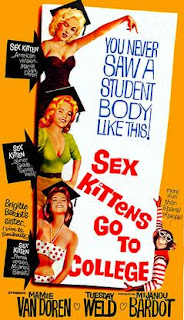
The term psychotronic refers to movies made on low budgets, often in the science fiction, fantasy, or horror genres, that were ridiculed by critics. There is perhaps no movie more "psychotronic" than Sex Kittens Go to College (1960). The comedy anticipated AIP's "Beach Party" movies in combining a college setting with touches of science fiction (and nearly everything else), all made on a shoe-string budget. Quite naturally, critics hated it. Also quite naturally, it has become a cult film.
Sex Kittens Go to College stars Mamie Van Doren as Dr. Mathilda West, a super-genius who holds thirteen different degrees and speaks 18 languages. She also happens to be a buxom blonde who drives the male staff and students at Collins College to distraction (no surprise there given she is played by Mamie Van Doren). In addition to a super-intelligent beauty, Sex Kittens Go to College also involves a robot, gangsters, a chimp, and the usual teen hi-jinks.
Sex Kittens Go to College originated with producer, director, and screenwriter Albert Zugsmith. Albert Zugsmith began his career as a journalist, publicist, newspaper broker, and attorney. Among other things, he represented Superman creators Jerry Siegel and Joe Shuster in their unsuccessful lawsuit against National Periodical Publications for the rights to Superman. He went from being a broker for newspapers, radio stations, and television stations to producing motion pictures. He started out with such low budget movies for RKO as Captive Women (1952) and Sword of Venus (1953) before producing such films as Raw Edge (1956), Star in the Dust (1956), and Touch of Evil (1958) for Universal.
Albert Zugsmith moved from Universal to MGM. His first film for MGM was High School Confidential! (1958), starring Russ Tamblyn and Mamie Van Doren. Mr. Zugsmith had met Miss Van Doren at the Universal commissary. He cast her in the Western Star in the Dust despite objections from Universal executives. Following Star in the Dust and High School Confidential!, Mr. Zugsmith and Miss Van Doren would make five more films together. Initially Albert Zugsmith did not direct the films he produced, but all of that changed with College Confidential (1960). He also directed Sex Kittens Go to College (1960), which was filmed before College Confidential, but was released after it. Both films starred Mamie Van Doren.
Albert Zugsmith would have some problems with MGM regarding the title of Sex Kittens Go to College. It went through such titles as Sexpot Goes to College, Sexpot Versus Teacher, and Teacher Was a Sexpot. MGM objected to the word "sexpot" as being too salacious. Mr. Zugsmith and MGM then settled on the title Sex Kittens Go To College as if the term "sex kitten" was somehow less provocative than "sexpot." When released to television it would undergo another title change, being renamed the much less provocative Beauty and the Robot.
Sex Kittens Go to College was filmed from November to December 1959. Despite this, it was released in October 1960, only two months after College Confidential. To put it lightly, the film was less than well received by critics. Despite the critics' opinions, Sex Kittens Go to College did relatively well at the box office for a low budget film.
Mamie Van Doren was hardly the only big name to star in Sex Kittens Go to College. Martin Milner, who had appeared in such films as Pete Kelly's Blues (1955) and Sweet Smell of Success (1957) and would start his run as Tod Stiles on the TV show Route 66 not long before the movie was released, played Mamie Van Doren's love interest, George Barton. Jackie Coogan played gangster Wildcat MacPherson, while John Carradine played Professor Watts and Louis Nye played Dr. Zorch. Tuesday Weld played college student Jody; she was appearing as Thalia Menniger on The Many Loves of Dobie Gillis even as Sex Kittens Go to College was filming. The movie also featured Conway Twitty, Vampira, and, in minor roles, Charlie Chaplin Jr. and Harold Lloyd Jr. Conway Twitty also performed the movie's title song, "Sexpot Goes to College." Although today firmly identified with country music, at the time Conway Twitter was counted as a rock 'n' roller.
As to Thinko, the robot who played a major role in the plot, he was not a mere prop. In reality Thinko was Elecktro, a robot built by Westinghouse Electric Corporation between 1937 and 1938. In 1939 he was exhibited at the New York World's Fair. In the Fifties Elektro toured the United States, promoting Westinghouse. From the late Fifties into the early Sixties, he was displayed at Pacific Ocean Park in Venice, California. He is currently owned by the Mansfield Memorial Museum in Mansfield, Ohio.
Perhaps because of the low budget, it sometimes seems as if they simply made Sex Kittens Go to College up as they went along. The film is certainly over the top. After all, it combines a plot lifted from Ball of Fire (1941) with a robot, a bongo playing chimpanzee, gangsters, college politics, and college hi-jinks. It should be no surprise that in many ways Sex Kittens Go to College is a bad movie. Some might even say that it is a very bad movie. Despite, this somehow it all works. Sex Kittens Go to College is so outrageous, so blatant in its excesses, that it can't help but be entertaining. Indeed, the cast, from Mamie Van Doren to Martin Milner, all seem to be having fun in the movie. There is perhaps a good reason that while critics hated Sex Kittens Go to College, it went onto become a cult film anyway.
Friday, February 25, 2022
Godspeed Sally Kellerman
Sally Kellerman, who played Major Margaret "Hot Lips" Houlihan in the movie M*A*S*H (1970) and appeared on such TV shows as The Twilight Zone and Star Trek, died yesterday, February 24 2021 at the age of 84. The cause was heart failure.
Sally Kellerman was born on June 2 1937 in Long Beach, California. Her family moved to San Fernando Valley when she was in fifth grade at school. It was when she was a sophomore in high school that her family moved to Park La Brea, Los Angeles. After graduating from Hollywood High School, Miss Kellerman attended Los Angeles City College where she took Jeff Corey's acting class. While at Los Angeles City College she appeared in Jeff Corey's production of Look Back in Anger. She later joined Actors Studio West. She made her film debut in 1957 in Reform School Girl (1957). She made her television debut in an episode of Playhouse 90 in 1959 and guest starred on an episode of Bachelor Father in 1960.
Sally Kellerman appeared frequently on television in the Sixties. Among her guest appearances was playing Dr. Elizabeth Dehner in the second Star Trek pilot "Where No Man Has Gone Before." She also guest starred on the shows Lock Up; Surfside 6; Cheyenne; The Twilight Zone; I'm Dickens, He's Fenster; The Lloyd Bridges Show, The adventures of Ozzie and Harriet; The Many Loves of Dobie Gillis; My Three Sons; The Outer Limits; The Greatest Show on Earth; Slattery's People; Bob Hope Presents the Chrysler Theatre; 12 O' Clock High; The Rouges, The Alfred Hitchcock Hour; Kraft Suspense Theatre; Seaway; Ben Casey; A Man Called Shenandoah; The Legends of Jesse James; Bonanza; I Spy; That Girl; T.H.E. Cat; Tarzan; Insight; Coronet Blue; Dundee and the Culhane; The Invaders; Premiere; IT Takes a Thief; Hawaii Five-O, and Mannix. She played Major Houlihan in the movie M*A*S*H (1970, for which she was nominated for the Oscar for Best Actress in a Supporting Role. She also appeared in the movies Hands of a Stranger (1962), The Third Day (1965), The Lollipop Cover (1965), The Boston Strangler (1968), The April Fools (1969), and Brewster McCloud (1970).
In the Seventies Miss Kellerman appeared in the movies Last of the Red Hot Lovers (1972), A Reflection of Fear (1972), Slither (1973), Lost Horizon (1973), Rafferty and the Gold Dust Twins (1975), The Big Bus (1976), Welcome to L.A. (1976), A Little Romance (1979), Foxes (1980), It Rained All Night the Day I Left (1980), Serial (1980), Loving Couples (1980), and Head On (1980). She was the voice of The Seal in the animated film The Mouse and His Child (1977). On television she appeared in the mini-series Centennial. She guest starred on Great Performances.
In the Eighties Sally Kellerman guest starred on the TV shows Faerie Tale Theatre, CBS Children's Mystery Theatre, Hotel, Tall Tales & Legends, CBS Summer Playhouse, and Evening Shade. She appeared in the movies Moving Violations (1985), KGB: The Secret War (1985), Back to School (1986), That's Life! (1986), Meatballs III: Summer Job (1986), Three for the Road (1987), Someone to Love (1987), You Can't Hurry Love (1988), All's Fair (1989), Limit Up (1989), and The Secret of the Ice Cave (1989).
In the Nineties Sally Kellerman was a regular on the short-lived TV series 2000 Malibu Road. She guest starred on the shows Dinosaurs; Murder, She Wrote; Dream On; Burke's Law; High Society; The Naked Truth; Touched by an Angel; Ink; Gun; Diagnosis Murder; Columbo; and The Norm Show. Sally Kellerman appeared as herself in the movie The Player (1992) and also appeared in the movies Doppleganger (1993), Younger and Younger (1993), Mirror Mirror 2: Raven Dance (1994), Ready to Wear (1994), It's My Party (1996), The Maze (1997), The Lay of the Land (1997), and American Virgin (1999).
In the Naughts Miss Kellerman guest starred on the TV shows In-Laws, Providence, and Masters of Science Fiction. She appeared in the movies Women of the Night (2001), Open House (2004), The Boynton Beach Bereavement Club (2005), and I Could Never Be Your Woman (2007). In the Teens Sally Kellerman was a regular on the TV shows Chemistry, Unsupervised, The Young and the Restless, Maron, and Decker. She guest starred on the shows Law & Order: Los Angeles, 90210, Workaholics, The High Fructose Adventures of Annoying Orange, High School USA!, Comedy Bang! Bang!, and Difficult People.
Sally Kellerman was an incredible actress. Her performance was Major Houlihan in M*A*S*H was truly worthy of an Oscar nomination. In Brewster McCloud she played the mysterious woman Louise, giving another great performance. Her performances on television were no less impressive. She was fantastic as Dr. Elizabeth Dehner, the psychiatrist who develops psionic abilities in Star Trek's second pilot, "Where No Man Has Gone Before."In the humorous Bonanza episode "A Dollar's Worth of Trouble" she excelled as a blonde who causes trouble for Hoss. In the Centennial she did well as Lise Bockweiss, a Bavarian immigrant. Sally Kellerman was a versatile actress who could perform both comedy and drama equally well.
Sally Kellerman was born on June 2 1937 in Long Beach, California. Her family moved to San Fernando Valley when she was in fifth grade at school. It was when she was a sophomore in high school that her family moved to Park La Brea, Los Angeles. After graduating from Hollywood High School, Miss Kellerman attended Los Angeles City College where she took Jeff Corey's acting class. While at Los Angeles City College she appeared in Jeff Corey's production of Look Back in Anger. She later joined Actors Studio West. She made her film debut in 1957 in Reform School Girl (1957). She made her television debut in an episode of Playhouse 90 in 1959 and guest starred on an episode of Bachelor Father in 1960.
Sally Kellerman appeared frequently on television in the Sixties. Among her guest appearances was playing Dr. Elizabeth Dehner in the second Star Trek pilot "Where No Man Has Gone Before." She also guest starred on the shows Lock Up; Surfside 6; Cheyenne; The Twilight Zone; I'm Dickens, He's Fenster; The Lloyd Bridges Show, The adventures of Ozzie and Harriet; The Many Loves of Dobie Gillis; My Three Sons; The Outer Limits; The Greatest Show on Earth; Slattery's People; Bob Hope Presents the Chrysler Theatre; 12 O' Clock High; The Rouges, The Alfred Hitchcock Hour; Kraft Suspense Theatre; Seaway; Ben Casey; A Man Called Shenandoah; The Legends of Jesse James; Bonanza; I Spy; That Girl; T.H.E. Cat; Tarzan; Insight; Coronet Blue; Dundee and the Culhane; The Invaders; Premiere; IT Takes a Thief; Hawaii Five-O, and Mannix. She played Major Houlihan in the movie M*A*S*H (1970, for which she was nominated for the Oscar for Best Actress in a Supporting Role. She also appeared in the movies Hands of a Stranger (1962), The Third Day (1965), The Lollipop Cover (1965), The Boston Strangler (1968), The April Fools (1969), and Brewster McCloud (1970).
In the Seventies Miss Kellerman appeared in the movies Last of the Red Hot Lovers (1972), A Reflection of Fear (1972), Slither (1973), Lost Horizon (1973), Rafferty and the Gold Dust Twins (1975), The Big Bus (1976), Welcome to L.A. (1976), A Little Romance (1979), Foxes (1980), It Rained All Night the Day I Left (1980), Serial (1980), Loving Couples (1980), and Head On (1980). She was the voice of The Seal in the animated film The Mouse and His Child (1977). On television she appeared in the mini-series Centennial. She guest starred on Great Performances.
In the Eighties Sally Kellerman guest starred on the TV shows Faerie Tale Theatre, CBS Children's Mystery Theatre, Hotel, Tall Tales & Legends, CBS Summer Playhouse, and Evening Shade. She appeared in the movies Moving Violations (1985), KGB: The Secret War (1985), Back to School (1986), That's Life! (1986), Meatballs III: Summer Job (1986), Three for the Road (1987), Someone to Love (1987), You Can't Hurry Love (1988), All's Fair (1989), Limit Up (1989), and The Secret of the Ice Cave (1989).
In the Nineties Sally Kellerman was a regular on the short-lived TV series 2000 Malibu Road. She guest starred on the shows Dinosaurs; Murder, She Wrote; Dream On; Burke's Law; High Society; The Naked Truth; Touched by an Angel; Ink; Gun; Diagnosis Murder; Columbo; and The Norm Show. Sally Kellerman appeared as herself in the movie The Player (1992) and also appeared in the movies Doppleganger (1993), Younger and Younger (1993), Mirror Mirror 2: Raven Dance (1994), Ready to Wear (1994), It's My Party (1996), The Maze (1997), The Lay of the Land (1997), and American Virgin (1999).
In the Naughts Miss Kellerman guest starred on the TV shows In-Laws, Providence, and Masters of Science Fiction. She appeared in the movies Women of the Night (2001), Open House (2004), The Boynton Beach Bereavement Club (2005), and I Could Never Be Your Woman (2007). In the Teens Sally Kellerman was a regular on the TV shows Chemistry, Unsupervised, The Young and the Restless, Maron, and Decker. She guest starred on the shows Law & Order: Los Angeles, 90210, Workaholics, The High Fructose Adventures of Annoying Orange, High School USA!, Comedy Bang! Bang!, and Difficult People.
Sally Kellerman was an incredible actress. Her performance was Major Houlihan in M*A*S*H was truly worthy of an Oscar nomination. In Brewster McCloud she played the mysterious woman Louise, giving another great performance. Her performances on television were no less impressive. She was fantastic as Dr. Elizabeth Dehner, the psychiatrist who develops psionic abilities in Star Trek's second pilot, "Where No Man Has Gone Before."In the humorous Bonanza episode "A Dollar's Worth of Trouble" she excelled as a blonde who causes trouble for Hoss. In the Centennial she did well as Lise Bockweiss, a Bavarian immigrant. Sally Kellerman was a versatile actress who could perform both comedy and drama equally well.
Subscribe to:
Posts (Atom)