Wednesday, February 16, 2022

Godspeed Ivan Reitman

Ivan Reitman, who produced the classic National Lampoon's Animal House (1978) and produced and directed Stripes (1981) and Ghostbusters (1984), died on February 12 2022 at the age of 75.

Ivan Reitman was born on October 27 1946 in Komárno, Czechoslovakia. His family migrated to Canada when he was four years old. He attended Oakwood Collegiate in Toronto. In 1969 he received a  Bachelor of Music from McMaster University in Hamilton, Ontario. He worked as a producer at CITY-TV in Toronto briefly. In 1973 he produced the stage production Spellbound in Toronto. The production moved to Broadway in 1974 where it became The Magic Show, with Mr. Reitman still serving as its producer.

Ivan Reitman produced Shivers (1975), the controversial horror movie that started David Cronenberg's career as a director. He also produced David Cronenberg's movie Rabid (1977). He produced the movies Death Weekend (1976), Isla the Tigress of Siberia (1977), and Blackout (1978) before making his commercial breakthrough with National Lampoon's Animal House. It was in 1979 that he made his mainstream directorial debut with Meatballs.

In the Eighties Ivan Reitman directed the films Stripes (1981), Ghostbusters (1984), Legal Eagles (1986), Twins (1988), Ghostbusters II (1989), and Kindergarten Cop (1990). He produced the films Stripes, Heavy Metal (1981), The Magic Show (1983), Spacehunter: Adventures in the Forbidden Zone (1983), Legal Eagles, Big Shots (1987), Casual Sex? (1988), Feds (1988), Twins, Ghostbusters II, and Kindergarten Cop. In 1983 he produced and directed the Broadway production Merlin.

In the Nineties he directed the films Dave (1993), Junior (1994), Father's Day (1997), and Six Days Seven Nights (1998). He produced the films Stop! or My Mom Will Shoot (1992), Beethoven (1992), Dave, Beethoven's 2nd (1993), Junior, Space Jam (1996), Private Parts (1997), Commandments (1997), Father's Day (1997), Six Days Seven Nights, and Road Trip (2000).

In the Naughts Ivan Reitman directed the films Evolution (2001) and My Super Ex-Girlfriend (2006). He produced the films Evolution, Killing Me Softly (2002), Old School (2003), EuroTrip (2004), Trailer Park Boys: The Movie (2006), Disturbia (2007), Hotel for Dogs (2009), The Uninvited (2009), I Love You, Man (2009), Post Grad (2009), Up in the Air (2009), Chloe (2009), and Trailer Park Boys: Countdown to Liquor Day (2009).

In the Teens Mr. Reitman directed the films No String Attached (2011) and Draft Day (2014). He produced the movies No Strings Attached, Hitchcock  (2012), Draft Day, Ghostbusters (2016), Baywatch (2017), Father Figures (2017), A Babysitter's Guide to Monster Hunting (2020), and Godmothered (2020). In the Twenties he produced the films Space Jam: A New Legacy (2021) and Ghostbusters: Afterlife (2021).

Ivan Reitman either produced or directed films that had a lasting impact on American pop culture. National Lampoon's Animal House and Ghostbusters both proved influential. Indeed, Ghostbusters spawned an entire franchise. Many of his other films, from Stripes to Twins remain popular. It is safe to say that many of his movies will still be watched for several years to come.

Tuesday, February 15, 2022

Leave the Hollywood Sign Alone

The Hollywood Sign in 1935
Following the Los Angeles Rams' victory in the Super Bowl Sunday, Los Angeles Mayor Eric Garcetti announced that a temporary installation reading "Rams' House" would be placed over the Hollywood Sign starting Monday and would remain in place until Wednesday in partnership with the Hollywood Chamber of Commerce, the Hollywood Sign Trust, and the Los Angles Rams. As of yet, the installation has yet to be completed. To say I am upset would be putting it mildly.

Now I know some people might think that this is due to the fact that I have hated the Rams ever since they left St. Louis, but that actually has nothing to do with it. I love the Los Angeles Dodgers, but if they won the World Series I would not want a temporary installation placed over the sign to celebrate that victory. Instead, for me it comes down to two things for me. The first is that the Hollywood Sign is important to me on a personal level. After all, it is where my dearest friend Vanessa's ashes were scattered. Any time I see the Hollywood sign, I cannot help but think of her and her love of classic film and Hollywood.

The second and more important reason can be summed up by what the Hollywood Sign Trust says on the official website, "The Hollywood Sign is more than just nine white letters spelling out a city's name. It’s one of the world's most famous monuments and a universal metaphor for ambition, success, glamour...for this dazzling place, industry and dream we call H-O-L-L-Y-W-O-O-D."  For classic film fans, the Hollywood Sign is even more important than most people. For us it is a symbol of the films we love and the Los Angeles neighbourhood where those films originated. Indeed, the Hollywood Sign is one of those things people around the world want to see when they visit Los Angeles. I suspect many of those people, visiting Hollywood for the first time, would be very disappointed to see an installation altering the sign to read "Ram's House." I have seen the Sign up close and I know I would be disappointed.

Now I know the Sign originally read "Hollywoodland" and was constructed in 1923 to promote  a housing development in the Hollywood Hills. I know it remained that way until 1949, when it was shortened to "Hollywood." I know in 1987 Fox Broadcasting paid to have the sign altered to read "Fox" as promotion for their new network. And it has been altered unofficially many times over (such as the notorious "Hollyweed" in 1976). Given how iconic the sign and close to many people's hearts the sign has become, my thought is that it should never be altered, even temporarily. Tourists want to see the "Hollywood Sign," not the "Fox Sign" or the "Rams' House Sign." If someone is only in Los Angeles for a few days and one of these temporary installations is up, then effectively their experience of the sign has been spoiled. In 2019 I was in Hollywood for only three days. I would have been  very disappointed and even hurt had the Sign read something other than "Hollywood" while I was there.

I believe that the Hollywood Sign ceased to belong to the neighbourhood of Hollywood or even the City of Los Angeles long ago. It has become the property of anyone who loves film and loves the place where films are made. To place any kind of an installation over the name "Holywood" is to disappoint any film lover who wants to see the Sign on the days of that installation. The way I see, if the Hollywood Sign Trust and the Hollywood Chamber of Commerce wanted to celebrate the Rams' victory, they could have simply illuminated the sign in royal blue and gold, much the way New York City illuminates the Empire State Building or St. Louis illuminates the Arch for special occasions. That way Los Angelinos can celebrate and those who love the Sign can rest assured that it reads "Hollywood."

Monday, February 14, 2022

Happy Valentine's Day 2022

Valentine's Day is not a particularly easy day for me, as are many holidays these days. Like many holidays, however, I still observe it. Here at my blog one of the ways I have of observing the holiday is by posting pinups. Here, then, are this year's pinups.


First up is Olympe Bradna, who is waiting for her Valentine!


Here is Dorothy Hart, who is also waiting for her Valentine.


Rita Hayworth has her Valentine ready for her sweetie.
 
Lana Turner is playing Cupid.

Joan Leslie is the Queen of Hearts.


And Ann Miller is busy creating her Valentine's Day card!

Happy Valentine's Day!

Saturday, February 12, 2022

The TV Series Julia

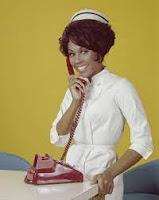
It was on September 17 1968 that the sitcom Julia, starring  Diahann Carroll, debuted. The show centred on Julia Baker, the widow whose husband had died in Vietnam, and her young son Corey (Marc Copage). Julia worked as a registered nurse for Dr. Morton Chegley (Lloyd Nolan), a physician for an aerospace company. For the first two seasons Hannah Yarby (Lurene Tuttle) was Dr. Chegley's clinic manager. Other regulars included neighbour boy Earl J. Waggedorn (Michael Link) and his mother Marie Waggedorn (Betty Beaird),  Julia was historic as the first sitcom to star an African American since Amos 'n' Andy and Beulah in the Fifties. It was also the first sitcom to feature an African American woman as a professional. Beulah on the show of the same name had been a domestic.

Julia was created by Hal Kanter, who already had an extensive career at the time. He had written the screenplays for such films as Road to Bali (1952), Casanova's Big Night (1954), and Move Over, Darling (1963), among others. He had also worked on the TV series The Ed Wynn Show and The George Gobel Show. Julia was not the first show he had created. Mr. Kanter also created the sitcom Valentine's Day, which was historic in featuring the first East Asian American in a supporting role on an American sitcom (Jack Soo as Rocky Sin).

Hal Kanter's inspiration for Julia emerged from a luncheon honouring NAACP Executive Director Roy Wilkins. He was greatly impressed by what he described as Mr. Wilkins's "calm, objective appraisal of what was happening in America." Hal Kanter then pondered what he could do himself with regards to race relations, and the result was the script for the pilot of what was then called Mama's Man, which was later changed to Julia. Hal Kanter's agent was impressed with the script and pitched it to NBC. NBC would buy Julia as a series.

Hal Kanter auditioned several actresses for the role of Julia, but upon noticing Diahann Carroll decided that she must be Julia. Miss Carroll already had a highly successful career. She was the first Black woman to win a Tony Award for Best Actress in a Musical for her role in No Strings. She had already appeared in such movies as Paris Blues (1961) and Hurry Sundown (1967). Miss Carroll was initially reticent to do the series, as she did not think it would work. It was David Tebet, NBC's  vice president for talent relations, who convinced her to sign on to the series.

Despite Hal Kanter's well intentions, Julia would become the source of controversy well before it even debuted. In April 1968, a full five months before the show's debut, Robert Lewis Shayon wrote in The Saturday Review that Julia was "...a far, far cry from the bitter realities of Negro life in the urban ghetto." Not only would criticism of Julia continue after the show debuted, but throughout its three year run. In Time magazine it was remarked that Julia "...would not recognize a ghetto if she stumbled into it, and she is, in every respect save colour, a figure in a white milieu." Much of the criticism of Julia centred on the fact that the show lacked a Black male figure, the lead character being a widow. Other critics claimed that the show did not recognize the racism faced by African American every day.  Much of the criticism also centred on the fact that Julia belonged to the middle class and lived in an impossibly nice apartment. Many felt that the life Julia led on the show was far removed from the reality of the lives led by many African Americans. Similar criticisms would be directed at The Cosby Show in the Eighties, which portrayed an upper middle class Black family.

As the star of the show, much of the criticism of Julia was directed at Diahann Carroll herself. To her credit, Miss Carroll fought for changes on the show behind the scenes. She was able to win some battles, while she lost others. Miss Carroll objected to a scene in which her character said her first experience of racism was at her high school prom, knowing as a Black woman that African Americans experience bigotry much, much earlier, and she even left the set in protest the day the scene was to be shot. While she ultimately won that battle, she was not able to convince the producers to let her wear an Afro. The stress from the controversy over Julia would ultimately lead Diahann Carroll to be hospitalized twice during the show's run.

Seen today, much of the criticism towards Julia during its original run must be considered valid. Julia lived in a lavish apartment that a nurse, even one working at an aerospace company could not possibly afford. Similarly, her wardrobe would have been out of reach not only of many Black women, but of nurses living a middle class lifestyle as well. Her friends (Marie, Dr. Chegley, and Hannah) were all white, as were her neighbours in her apartment building. Aside from Julia and Corey, the only other Black characters to appear on the show were Julia's two boyfriends during the run of the show (Fred Williamson as Steven Bruce and Paul Winfield as Paul Cameron).  Julia's apartment was devoid of anything related to Black culture, and could easily have belonged to any white character of the era.

For all the criticism Julia received, it did receive support from Ebony and Jet, although both magazines admitted it was a slight, sugary confection. And for all the criticism that Julia did not address the prejudice faced by African Americans every day, some episodes of the show did tackle the subject. In the episode "Romeo and Julia," there are awkward moments when Julia drops Corey off at a white classmate's birthday party and the mother did not realize Corey was black. In the episode "Paint Your Waggedorn," a neighbour accuses Corey and Earl of crayon drawings made in the hallway and even complains that " "turning into a ghetto" because of "those people." This leads Julia to explain prejudice to Corey. While it is true Julia did not encounter some of the more severe instances of prejudice experienced by not only African Americans, but other minorities, it was not entirely absent from the show.

While many of the other criticisms of Julia are valid, today they can easily explained by the shape of American television at the time. Portrayals of poverty in American sitcoms were virtually unknown in the Sixties. Even when a sitcom did not portray wealthy or upper middle class characters (such as the Stephens on Bewitched or Bill Davis on Family Affair) sitcoms characters were portrayed as living more lavishly than they would have in real life. On That Girl Ann Marie (Marlo Thomas) was a struggling actress who realistically have lived below the poverty line, but she lived in a fancy apartment and had a very posh wardrobe. The absence of a father on Julia can also be viewed through the lens of television in 1968. In the Sixties, the single parent was something of a sitcom standard. Andy Taylor on The Andy Griffith Show, Steven Douglas on My Three Sons, Doris Martin on The Doris Day Show, and Carolyn Muir on The Ghost & Mrs. Muir, among others, all raised children without a spouse. In portraying Julia as a widow, Julia was once again conforming to sitcom tropes of the 1960s.

It must also be pointed out that in the Sixties it was exceedingly rare for American sitcoms to address any sort of social or political issues. Gomer Pyle, U.S.M.C. centred on the Marine of the title and took place on a military base, yet the Vietnam War was not mentioned during the entire run of the show. The Andy Griffith Show took place in small Southern town, but there were no Black regulars (although Blacks did appear on the show) and it never dealt with racial issues (the Civil Rights Movement was never addressed at all). In the Sixties American sitcoms were devoted to escapism, and any political or social issues were avoided for the most part. That Julia's husband is acknowledged to have died when his helicopter was shot down in Vietnam was then a major break from other sitcoms of the era.  And while Julia may have been timid in its approach to racism, the fact that it acknowledged its existence at all was also a major break from other sitcoms of the era.

While audiences may have well been ready for a realistic portrayal of African Americans living in the ghetto in 1968, it would seem that most television producers and the broadcast networks were not. It would not be until All in the Family debuted in 1971 that a sitcom would actually address political and social issues, and even then CBS felt it had to include a warning before its first several episodes. Many of the criticisms of Julia at the time are valid, but at the same time one has to wonder if the show would have even made it to the air if Julia and Corey had been living in a ghetto and had experienced more extreme forms of prejudice than they had. In 1968 both the networks and TV producers were very cautious with regards to programming. While I am not certain that the theory of the least offensive program was as dominant in the late Sixties as some would lead one to believe, given the emphasis on escapism during the Sixties, network executives and television producers tended to avoid anything that might be too controversial.

Regardless of the controversy, Julia proved to be a popular show. In its first season it ranked no. 7 for the year in the Nielsen ratings. For its second season, facing new competition in the form of the ABC Movie of the Week (which ranked no. 22 for the year),  it came in at a still respectable no. 28 for the year. In its third season NBC moved Julia to an earlier time slot (although it remained on Tuesday night) opposite The Mod Squad. It dropped out of the top thirty for the year, but still it did well enough to warrant renewal. Sadly, the stress over the constant criticism of Julia, some of which included personal attacks on herself, led Diahann Carroll to ask to be released from her contract in 1970. Julia then ended its run after three seasons on the air. Its last original episode aired on March 31 1971.

While today Julia might seem to an unrealistic, if innocuous, sitcom, it can be considered groundbreaking given the shape of television in the Sixties. As mentioned earlier, it was the first sitcom with an African American since Amos 'n'  Andy and Beulah (the latter of which had gone off the air 15 years before Julia debuted). What is more, while Amos 'n' Andy featured gross, racist stereotypes, Julia and the other Black characters on the show were not caricatures. While this might not seem particularly remarkable now, one must consider the fact that for most of the Sixties regular, African American characters were virtually unknown on American sitcoms. In fact, the only one that comes to mind is Sgt. James "Kinch" Kinoche (played by the great Ivan Dixon) on Hogan's Heroes.As a nurse, Julia Baker was also the female African American character who was a professional on American television. Earlier female Black characters (such as Beulah) were domestics. As mentioned earlier, in having Julia's husband die in Vietnam the show broke with the sitcom tradition of avoiding any important issues.

Julia certainly did have its flaws. Belonging to the middle class, living in a nice apartment, and wearing posh clothing, Julia Baker had little in common with many African Americans in the late Sixties. The show failed to address more extreme types of prejudice even as the Civil Rights Movement was under way.The show lacked a black male lead, something which led to much of the criticism of the show. Still, the fact remains that Julia proved that a show with a Black lead could be successful. In this way Julia led to the many, more realistic sitcoms with Black characters in the Seventies. Controversial in its day and in some ways not very revolutionary, Julia id change American television.

Friday, February 11, 2022

TCM's 31 Days of Oscar 2022

While I realize there are many who love it, 31 Days of Oscars is my least favourite time of year on Turner Classic Movies. I have always had two problems with the programming block. The lesser of the two is that it pre-empts all of TCM's usual programming. That means no Noir Alley during the month, no Silent Sunday Nights, no TCM Underground. Now Summer Under the Stars also pre-empts all of TCM's usual programming, but I love it because it means Turner Classic Movies will air many, many films I love. That brings me to my other reason for not enjoying 31 Days of Oscar. It is often the case that TCM shows fewer of my favourite movies than any time of year. Worse yet, when they do show one of my favourite movies, it is often at an awkward time (like 6:00 AM).

Fortunately this year is a bit better than most years, with TCM showing several of my favourite movies and, what is more, showing them at good times for viewing. Indeed, they are even showing some of my favourite films in primetime!

Below are my picks for this year's 31 Days of Oscar. All times are Central.

Tuesday, March 1
11:00 AM Mighty Joe Young (1949)
3:15 PM The Naked City (1948)
5:00 PM Key Largo (1948)
7:00 PM The Lost Weekend (1945)
11:15 PM Laura (1944)
1:00 AM Gaslight (1944)

Wednesday, March 2
2:00 AM Seven Brides for Seven Brothers (1954)

Thursday, March 3
10:30 AM The Lion in the Winter (1968)
7:00 PM The Apartment (1960)
10:15 PM The Graduate (1967)
11:15 PM Bullitt (1968)
1:15 AM 8 1/2 (1963)

Friday, March 4
4:30 PM Cabaret (1972)
7:00 PM Network (1976)
9:15 PM The French Connection (1971)
1:30 AM The Omen (1976)
3:30 AM Cries and Whispers (1972)

Sunday, March 6
9:15 PM The Lavender Hill Mob (1952)
11:00 AM Citizen Kane (1942)
5:00 PM Pillow Talk (1959)

Monday, March 7
7:00 PM Wings (1927)
9:30 PM The Adventures of Robin Hood (1938)
1:15 AM Dr. Jekyll and Mr. Hyde (1932)

Tuesday, March 8
11:00 AM The Adventures of Don Juan (1948)
2:45 PM The Red Shoes (1948)
5:00 PM Cover Girl (1944)
9:15 PM The Philadelphia Story (1940)
11:15 PM The More the Merrier (1943)
1:15 PM Yankee Doodle Dandy (1942)
3:30 AM On the Town (1949)

Wednesday, March 9
11:00 AM The Defiant Ones (1958)
12:45 PM Mister Roberts (1955)
11:45 PM From Here to Eternity (1953)

Thursday, March 10 (my birthday)
5:30 AM The 7 Faces of Dr. Lao (1964)
10:00 AM The Great Race (1965)
4:15 PM The Dirty Dozen (1967)
10:15 PM A Man for All Seasons (1966)

Friday, March 11
11:00 AM The Summer of '42 (1971)

Saturday, March 12
7:00 AM Johnny Eager (1942)
11:00 AM Cool Hand Luke (1967)
1:15 PM Topkapi (1964)
3:30 AM Spartacus (1960)

Sunday, March 13
12:00 PM Elmer Gantry (1960)
5:00 PM Bonnie and Clyde (1967)
7:00 PM Sense and Sensibility (1995)

Monday, March 14
8:15 AM The Divorcee (1930)
1:30 PM Wuthering Heights (1939)

Tuesday, March 15
9:15 AM Easter Parade (1948)
3:00 PM Pride and Prejudice (1940)
12:00 PM The Treasure of the Sierra Madre (1948)
2:15 AM Anchors Aweigh (1945)

Wednesday, March 16
7:00 PM Marty (1955)
1:00 AM Mon Uncle (1958)
3:15 AM Rashomon (1950)

Thursday, March 17
11:00 PM Z (1969)
7:00 PM The Music Man (1962)

Friday, March 18
1:15 AM Dog Day Afternoon (1975)
3:30 AM Shaft (1971)

Saturday, March 19
11:00 PM Lilies of the Field (1963)
1:00 PM Sergeant York (1941)
12:00 AM Places in the Heart (1984)
2:00 AM A Fish Called Wanda (1988)

Sunday, March 20
1:00 PM Mildred Pierce (1944)
7:00 PM A River Runs Through It (1992)

Monday, March 21
8:15 AM "The Music Box" (1932)
3:00 PM The Awful Truth (1937)
4:45 PM You Can't Take It With You (1938)
7:00 PM Goodbye, Mr. Chips (1939)

Tuesday, March 22
11:30 PM  A Letter to Three Wives (1948)
1:30 AM Kitty Foyle (1940)
3:30 AM Blithe Spirit (1945)

Wednesday, March 23
5:15 AM That Hamilton Woman (1941)
7:30 AM Les Girls (1957)
5:00 PM Cyrano De Bergerac (1950)
7:00 PM Harvey (1950)
1:15 AM A Streetcar Named Desire (1951)

Thursday, March 24
11:30 AM It's a Mad, Mad, Mad, Mad World (1963)
2:30 PM The Time Machine (1960)
7:00 PM The Producers (1968)
1:15 AM Planet of the Apes (1968)
3:15 AM What Ever Happened to Baby Jane? (1962)

Friday, March 25
7:00 PM Fiddler on the Roof (1971)
10:15 PM All That Jazz (1979)

Saturday, March 26
6:45 AM The Best Years of Their Lives (1946)
10:00 AM Casablanca (1942)
3:00 PM The Bridge on the River Kwai (1957)
1:00 AM Dangerous Liaisons (1988)
4:45 AM Grand Hotel (1932)

Sunday, March 27
7:45 AM It Happened One Night (1934)
10:30 AM All About Eve (1950)
3:00 PM Gone with the Wind (1939)
7:00 PM The Artist (2011)
9:00 PM The Age of Innocence (1993)

Monday, March 28
5:15 PM Stagecoach (1939)

Tuesday, March 29
5:00 PM Now, Voyager (1942)
7:00 PM Mrs. Miniver (1942)
12:00 PM The Razor's Edge (1946)

Wednesday, March 30
5:00 AM Destination Moon (1950)
1:15 PM Giant (1956)
4:45 PM East of Eden (1955)

Thursday, March 31
7:00 PM To Kill a Mockingbird (1962)
4:00 AM The Virgin Spring (1960)

Thursday, February 10, 2022

Sounder (1972)

It was last year that the classic film Sounder (1972) was finally added to the National Film Registry. Many people, myself included, were shocked that it had not been added years ago. Sounder is a classic film that received critical acclaim upon its release and is still acclaimed now. It was nominated for four Academy Awards and was nominated for yet other awards. It won the National Board of Review Award for Best Actress for Cicely Tyson and the National Society of Film Critics Award for Best Actress for Miss Tyson as well. Released at the height of the Blaxpoitation cycle, Sounder has come to be regarded as a major achievement in Black Cinema. The movie celebrates its 50th anniversary on September 24 of this year.

Sounder was based on the young adult novel of the same name by William H. Armstrong. Sounder centred on an African American boy, his sharecropper family, and their dog. Sounder. In the novel , Sounder is the only character whose name is given. The boy is simply called "the boy," the father "the father," and so on. The time period is also kept vague. References to "mule-drawn wagons" make it clear Sounder is set before automobiles became common. The fact that the family use a chunk stove also make it clear that the novel is set sometime before electricity was commonplace. References to "chain gangs" make it clear it was set before 1955, when the practice was abolished. As to the place, references to Bartlow County and Gilmer County make it clear it is set in Georgia.

Sounder was critically acclaimed upon its publication in 1969, and it won the Newbery Medal in 1970. At the time it should have come as no surprise that Robert B. Radnitz, a producer known for such family films as A Dog of Flanders (1960), Misty (1961), and My Side of the Mountain (1969), decided to adapt the novel Sounder as a movie. Robert B. Radnitz called director Martin Ritt and sent him a copy of the novel. While Martin Ritt had seen some success with such movies as Hud (1963) and The Spy Who Came in from the Cold (1965), his last two films, The Great White Hope (1970) and The Molly Maguires (1970) had failed at the box office. Martin Ritt did not want to make another big motion picture, so he agreed to direct Sounder for an eighty percent cut because Robert B. Radnitz could not afford to pay him anything.

To write the screenplay African American playwright Lonne Elder III was contacted. He initially turned it down, but producer Robert B. Radnitz and director Martin Ritt convinced him to work on the film. Mr. Elder wanted to keep the film historically accurate. The film would see some changes from the novel. While the novel appears to be set in Georgia, the film is set in Louisiana, where it was shot on location (St. Helena Parish and East Feliciana Parish, to be exact). Here it must be pointed out the movie was set to film in Macon, Georgia, but reportedly did not do so due to racial tensions. While the time of the novel is vague as to when it set, the film is set in the year 1933. While human characters are unnamed in the novel, in the movie they are given names (for example, the family of sharecroppers are the Morgans). The film also centres more on the Morgan family and  less on the dog Sounder than the novel had.

As mentioned earlier, Sounder was shot on location in Louisiana. Both director Martin Ritt and cinematographer John A. Alonzo elected to film Sounder as realistically as possible. They took inspiration from photographers Walker Evans and Dorothea Lange, who both documented sharecroppers and farmers during the Great Depression.

As hard it might be to believe, initially Cicely Tyson was not cast as the mother, Rebecca Morgan. Initially she was cast as the schoolteacher. Martin Ritt offered the role to another actress, who turned it down. Cicely Tyson then approached Mr. Ritt about playing the role of the mother. Martin Ritt was reluctant to cast Cicely Tyson in the role, thinking she was "too beautiful." Fortunately, he eventually cast her in the role. Paul Winfield, who had guest starred on several television shows and appeared in the films The Lost Man (1969) and R.P.M. (1970), was cast in the role of the father, Nathan Lee Morgan. Many of the non-supporting roles were played by local people from around St. Helena Parish and East Feliciana Parish. In fact, the judge and the preacher in the film were a judge and a preacher in reality (Judge William Thomas Bennett and Reverend Thomas N. Phillips).

As mentioned earlier, Sounder would be nominated for several awards. It was the first film in which two Black actors (Paul Winfield for the Best Actor award and Cicely Tyson for the Best Actress award) were nominated for Oscars. This would not happen again until  What's Love Got to Do with It (1993), for which both Laurence Fishburne and Angela Bassett were nominated for Oscars.

A sequel, Part 2, Sounder was released in 1976. While Robert B. Radnitz produced the film and Lonne Elder III wrote the screenplay, Martin Ritt did not return as the film's director. Of the original cast, only Taj Mahal as Ike and Ted Airhart as Mr. Perkins returned. The film did not repeat the success of Sounder. Part 2, Sounder received poor reviews and did badly at the box office. In 2003 The Wonderful World of Disney aired a television adaptation of the novel Sounder. Kevin Hooks, who played David in the 1972 film, directed the movie, while Paul Winfield played the teacher in the film.

Sounder was released on September 24 1972 to nearly universal critical acclaim. It also did well at the box office. Made for only $1.9 million, Sounder made $16.9 million. What is more, Sounder has maintained its reputation over the years. The film was included AFI's list AFi's 100 Years...100 Cheers. It also made the list of Filmsite's Greatest Tearjerkers and Movie Moments of All-Time. As mentioned earlier, it was added to the National Film Registry last year.

Sounder has been one of my favourite movies since childhood. I grew up on a farm outside a small town, and I have always had plenty of Black friends. The movie largely appealed to me because it portrayed an African American family living in a rural area at a time when most Black characters in the media were portrayed as living in big cities. Despite being set in the 1930s and lacking much of the technology my friends and I grew up with (the average person did not own a TV set in 1933), the movie's milieu then seemed much more familiar to me than New York City, Chicago, or Los Angeles. Even as a boy, I could identify with David Lee Morgan (Kevin Hooks), his love for his dog Sounder, and his love of reading. As I got older I also appreciated its fine writing, its excellent performances, and it historical accuracy. Indeed, while Sounder is suitable viewing for older children, it does not shy away from the brutal realities of racism in the era. Sounder isn't only a landmark achievement in Black Cinema, it is a landmark achievement in American cinema and cinema all over the world.

Tuesday, February 8, 2022

The Late Great Douglas Trumbull

Legendary special effects artist Douglas Trumbull died yesterday, February 7 2022, at the age of 79. The past two years he had cancer, a brain tumour, and a stroke. Mr. Trumbull had worked on such movies as 2001: A Space Odyssey (1968), Silent Running (1972), and Blade Runner (1982).

Douglas Trumbull was born on April 8 1942 in Los Angeles. His father was Don Trumbull, who had been a special effects artist on The Wizard of Oz (1939). Growing up he enjoyed building crystal radio sets. He was also a fan of science fiction movies and serials. Initially planned to become an architect. He worked at an electronics contracting firm while attending El Camino Junior College where he was studying technical illustration. He was eventually hired by Graphic Films to provide art for a spiralling galaxy for their New York Worlds Fair film "To the Moon and Beyond." The film caught the attention of director Stanley Kubrick and author Arthur C. Clarke. Stanley Kubrick then hired both Douglas Trumbull and Graphic Films director Con Pederson to provide preliminary designs for 2001: A Space Odyssey (1968).

Stanley Kubrick decided to move production of 2001: A Space Odyssey to England and cancelled his contract with Graphic Films. In the interim Douglas Trumbull worked for a furniture company. Determined to work on the film, he asked Con Pederson for Stanley Kubrick's phone number and called the director. Douglas Trumbull's initial work on 2001: A Space Odyssey was designing the computer screen readouts on the monitors of the spaceship Discovery One. As he continued to work on the film, he received more and more responsibility.

Following 2001 Douglas Trumbull created the opening and closing sequences for the movie Candy (1968). He provided special effects for the movies The Andromeda Strain (1971), Silent Running (1972, which he also directed), Close Encounters of the Third Kind (1977), Star Trek: The Motion Picture (1979), and Blade Runner (1982). He was also a visual effects consultant on the movie The Tree of Life (2011). His final visual effects credit was The Man Who Killed Hitler and Then the Bigfoot (2018), on which he also served as an executive producer. He also provided special effects for the debut episode of the TV series The Starlost. He also served as an executive producer on the show.

Douglas Trumbull also directed the films Silent Running (1972), Brainstorm (1983), and Luxor Live (1993).

In 1974 Douglas Trumbull co-founded the research/visual effects house Future General Corp., which was based at Paramount. It was also that year that he founded Magicam, Inc. at Paramount. In 1994 Douglas Trumbull was Vice Chairman of Imax Corporation and President of its subsidiary Ridefilm for a time.

Douglas Trumbull also animated the opening sequence for ABC's movie anthology ABC Movie of the Week. The sequence was designed by Harry Marks. He also created the Showscan process, which was introduced with his film Brainstorm.

Douglas Trumbull brought movie special effects into the late 20th Century and his influence has been seen ever since. He was capable of creating effects that looked real, something that can be seen in both 2001 and Blade Runner. What is more, he could even do it on a low budget. Silent Running was made for only $1,350,000, but looked better than more expensive films. The opening sequence to The Tree of Life, portraying the creation of life, was simply mind boggling. If Douglas Trumbull was not the greatest special effects artists thus far, he certain numbered among the absolute greatest.