Thursday, November 12, 2015

Grace Kelly in Rear Window (1954)

(This blog post is part of The Wonderful Grace Kelly Blogathon hosted by The Wonderful World of Cinema)

When the phrase "Hitchcock Blonde" is mentioned, the actress that is likely to come to mind is Grace Kelly. What is more, the image of Grace Kelly that comes to mind is likely the way the actress looked in the Hitchcock classic Rear Window (1954). In fact, an argument can be made that Lisa Carol Fremont in Rear Window could be her most iconic role.

Of course, Grace Kelly had previously worked with Alfred Hitchcock on the movie Dial M for Murder (1954). Grace Kelly came to Alfred Hitchcock's attention through a screen test she had made in 1952 for the movie Taxi (1953). In the screen test she played opposite actor Robert Alda. Ultimately neither would be cast in the film, with Dan Dailey and Constance Smith ultimately playing the lead roles. Regardless, Alfred Hitchcock liked Miss Kelly's screen test and, as a result, cast her in Dial M for Murder. While making Dial M for Murder Alfred Hitchcock talked to Grace Kelly about Rear Window, even though he did not mention casting her in the film at the time. Miss Kelly was so eager to play Lisa in Rear Window that she even turned down the chance to star opposite Marlon Brando in On the Waterfront (1954). That role eventually went to Eva Marie Saint.

Rear Window was based on the short story "It Had to Be Murder" by Cornell Woolrich. The screenplay was written by John Michael Hayes. The original short story had no primary female character, so Alfred Hitchcock asked Mr. Hayes to spend a week or two with Grace Kelly to get to know her. In the end the character of Lisa was based on a combination of Grace Kelly and his wife, the former Mildred Louise Hicks, who had modelled under the name Mel Lawrence. 

Jimmy Stewart was cast in the lead role of L. B. "Jeff" Jefferies, a photographer confined to his wheelchair after breaking his leg. With nothing better to do all day, Jeff develops a habit of watching his neighbours in the apartment building across a courtyard from his own. Ultimately he becomes convinced that he has witnessed a murder. Jimmy Stewart was very happy about the casting of Grace Kelly. He said of her, "She was kind to everybody, so considerate, just great, and so beautiful." He also praised her talent, saying that she had "...complete understanding of the way motion picture acting is carried out."  

The costumes for Rear Window were designed by the legendary Edith Head, whom Hitchcock employed on all of the films he made for Paramount. As was typical of the director, Alfred Hitchcock worked closely with Miss Head in creating the look of Grace Kelly's character. Despite this there was one instance where Edith Head and Grace Kelly got around what Alfred Hitchcock wanted. For a scene in which Grace Kelly was required to wear a negligee he suggested that falsies be used to give Miss Kelly a more busty look. Edith Head and Grace Kelly did not go along with the idea, and instead Miss Head made subtle changes to the costume while Miss Kelly changed her posture. Alfred Hitchcock never knew the difference.

Amazingly enough given the fact that film is set in two apartment buildings separated by a courtyard, Rear Window was shot entirely on one set. The basement of the Paramount soundstage was actually excavated so that the buildings could be multiple storeys. The courtyard was actually the basement floor of the soundstage and Jeff's upper storey apartment was actually at street level. What is more, all of the apartments in the building that Jeff watches all day had running water and electricity. Georgine Darcy, who played "Miss Torso", very nearly lived in her apartment during the shooting of Rear Window, spending the entire day there.

A world premiere for Rear Window was held on August 4 1954 to benefit the American-Korean Foundation, a charity founded shortly after the end of the Korean War. Rear Window went into wide release on September 1 1954. The film received overwhelmingly good reviews. After The 39 Steps Time magazine considered it "just possibly the second most entertaining picture ever made by Alfred Hitchcock." It did very well at the box office, grossing $27,559,601 at the American box office. In the end it was the third highest grossing film of 1954.  Rear Window was nominated for four Oscars, including Best Director; Best Story and Screenplay;  Best Cinematography, Colour; and Best Sound Recording,

For many years Rear Window would be unavailable, along with Alfred Hitchcock's films Rope (1948), The Trouble with Harry (1955), The Man Who Knew Too Much (1956), and Vertigo (1958). The rights to all five were owned by Alfred Hitchcock. Except for Rope, the films had bee made at Paramount, with whom Hitchcock's contract stipulated that ownership of the films would revert to him after eight years. For whatever reason Alfred Hitchcock removed the films from circulation in the Sixties, although he did will the rights to the films to his daughter Patricia. Fortunately in the Eighties the films re-emerged in circulation. Rear Window was shown legally for the first time in nearly two decades. Upon its re-release Rear Window was still counted as one of Hitchcock's masterpieces. 

As to Grace Kelly, the role of Lisa in Rear Window was a pivotal one. Miss Kelly received good notices for her performance in the film, with both New York Times critic Bosley Crowther and the critic at Variety taking note of her. In many respects Rear Window marked a change from the sort of roles Grace Kelly usually played. She was not simply window dressing. She was not merely the passive wife or girlfriend of the lead character. Lisa was a woman who made her own living at her own career. What is more, as Jeff is wheelchair bound throughout the movie, it is Lisa who must engage in much of the film's action.

Today Rear Window is considered one of Hitchcock's greatest films. It is one of the very, very few films that holds a 100% Fresh rating at the website Rotten Tomatoes. There can be little doubt that much of the reason for the film's lasting success is Grace Kelly. In Rear Window she did not simply play a beautiful woman, but she also played a woman who was independent and self-sufficient as well. In the end it made her one of the most iconic of the Hitchcock Blondes.


Wednesday, November 11, 2015

Three Movie Star Veterans

Today in 1918, at the eleventh hour on the eleventh day of the eleventh month, the armistice was signed between the Allies and Germany at Compiègne, France, thus ending World War I. Since then the day has been observed in honour of those who have served in the armed forces, as Veteran's Day in the United States and Remembrance Day in the United Kingdom and Commonwealth countries. In honour of veterans today, then, I am taking a brief at three movie stars who served in the British and United States Armed Services during the World Wars.

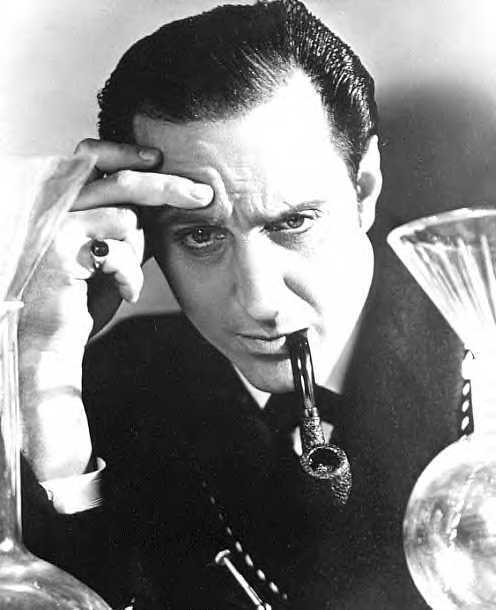
Basil Rathbone

Before Basil Rathbone played Sherlock Holmes or the villain in many a swashbuckler movie, he served in the British Army during World War I.  It was in late 1915 that Basil Rathbone joined the British Army. Initially a private with the London Scottish Regiment, in 1916 he was commissioned as a Second Lieutenant in the 2/10th Battalion of the King's Liverpool Regiment. In the Liverpool Scottish he served as an intelligence officer, often going behind enemy lines to scout the enemy's position. Such reconnaissance was generally conduced at night when it was thought to be safer, but Basil Rathbone convinced his superiors to allow him to scout enemy positions by day. Basil Rathbone proved very effective as an intelligence office and not only rose to the rank of Captain, but in September 1918 was also awarded the Military Cross for "conspicuous daring and resource on patrol.

Lee Marvin


It was in 1942, during World War II, that Lee Marvin enlisted in the United States Marine Corps. He served in the 4th Marine Division, seeing action in the Pacific Theatre. He was injured in the Battle of Saipan when his unit assaulted Mount Tapochau in the  Northern Mariana Islands.  While most of his unit was killed, Priavate Marvin's sciatic nerve was severed from machine gun fire. He was given a medical discharge in 1945 at the rank of Private First Class. He received the the Purple Heart, the Presidential Unit Citation, the Asiatic-Pacific Campaign Medal, and the World War II Victory Medal.

Sir Christopher Lee


With the outbreak of World War II Christopher Lee joined the Royal Air Force. Unfortunately his eyesight proved to be too poor for him to become a pilot. Shortly thereafter he applied to join RAF Intelligence. During World War II Sir Christopher Lee was attached to the Special Operations Executive (informally known as "the Ministry of Ungentlemanly Warfare"), but always declined to discuss his involvement.  Following the war he worked with the Central Registry of War Crimes. Sir Christopher Lee was demobilised when he was 24

Tuesday, November 10, 2015

Support Honouring Hedy Lamarr With a Memorial

Hedy Lamarr is a true legend in more ways than one. During her lifetime she was proclaimed "the Most Beautiful Woman in the World" and she is still considered one of the all time great beauties. She was a talented actress who starred in a number of successful films. More importantly, she was a brilliant inventor. With composer George Antheil, she developed frequency hopping technology without which such things as mobile phones, Wi-Fi, GPS, and many other modern technologies would not be possible. Hedy Lamarr made a difference. In fact, without her the world of the 21st Century would not be the same.

Hedy Lamarr died in 2000. A portion of her ashes were scattered in the Vienna Woods. The rest were placed in an honorary grave in the Vienna Central Cemetery in 2014. Sadly, the grave of this most remarkable woman is unmarked. There is not so much as a gravestone. Fortunately Viennese designer Christian Thomas has designed a stainless steel grave marker for her final resting place. Unfortunately her son, Anthony Loder, as many of you may already know, has been battling cancer for years and cannot afford to pay for the memorial. He has then turned to crowdfunding in order to finance the grave marker for his mother, a woman to whom we all owe an enormous debt.

If you would be interested in helping finance a memorial for Hedy Lamarr, you can do so here.

Monday, November 9, 2015

The 60th Anniversary of The Everly Brothers' First Recordings

It was today in 1955 at the Tulane Hotel studios that The Everly Brothers made their first recordings. In a space of 22 minutes they cut four tracks. By early 1956 family friend Chet Atkins was able to get the Everly Brothers signed to Columbia Records. Unfortunately their time with Columbia would be brief. Their only single on the label, "Keep A-Lovin' Me", failed to chart and Columbia soon dropped The Everly Brothers. Fortunately the duo would be signed to Cadence Records later in the year. Their first single with Cadence, "Bye Bye Love", proved to be a smash hit. It went to no. 2 on the Billboard singles chart, no. 2 on the Canadian singles chart, and no. 2 on the UK singles chart.

"Bye Bye Love" was the beginning of a successful career for The Everly Brothers that lasted into the Sixties. The two would also prove very influential. Their particular blend of close harmony would prove a huge influence on British bands such as The Beatles, who combined the Everlys' close harmony with the style of Buddy Holly and the pure electric guitar sound of Chuck Berry. Of course, the sound created by The Beatles and such British bands as The Who and The Kinks would evolve into the rock music subgenre known as power pop.

This is not one of the songs they recorded on that historic day in 1955, but it is quite possibly their biggest hit. "All I Have to Do is Dream" went to no. 1 on the Billboard Hot 100, as well as the Canadian and British charts. Indeed, it was the only single that ever topped all of Billboard's charts at the same time (it happened on June 2 1958).  It was certified Gold in the United States.

Saturday, November 7, 2015

The Black Swan (1942)

This post is part of The Swashathon hosted by Movies Silently) 

If you ask many what in their opinion is the greatest pirate movie of all time, they might well say, "Captain Blood." Others might say, "The Crimson Pirate." Those wholly unfamiliar with classic movies might even say, "Pirates of the Caribbean: The Curse of the Black Pearl." That having been said, many true connoisseurs of the genre will likely say, "The Black Swan."  The Black Swan (1942) starred what would be two true superstars of the genre, Tyrone Power and Maureen O'Hara. It also featured George Sanders in one of his best turns as a villain. As to swashbuckling, it featured more than enough derring-do to fill another two movies.

The Black Swan was ostensibly based on the novel by Rafael Sabatini, who also wrote the novels The Sea Hawk, Scaramouche, and Captain Blood. Indeed, the movie is called Rafael Sabatini's The Black Swan in the opening credits and in the writing credits the movie is said to be "from the Novel by Rafael Sabatini". In truth The Black Swan owes very little to the novel from which it took its name. The only character the two have in common is Henry Morgan, the historical Welsh privateer who became Lieutenant Governor of Jamaica. Rather than being actually based on the novel of the same name, The Black Swan features an original story that, nonetheless, seems like something that Rafael Sabatini might have written.

If The Black Swan is regarded as one of the classics of the pirate movie genre, it is because it emerged from a rather remarkable creative team. Henry King had been a director since 1915 and had already directed such classics as Tol'able David (1921), Stella Dallas (1925), In Old Chicago (1937), and Jesse James (1939). The screenplay was written by none other than Ben Hecht and Seton I. Miller. Ben Hecht had already co-written the classic play The Front Page with Charles MacArthur, and had worked on such films as Scarface (1932), Nothing Sacred (1937), and Gunga Din (1939). Seton I. Miller already had experience in the swashbuckling genre when he co-wrote the screenplay for The Black Swan, having worked on the screenplays of some true classics of the genre: The Adventures of Robin Hood (1938) and The Sea Hawk (1940).

Cast in the role of the hero, Captain  Jamie Waring was Tyrone Power. Not only was Tyrone Power already a major movie star, but he had already starred in one classic swashbuckler, the 1940 version of The Mark of Zorro.  Arguably Tyrone Power was perfectly cast in the role. It was not simply a case that he was devilishly handsome. Unlike fellow swashbuckling star Errol Flynn, Tyrone Power actually was skilled with a sword. Basil Rathbone, who had appeared opposite Tyrone Power in The Mark of Zorro and was a master swordsman himself once said, "“Power was the most agile man with a sword I’ve ever faced before a camera.”

 The Black Swan would mark the first swashbuckler film in which Maureen O'Hara was ever cast. As her career progressed she would star in enough swashbucklers that today she is one of the actresses most identified with the genre. Even in The Black Swan Miss O'Hara's character,  Lady Margaret Denby, is dramatically different from heroines in previous swashbuckler movies. Unlike the sort of passive heroines often played by Olivia de Havilland in movies of the genre, Lady Margaret had a mind and will of her own. She could take whatever the men dished out to her and dish it right back at them. She could easily be described as a "fiery redhead" or an "Irish spitfire"

The rest of the cast were well suited to their roles as well. Thomas Mitchell, now best known as Gerald O'Hara in Gone with the Wind and Uncle Billy in It's a Wonderful Life, played Jamie's lieutenant Tom Blue. George Sanders was perfect as the villain of the piece, Captain Billy Leach, as was Anthony Quinn as his first mate, Wogan. Laird Cregar not only looked like historical figure Sir Henry Morgan, but behaved as many of us imagine he would have in real life.

While The Black Swan boasted an excellent screenplay and a truly fine cast, it also boasted as much action as any swashbuckler fan could ever want. The action went well beyond swordfights, of which there are plenty in the film. The Black Swan is remarkable for its scenes of ship to ship battle--indeed, it even opens with one before the credits. What is more, the ships in the film are intricately designed and look very realistic.

Of course, the shooting of any swashbuckler film was apt to be rough and tumble, and The Black Swan was no different. That having been said, some of the mishaps on the set came from what at the time was probably an unexpected source. Columnist Sara Hamilton visited the set one day, having been told how nice a person Maureen O'Hara was. She noticed Tyrone Power with a swollen lip, who told her, "Maureen hit me." A few minutes later she ran into George Sanders, who told her, "Maureen hit me with a bottle." Unlike many actresses, apparently when Maureen O'Hara was called upon to hit one of her co-stars, she actually hit them. Maureen O'Hara admitted, "I had to smack him (referring to Tyrone Power) in the face seven times, and I know how to smack."

With the United States entering World War II, an effort was made to shoot scenes in as few takes as possible. Amazingly enough, around thirty scenes in The Black Swan were shot in only one take. 20th Century Fox felt that the chemicals used to develop film would be better used by the military.

The Black Swan proved to be a hit at the box office. It was the sixth highest grossing film in 1942, one of the banner years in film history. It also won the Oscar for Best Cinematography for cinematographer Leon Shamroy, and was nominated for the Academy Awards for Best Visual Effects (Fred Sersen, Roger Heman Sr., George Leverett and Best Original Score.

Seen today it is easy to see why The Black Swan was so well received upon its initial release. The film has plenty of action, including sword fights and ship to ship battles. What it is more, it benefits from very clever dialogue, most likely courtesy of screenwriter Ben Hecht. The cast does remarkably well with the material, with Tyrone Power and Maureen O'Hara in particular playing well against each other. In many respects The Black Swan is a nearly perfect movie, with an even blend of excitement, romance, and humour. There are few pirate movies that could ever match it for its sheer amount of swashbuckling fun.


Thursday, November 5, 2015

The Late Great George Barris, Car Customiser

George Barris, the car customiser who designed such famous cars for television as the Batmobile and the Munster Koach, died November 5 2015 at age 89.

George Barris was born George Salapatas in Chicago on November 20 1925. He was only three years old when his father sent him and his older brother Sam to live with an uncle in Roseville, California after the death of their mother. George Barris took an interest in automobiles at an early age, building model cars out of balsa wood when he was only seven years old. He was only 13 years old when he and his brother restored a 1925 Buick. He attended San Juan High School in Citrus Heights, California and swept the floors of a local auto body shop after school. After graduating high school he moved to Los Angeles and opened his custom car shop on Imperial Highway in Bell, California. His brother joined him at the shop after serving in the United States Navy during World War II.

George Barris both built and raced his own cars as well as designing custom cars for private buyers. In 1948 a Buick that Mr. Barris had customised was featured in Hot Rod magazine. In 1949 he founded the organisation Kustoms of America, which had evolved out of the Kustom Car Club Mr. Barris had formed while still a teenager. In 1953 George and Sam Barris customised a 1951 Mercury Club Coupe for their customer Bob Hirohata. The "Hirota Merc", as it came to be called, attracted a good deal of attention. It was featured in the March 1953 issues of Hot Rod and Motor Trend, and the October 1953 issue of Rod and Custom. It also appeared in the 1955 crime drama Running Wild.

Hollywood having taken notice of George Barris, he was hired to build and customise cars for the 1958 movie High School Confidential. He designed the Golden Sahara car for the Jerry Lewis movie Cinderfella (1960). The Sixties would be George Barris's most active period in designing vehicles for Hollywood. He designed the Clampetts' truck on The Beverly Hillbillies from a 1922 Oldsmobile base. George Barris's shop was also responsible for designing both the Munsters Koach and Drag-u-la for The Munsters. By far the most famous car designed by his shop was the Batmobile for the Sixties TV show Batman. Dean Jeffries had been hired to design the Batmobile, but could not do so when ABC decided that Batman would debut in January 1966 rather than September 1966 as originally planned. The project then went to George Barris, who took a  1955 Lincoln Futura concept car and transformed it into the Batmobile. The Futura itself had appeared in the movie It Started with a Kiss (1959).

In the Sixties George Barris also designed Joe Mannix's roadster on the detective series Mannix, Rufus Butterworth's taxi on the 1968 sitcom The Good Guys, The Banana Splits' Buggy on the Saturday morning TV show of the same name, and The Bugaloos' Buggy on the Saturday morning show of the same name. Mr. Barris also did car customisation for films in the Sixties, including For Those Who Think Young (1964), Marriage on the Rocks (1965), The Silencers (1966), Out of Sight (1966), Fireball 500 (1966), and Thunder Alley (1967).

In the Seventies George Barris was responsible for the replica 1914 Stutz Bearcats used in the short-lived 1971 series Bearcats!. He also customised cars for the films Supervan (1977) and The Car (1977).  In addition to his work in film and television, George Barris also customised and modified vehicles for many celebrities, including Glenn Campbell, Bing Crosby, Zsa Zsa Gabor, Bob Hope, Elton John, Dean Martin, Elvis Presley, and John Wayne. George Barris's shop also created replicas of cars that were not originally designed by them, including replicas of the Monkeemobile from The Monkees, the General Lee from The Dukes of Hazzard, and KITT from Knight Rider.

George Barris also served as a producer on the films Juke Box Racket (1960), Mag Wheels (1978), and Disco Fever (1978). He served as a co-director on Juke Box Racket and a writer on Disco Fever.

Alongside fellow customiser Dean Jeffries, George Barris was largely responsible for popularising car customising in the Fifties and Sixties. Mr. Barris had a gift for self promotion and the attention he drew to his designs as early as the Fifties helped publicise car customising in the United States. Of course, Mr. Barris's gift for public relations would have come to naught if he had not been a very fine customiser himself. Either he or his shop created some of the most iconic vehicles in the history of television. The Batmobile, the Munsters Koach, the Clampetts' truck on The Beverly Hillbillies, and several other famous cars from television and film in the Sixties emerged from George Barris's customising shop. It seems likely that without George Barrris, cars on Sixties television might not have been quite so cool.

Wednesday, November 4, 2015

Twitter Users Don't "Heart" Hearts

Tuesday morning Twitter users awakened to a rather big change to the social media site. Twitter replaced the term "Favourite" with "Like". What is more, they replaced the star symbol used for Favourites with a heart symbol. To say Twitter users were unhappy would be an understatement. Thousands of people tweeted their rage at the change, while yet others wrote articles expressing their anger. One would be hard pressed to find even one Twitter user who was happy about the change.

As to Twitter, their product manager Akarshan Kumar said in a blog post, "We want to make Twitter easier and more rewarding to use, and we know that at times the star could be confusing, especially to newcomers." In the same blog post, Krumar also said, " The heart is more expressive, enabling you to convey a range of emotions and easily connect with people.  And in our tests, we found that people loved it."

People in Twitter's tests may have loved the heart, but apparently very few Twitter users do. And while much of the outrage is probably due to the fact that people generally don't like change, Twitter users have very good reasons to be angry about "Like" replacing "Favourite" and stars replacing hearts. Quite simply, over the years the Favourite evolved a wide array of uses. Many of us used Favourite for exactly that, our favourite tweets, but others used them for a wide variety of purposes. Perhaps the most common was to bookmark a tweet with a link to a news article one wants to read later, using "Favourite" the same way Favourites might be used on Internet Explorer or Bookmarks on Firefox. Others used the Favourite button as a way of acknowledging they had read a tweet, usually one in which they were mentioned. Others even used the Favourite button as a way of politely ending a conversation. Indeed, there are yet other uses people had for the Favourite button, including even a "Hate-Favourite" (which I will not even pretend to understand).

Given the number of uses to which people put the Favourite button, the star was the perfect symbol for it. The star is a relatively neutral and hence versatile symbol. It can be used to mean approval or it can be used to mean only a place marker. The star does does not come loaded with a lot of emotional meaning that would prevent it from being very adaptable in its use.

On the other hand, contrary to what Twitter might think, the term "Like" and the heart symbol are not versatile and cannot be used to "convey a range of emotions". According to the Merriam-Webster Dictionary, the verb like means, "to enjoy (something) : to get pleasure from (something); : to regard (something) in a favourable way;  : to feel affection for (someone) :  and to enjoy being with (someone)." Whereas  someone might Favourite a story with the headline, "Five Million People Killed in Los Angeles in Earthquake" in order to read the story later, there is no way they would Like that same story. Quite simply, Liking the story might make it look like they like the idea of five million people dying in a natural disaster or that they feel favourably about five million people being killed in an earthquake. By the same token, no one would Like a tweet about the death of someone's pet, political tweets with which they vehemently disagree, or a tweet advocating suicide. In other words, the term "Like" is much more limited than the term "Favourite".

While the term "Like" is limited, the heart symbol is even more so. To nearly everyone the heart means one thing and one thing only: love. While the star symbol is a relatively neutral symbol with little in the way of emotional meaning, the heart symbol is simply loaded with emotional meaning. That will make it difficult for many, perhaps even most Twitter users. Whereas I have Favourited the tweets of total strangers in the past, I cannot see myself ever Liking the tweets of total strangers because of that heart symbol. After all, it would seem as if I am sending the message not that I like their tweet, but that I love them. Maybe it's just me, but that seems like a rather creepy message to be sending to a total stranger! Indeed, I have to wonder why Twitter chose the heart symbol given the amount of harassment many women face on the social media site every single day....

As to Twitter's claim that the star could be confusing to newcomers, I am calling that utter balderdash (actually I would use a stronger word, but this is a PG-13 rated blog). When I joined Twitter in 2009 I was not confused by the star or Favourites. I did not need anyone to explain the star or Favourites to me. What is more, I know of no one who has ever admitted to being confused by stars or Favourites. I think Twitter is seriously underestimating the intelligence of their users and, quite frankly, as a Twitter user I do find that a tad insulting.

Over the past few years Twitter has undergone a number of changes, many of which have not been popular with Twitter users: the introduction of inline images with no way to shut them off on the web interface; a change to Twitter profiles complete with varying font sizes for tweets; and doing away with background images on Twitter profiles. Replacing "Favourite" with "Like" and the star symbol with a heart symbol is only the latest in a number of changes which seem to be designed solely to drive away Twitter's core users. While I doubt that there will be many who will abandon Twitter due to this change, there might be a few who do. As to those who remain (among which I will number), we won't be Liking tweets nearly as much as we were Favouriting tweets. I don't think that is quite what Twitter had planned.

Right now I think it would be a good idea for Twitter to admit it made a mistake and to restore the term "Favourite" and restore the star symbol as well. At the very least they could bring the term "Favourite" and the star back and keep the term "Like" and the heart alongside them. Clearly Twitter users do not like having lost the ability to Favourite things and they clearly prefer the star to the heart. Unless Twitter wants to drive away core users with their next big change (which at the rate thing are going could be only a few months from now...), I think it might be the best course of action they can take.